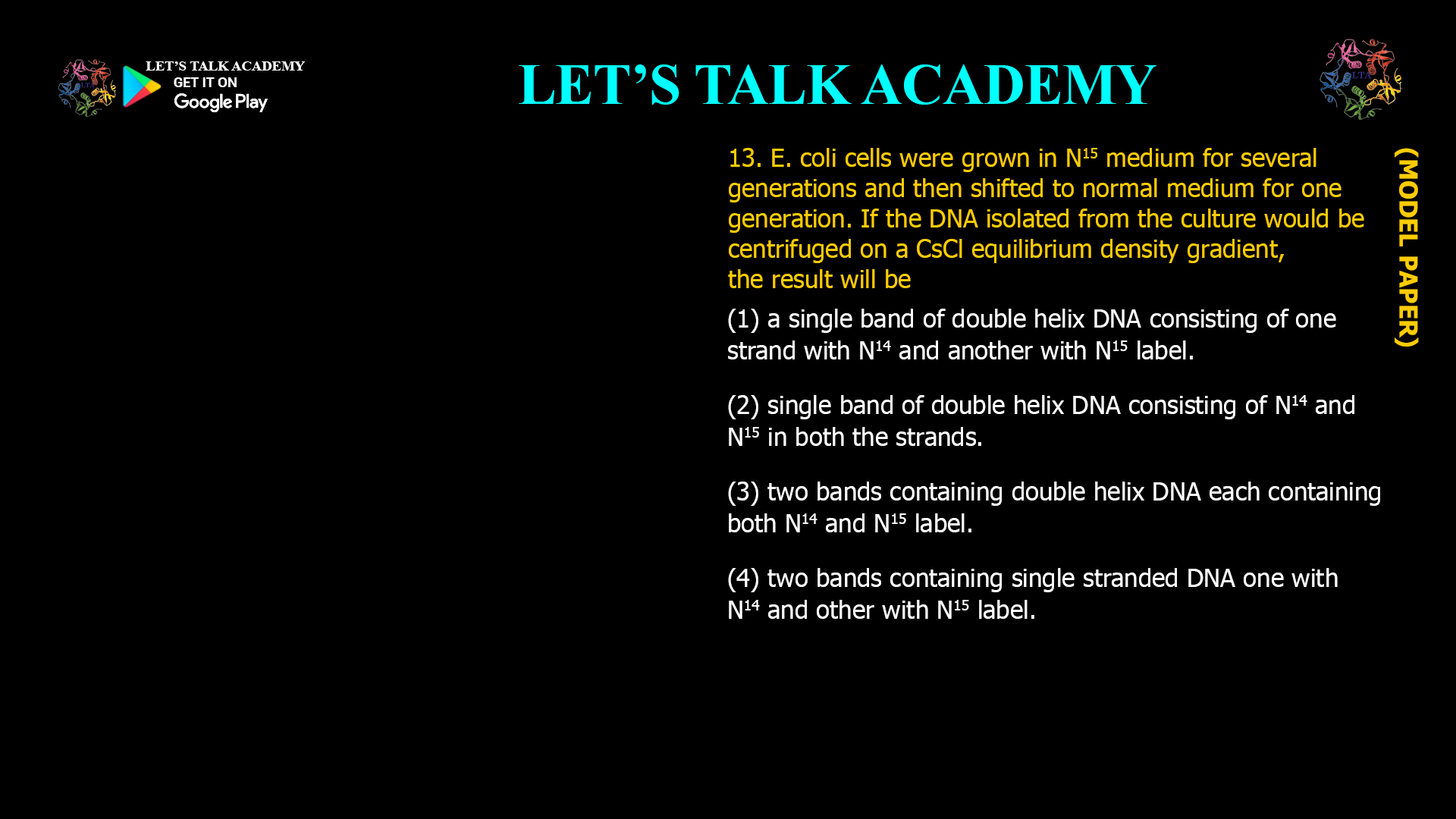
- E. coli cells were grown in N15 medium for several generations and then shifted to normal medium for one generation. If the DNA isolated from the culture would be centrifuged on a CSCl equilibrium density gradient, the result will be
(1) a single band of double helix DNA consisting of one strand with N14 and another with N15 label.
(2) single band of double helix DNA consisting of N14and N15 in both the strands.
(3) two bands containing double helix DNA each containing both N14 and N15 label.
(4) two bands containing single stranded DNA one with N14 and other with N15 label.
Introduction
The use of nitrogen isotopes (^15N and ^14N) in bacterial DNA labeling combined with cesium chloride (CsCl) density gradient centrifugation has been pivotal in understanding DNA replication. When E. coli cells grown in heavy nitrogen (^15N) medium are shifted to normal nitrogen (^14N) medium, the resulting DNA after one generation shows characteristic banding patterns that provide insights into the mode of DNA replication.
Experimental Background
-
E. coli cells are cultured in ^15N-containing medium for several generations, resulting in DNA fully labeled with heavy nitrogen.
-
The cells are then shifted to ^14N medium and allowed to replicate once.
-
DNA is extracted and subjected to CsCl equilibrium density gradient centrifugation, which separates DNA molecules based on density differences.
Expected DNA Banding Pattern After One Generation
-
After one generation in ^14N medium, DNA molecules will be hybrid: each double helix contains one strand with ^15N (heavy) and one strand with ^14N (light).
-
This results in a single band at an intermediate density position between the heavy (^15N) and light (^14N) DNA bands.
-
The band represents double-stranded DNA molecules with one heavy and one light strand.
Analysis of Options
| Option | Description | Correctness |
|---|---|---|
| (1) | Single band of double helix DNA with one strand ^14N and one strand ^15N | Correct |
| (2) | Single band of double helix DNA containing both ^14N and ^15N in both strands | Incorrect (both strands cannot be mixed) |
| (3) | Two bands each containing double helix DNA with both ^14N and ^15N | Incorrect (one generation does not produce two bands) |
| (4) | Two bands containing single-stranded DNA, one with ^14N and one with ^15N | Incorrect (DNA is double-stranded) |
Correct Answer
(1) a single band of double helix DNA consisting of one strand with N14 and another with N15 label
Biological Significance
This result supports the semi-conservative model of DNA replication, where each daughter DNA molecule contains one parental (heavy) strand and one newly synthesized (light) strand. The experiment elegantly demonstrates how DNA replication conserves one original strand in each daughter molecule.
Keywords
E. coli DNA replication, N15 labeling, N14 medium shift, CsCl density gradient centrifugation, DNA banding pattern, semi-conservative replication, hybrid DNA, molecular biology, DNA strands, isotopic labeling.
Conclusion
When E. coli cells grown in ^15N medium are shifted to ^14N medium for one generation, DNA isolated and centrifuged in a CsCl density gradient forms a single hybrid band. This band represents double-stranded DNA molecules with one strand labeled with ^15N and the other with ^14N, confirming the semi-conservative nature of DNA replication.


27 Comments
Manisha choudhary
July 25, 2025😎😎😎🤓
Khushi Agarwal
July 29, 2025Option a is correct
Vanshika Sharma
July 29, 2025Ans 1 is correct
Surbhi Rajawat
July 29, 2025Option 1 is correct because after one generation we will have all hybrid DNAs which will be depicted by one band
Diksha Chhipa
July 29, 2025One strand of dna is n 15 while another is n14 so it support semi conservative mode of replication.and we observe only one band of intermediate dna
Mansukh Kapoor
July 29, 2025The correct answer is 1st in that 1 band of N14 and 1 band of N15 is found in the ds DNA
Heena
July 29, 2025A single band is produced that shows semi conservativeness
Priti Khandal
July 29, 2025Option 1 is right
Priya Khandal
July 29, 2025A is right
HIMANI FAUJDAR
July 30, 2025Correct answer is 1 , Intermediate band will have density between 14N and 15N
Priya Dhakad
July 30, 2025The answer is 1 because single hybrid band between N14and N15.
Payal Gaur
July 30, 2025Single band is formed of double helix DNA (one strand N¹⁴ and one strand N¹5)
Intermediate form
Aafreen
July 30, 2025Ans-1 Due to semi-conservative replication, each new DNA molecule will consist of one original (N15) strand and one newly synthesized (N14) strand. This shows in hybrid DNA
Aafreen
July 30, 2025Ans-1 Due to semi-conservative replication, each new DNA molecule will consist of one original (N15) strand and one newly synthesized (N14) strand.
Niti tanwar
July 30, 2025Right answer is a
anurag giri
July 30, 2025Ans 1 bcoz single band at an intermediate density position between the heavy (^15N) and light (^14N) DNA bands
Deepika Sheoran
July 30, 2025One strand of dna is labelled with N15 a Heavier isotope.The other strand is labelled with N14 a lighter isotope.
Semiconservative mode of replication and we observe only one band of intermediate DNA.
Pratibha Sethiya
July 30, 2025Correct option is option (1)
In this we get a single hybrid band
This band represents double-stranded DNA molecules with one strand labeled with ^15N and the other with ^14N, confirming the semi-conservative nature of DNA replication.
Anisha jakhar
July 31, 2025Option 1 is the right answer bcz hybrid DNA is formed according to semi conservative replication
Dipti Sharma
July 31, 2025DNA molecules will be hybrid: each double helix contains one strand with ^15N (heavy) and one strand with ^14N (light).
so the correct answer is 1.
Aman Choudhary
July 31, 2025Option 1 is correct
Khushi Mehra
August 1, 2025DNA replication is semi conservative so after replication with 15^N labelling and once replication performed with 14^N labelling…then the newly Synthesized dna have both heavy and light dna strands but only a single band is observed which represent the intermediate hybrid dna .
Mahima Sharma
August 2, 20251s1
Vijay Marmat
August 2, 20251 ✔️
Soniya Shekhawat
August 3, 2025Option 1st correct bcz after one generation we will seen intermediate band or hybrid band that is single band of N14 and another N15 label.
Anita Choudhary
August 28, 2025Option 1st is correct
Deepika Sheoran
November 6, 2025One strand of DNA is labelled with N15 a heavier isotope. the other strand is labelled with N14 a lighter isotope.
Semi conservative mode of replication and we observe only one band of intermediate DNA