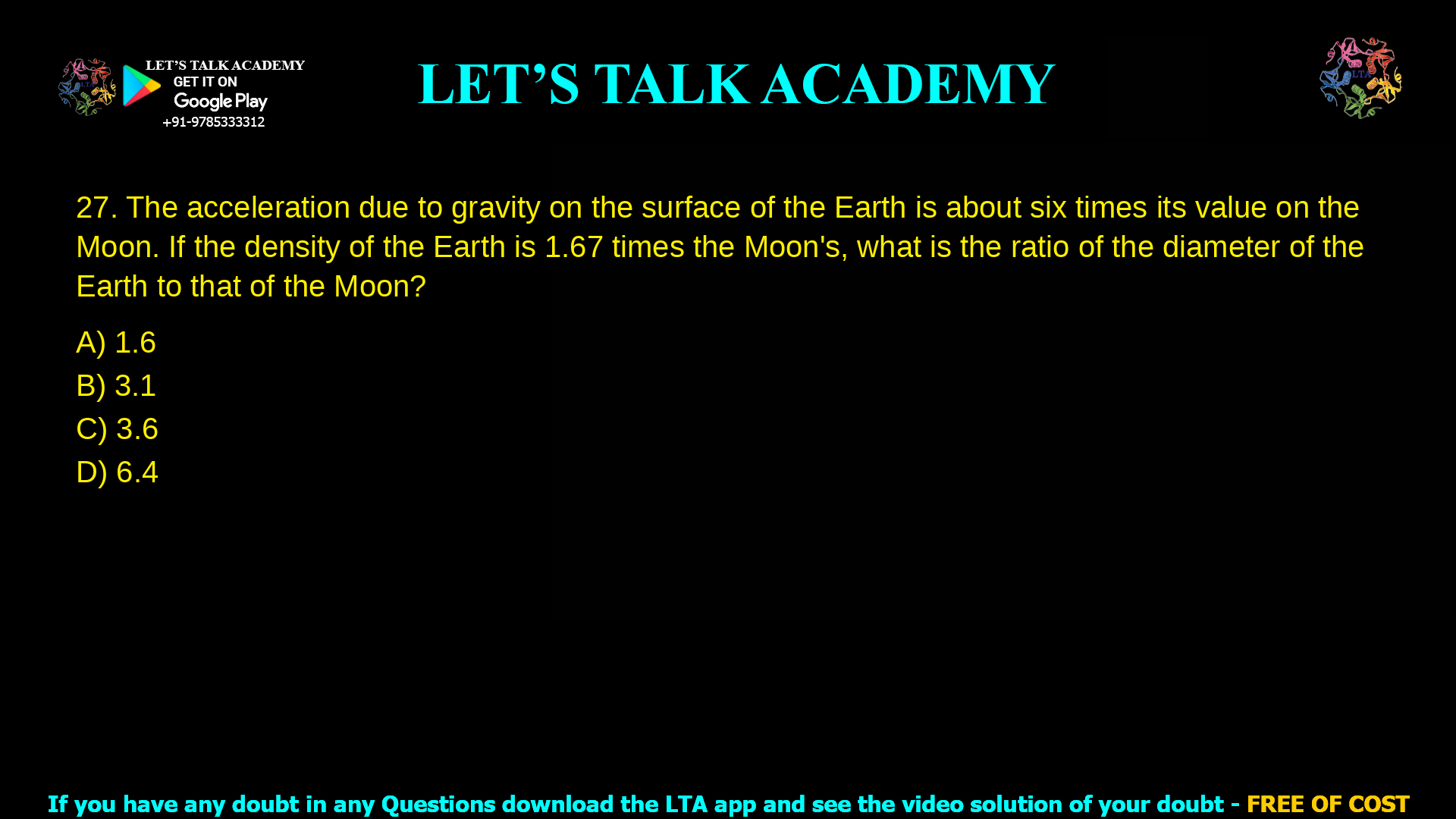
12. The acceleration due to gravity on the surface of the Earth is about six times its value
on the Moon. If the density of the Earth is 1.67 times the Moon’s, what is the ratio of
the diameter of the Earth to that of the Moon?
a. 1.6
b. 3.1
c. 3.6
d. 6.4
Earth–Moon Gravity and Diameter Ratio
The acceleration due to gravity on Earth exceeds that on the Moon by a factor of 6, while Earth’s density surpasses the Moon’s by 1.67 times.
This yields an Earth-to-Moon diameter ratio of approximately 3.6.
Core Formula
Surface gravity follows:
g = (4/3)πGρR
This links gravity directly to density (ρ) and radius (R).
Thus,
gE / gM = (ρE / ρM) × (RE / RM)
or equivalently,
gM / gE = (ρM / ρE) × (RM / RE)
Substituting gE / gM = 6 and ρE / ρM = 1.67 gives:
RE / RM = 6 / 1.67 ≈ 3.59
Therefore, the diameter ratio (DE / DM) matches the radius ratio and is closest to option (c) 3.6.
Option Analysis
- a. 1.6: Too low; implies the ratio is driven only by density, neglecting gravity scaling. Wrong by about a factor of 2.
- b. 3.1: Underestimates;
6 / 1.94 ≈ 3.1but given density ratio is 1.67. Off by about 0.5. - c. 3.6: Correct;
6 ÷ 1.67 ≈ 3.59, rounding to 3.6 and aligning with real data (~3.7). - d. 6.4: Matches gravity ratio directly but ignores density differences, overestimating.
Real-World Context
The actual Earth diameter (~12,742 km) to Moon (~3,475 km) ratio is about 3.67, aligning closely with the calculation.
The Moon’s lower density (3.34 g/cm³ vs Earth’s 5.51 g/cm³) explains its weaker surface gravity despite being smaller in size.
This problem conceptually tests understanding of surface gravity dependence on planetary radius and density.


