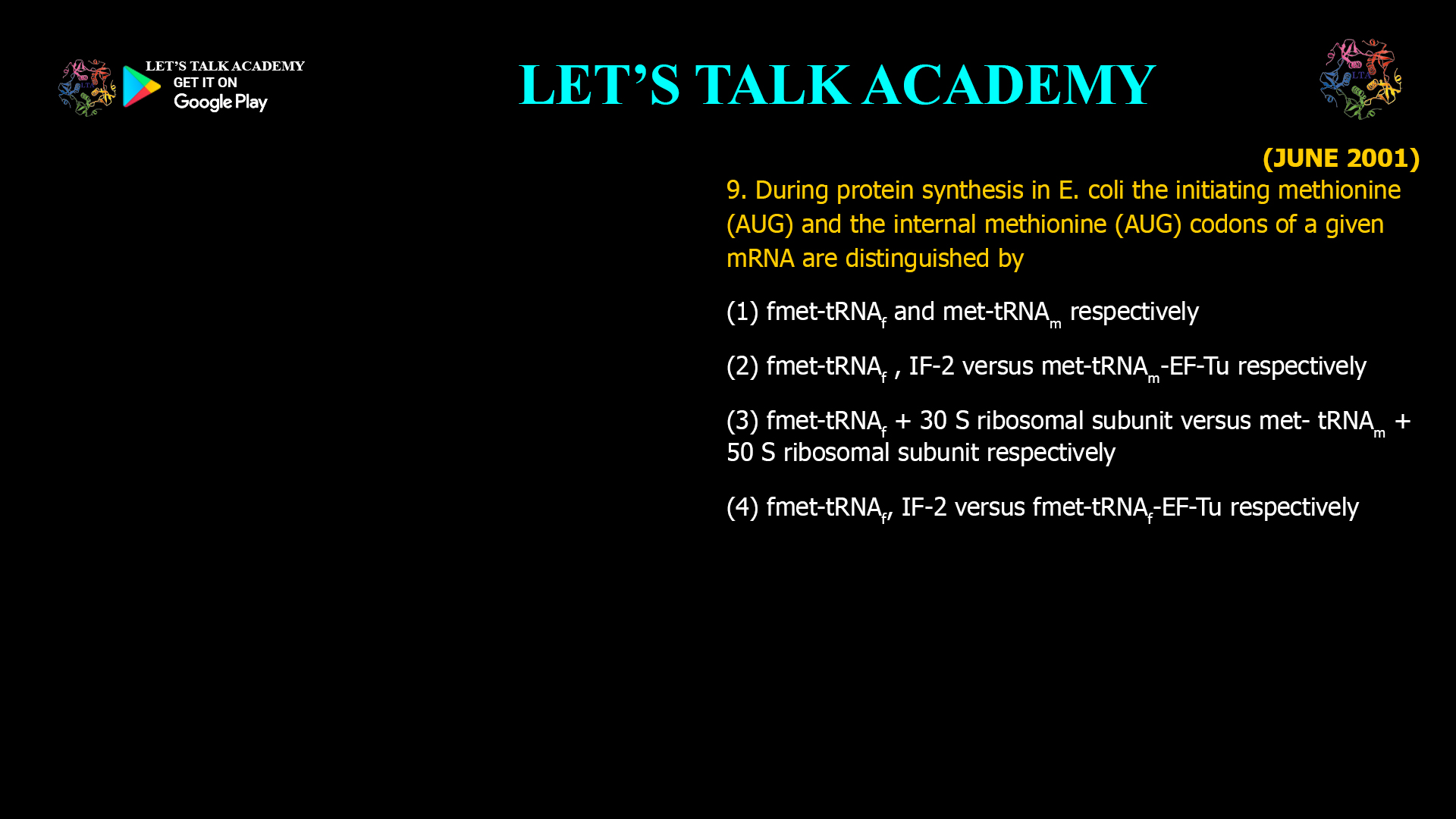
During protein synthesis in E. coli the initiating methionine (AUG) and the internal methionine (AUG) codons of a given mRNA are distinguished by
(1) fmet-tRNAf and met-tRNAm respectively
(2) fmet-tRNAf , IF-2 versus met-tRNAm-EF-Tu respectively
(3) fmet-tRNAf + 30 S ribosomal subunit versus met- tRNAm + 50 S ribosomal subunit respectively
(4) fmet-tRNAf, IF-2 versus fmet-tRNAf-EF-Tu respectively
Introduction
During protein synthesis in Escherichia coli, the ribosome must accurately distinguish between the initiating methionine codon (AUG) at the start of an open reading frame and internal AUG codons that specify methionine elsewhere in the protein. This distinction is crucial for proper protein production and function. This article explores the mechanisms by which E. coli differentiates these two types of methionine codons and the molecular players involved.
The Central Problem: Initiating vs. Internal Methionine
Both the start codon (AUG) and internal methionine codons (AUG) are read as methionine, but the way they are interpreted by the translation machinery differs significantly. The initiating methionine codon is recognized by a specialized tRNA and set of factors, while internal AUG codons use a different tRNA and elongation factors.
Key Molecular Players
1. Initiator tRNA (tRNAfMet)
-
Role: Recognizes the start codon (AUG) at the beginning of mRNA.
-
Amino Acid: Charged with methionine, which is then formylated to become N-formylmethionine (fMet).
-
Function: Binds to the ribosome at the initiation step, facilitated by initiation factor IF-2 and GTP.
-
Exclusivity: Used exclusively for initiation, not for elongation.
2. Elongator tRNA (tRNAmMet)
-
Role: Recognizes internal AUG codons.
-
Amino Acid: Charged with methionine (not formylated).
-
Function: Delivers methionine to the ribosome during the elongation phase, mediated by elongation factor EF-Tu and GTP.
3. Translation Factors
-
IF-2 (Initiation Factor 2): Binds to fMet-tRNAf and GTP, facilitating its entry into the ribosome at the start codon.
-
EF-Tu (Elongation Factor Tu): Binds to all elongator tRNAs (including Met-tRNAm), delivering them to the ribosome during elongation.
Mechanism of Distinction
The distinction between initiating and internal methionine codons is achieved through several mechanisms:
-
Formylation of Initiator Methionine
-
Process: The methionine attached to the initiator tRNA (tRNAfMet) is formylated by methionyl-tRNA formyltransferase (MTF), resulting in fMet-tRNAf.
-
Significance: The formyl group acts as a positive determinant for IF-2 and a negative determinant for EF-Tu, ensuring that fMet-tRNAf is used only for initiation.
-
-
Translation Factor Specificity
-
Initiation: IF-2 specifically recognizes fMet-tRNAf and brings it to the ribosome at the start codon.
-
Elongation: EF-Tu recognizes all elongator tRNAs (including Met-tRNAm) and delivers them to the ribosome at internal codons.
-
-
Ribosomal Context
-
Initiation: The ribosome assembles at the start codon with the small (30S) subunit, fMet-tRNAf, IF-2, and other initiation factors.
-
Elongation: The ribosome uses the large (50S) subunit and elongator tRNAs (Met-tRNAm) for internal methionine incorporation.
-
Analysis of the Multiple-Choice Options
Let’s examine each option in detail:
(1) fMet-tRNAf and Met-tRNAm respectively
-
Explanation: The initiating methionine codon is recognized by fMet-tRNAf, while internal methionine codons are recognized by Met-tRNAm.
-
Correctness: This is the fundamental distinction. However, the question asks about the mechanism by which the two are distinguished, which also involves the translation factors IF-2 and EF-Tu.
(2) fMet-tRNAf, IF-2 versus Met-tRNAm, EF-Tu respectively
-
Explanation: The initiating methionine codon is recognized by fMet-tRNAf delivered by IF-2, while the internal methionine codon is recognized by Met-tRNAm delivered by EF-Tu.
-
Correctness: This option includes both the tRNAs and the factors that deliver them, making it the most accurate and complete answer.
(3) fMet-tRNAf + 30S ribosomal subunit versus Met-tRNAm + 50S ribosomal subunit respectively
-
Explanation: The initiating methionine codon is recognized by fMet-tRNAf and the small (30S) ribosomal subunit, while the internal methionine codon is recognized by Met-tRNAm and the large (50S) subunit.
-
Correctness: This is incorrect. Both the 30S and 50S subunits are present during both initiation and elongation; the distinction is not based on the ribosomal subunits.
(4) fMet-tRNAf, IF-2 versus fMet-tRNAf, EF-Tu respectively
-
Explanation: Both the initiating and internal methionine codons would be recognized by fMet-tRNAf, but with different factors (IF-2 vs. EF-Tu).
-
Correctness: This is incorrect. Only fMet-tRNAf is used for initiation; internal methionine codons are recognized by Met-tRNAm.
Detailed Mechanism
Initiation
-
fMet-tRNAf: The initiator tRNA is charged with methionine and then formylated.
-
IF-2: Binds to fMet-tRNAf and GTP, delivering it to the ribosome at the start codon.
-
Specificity: The formyl group on fMet-tRNAf is recognized by IF-2 and prevents binding by EF-Tu, ensuring that fMet-tRNAf is used only for initiation137.
Elongation
-
Met-tRNAm: The elongator tRNA is charged with methionine (not formylated).
-
EF-Tu: Binds to Met-tRNAm and GTP, delivering it to the ribosome at internal codons.
-
Specificity: Met-tRNAm is not recognized by IF-2 and is only used during elongation.
Evolutionary and Functional Significance
The distinction between initiating and internal methionine codons is conserved in bacteria, mitochondria, and chloroplasts. This mechanism ensures that protein synthesis begins at the correct site and that internal methionines are incorporated accurately. The formyl group on fMet-tRNAf is a key determinant for this specificity137.
Common Misconceptions
-
Both fMet-tRNAf and Met-tRNAm can recognize AUG:
-
Fact: Only fMet-tRNAf is used at the start codon; Met-tRNAm is used at internal codons.
-
-
EF-Tu can deliver fMet-tRNAf to the ribosome:
-
The ribosomal subunits determine the distinction:
-
Fact: Both subunits are present during both initiation and elongation; the distinction is based on the tRNA and its associated factors.
-
Summary Table
| Codon Type | tRNA Used | Translation Factor | Function |
|---|---|---|---|
| Initiating AUG | fMet-tRNAf | IF-2 | Initiation |
| Internal AUG | Met-tRNAm | EF-Tu | Elongation |
Conclusion
During protein synthesis in E. coli, the initiating methionine codon (AUG) is distinguished from internal methionine codons by the use of different tRNAs and translation factors. The initiating AUG is recognized by fMet-tRNAf delivered by IF-2, while internal AUG codons are recognized by Met-tRNAm delivered by EF-Tu. This mechanism ensures accurate initiation and elongation of protein synthesis.
Correct answer:
(2) fMet-tRNAf, IF-2 versus Met-tRNAm, EF-Tu respectively


5 Comments
Suman bhakar
June 12, 2025👍👍
Arushi
June 12, 2025Nice explanation sir
Kirti Agarwal
November 2, 2025Opt 2
Heena Mahlawat
November 6, 2025Option 2
MOHIT AKHAND
November 14, 2025Done sir ✅