During Translation, the tRNA First Gets Attached to: A Comprehensive Guide
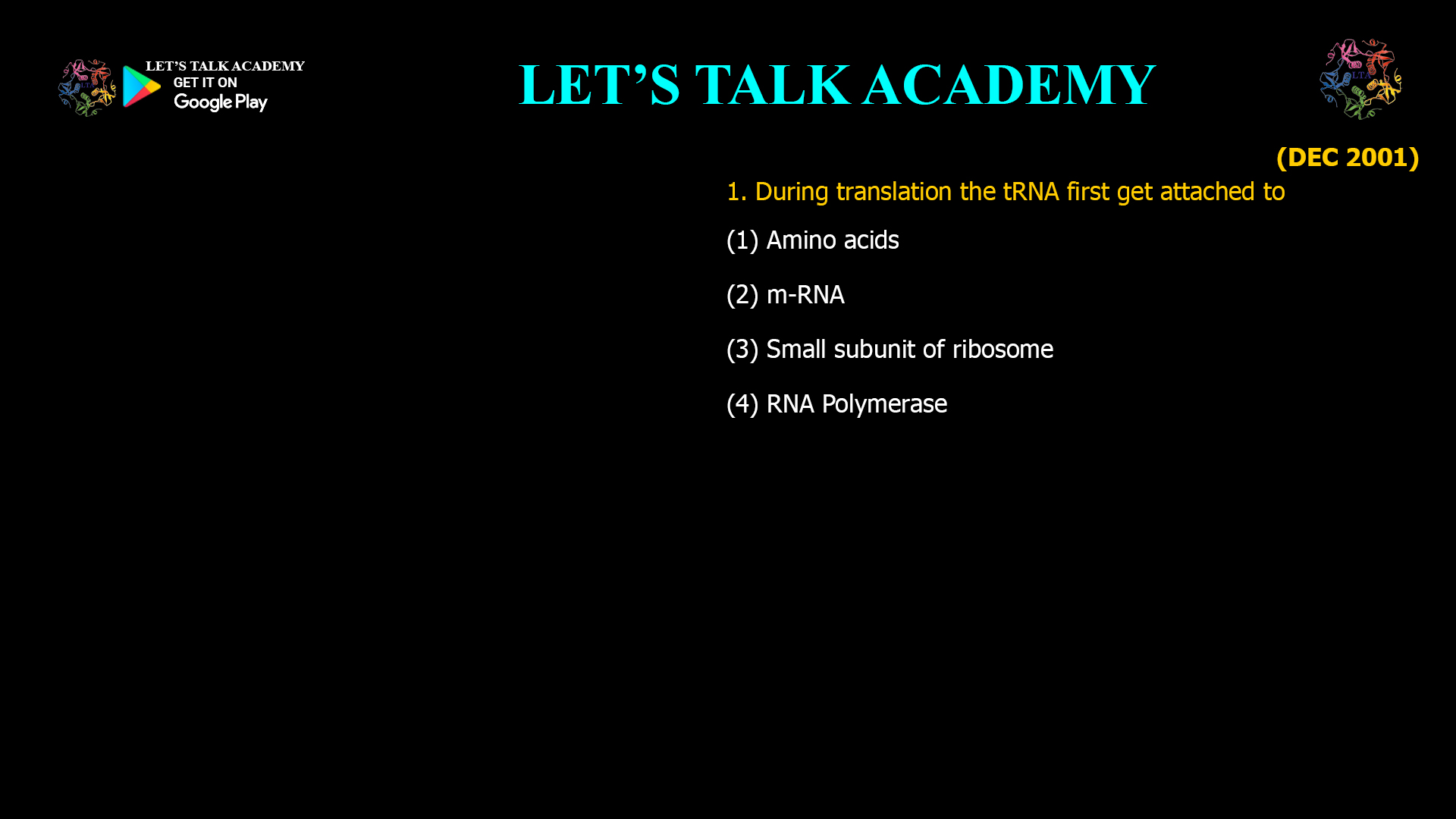
1. During translation the tRNA first get attached to
(1) Amino acids
(2) m-RNA
(3) Small subunit of ribosome
(4) RNA Polymerase
Introduction
Understanding the molecular mechanisms of protein synthesis is fundamental in biology. One of the most common questions asked by students is: During translation, what does the tRNA first get attached to? The correct answer is amino acids. This article will explore the process in detail, clarify why this is the case, and provide an in-depth look at the roles of tRNA, mRNA, and ribosomes during translation.
What is tRNA?
Transfer RNA (tRNA) is a small RNA molecule that plays a critical role in translating the genetic code from messenger RNA (mRNA) into proteins. Each tRNA molecule is responsible for:
-
Carrying a specific amino acid
-
Recognizing and binding to the corresponding codon on the mRNA through its anticodon loop
The Translation Process: Overview
Translation is the process by which proteins are synthesized from mRNA templates. It occurs in three main stages:
-
Initiation
-
Elongation
-
Termination
Step-by-Step: How tRNA Functions in Translation
1. Aminoacylation (Charging of tRNA)
Before translation can begin, tRNA molecules must be “charged” with their corresponding amino acids. This process is called aminoacylation and is catalyzed by enzymes called aminoacyl-tRNA synthetases. Each tRNA is matched with its specific amino acid, forming an aminoacyl-tRNA.
Key Point:
The very first thing that happens is that tRNA gets attached to an amino acid, not to the mRNA, ribosome, or RNA polymerase.
2. Initiation of Translation
-
The small subunit of the ribosome binds to the mRNA at the ribosome binding site.
-
The initiator tRNA, carrying the amino acid methionine (in eukaryotes), recognizes the start codon (AUG) on the mRNA and binds to it via its anticodon24.
-
The large ribosomal subunit then attaches, forming the complete initiation complex.
3. Elongation
-
tRNAs continue to bring amino acids to the ribosome, matching their anticodons with codons on the mRNA.
-
Peptide bonds form between the amino acids, creating a growing polypeptide chain.
4. Termination
-
When a stop codon is reached, the process ends, and the newly synthesized protein is released.
Detailed Roles of tRNA, mRNA, and Ribosomes
| Component | Function in Translation |
|---|---|
| tRNA | Carries specific amino acids to the ribosome; matches mRNA codons with the correct amino acid via its anticodon |
| mRNA | Provides the template with codons that dictate the amino acid sequence of the protein |
| Ribosome | Site of protein synthesis; has three binding sites for tRNA (A, P, and E sites); catalyzes peptide bond formation |
Why is the Attachment to Amino Acids First?
-
Aminoacylation is essential: Only aminoacyl-tRNA (tRNA attached to its amino acid) can participate in translation.
-
Recognition: The ribosome cannot use a tRNA unless it is already charged with its amino acid.
-
Specificity: Each tRNA is specific for one amino acid, ensuring the correct sequence in the protein.
Common Student Questions
Q: Why not mRNA, ribosome, or RNA polymerase?
-
mRNA: tRNA only interacts with mRNA after it has already been charged with an amino acid.
-
Small subunit of ribosome: The ribosome only accepts tRNAs that are already attached to their amino acids.
-
RNA polymerase: This enzyme is involved in transcription, not translation; tRNA does not attach to RNA polymerase during translation.
Related Search Keywords and Their Explanations
-
Aminoacyl-tRNA: tRNA molecule attached to an amino acid, ready for translation.
-
tRNA charging: The process of attaching an amino acid to tRNA.
-
Initiator tRNA: The first tRNA that starts protein synthesis, usually carrying methionine.
-
Codon-anticodon pairing: The matching of tRNA anticodon with mRNA codon to ensure correct amino acid incorporation.
-
Translation initiation complex: The assembly of mRNA, ribosome, and initiator tRNA at the start codon.
Summary Table: tRNA Attachment Sequence
| Step | What tRNA Attaches To | Description |
|---|---|---|
| Aminoacylation (First Step) | Amino acid | tRNA is charged with its specific amino acid by aminoacyl-tRNA synthetase |
| Initiation | mRNA (via ribosome complex) | Charged tRNA binds to start codon on mRNA, facilitated by ribosome |
| Elongation | Ribosome (A, P, E sites) | tRNAs sequentially bring amino acids, forming polypeptide chain as ribosome moves along mRNA |
Conclusion
Answer to MCQ:
During translation, the tRNA first gets attached to: (1) Amino acids.
This step is crucial for the fidelity and efficiency of protein synthesis. Without the initial attachment of amino acids to tRNA, the translation process cannot proceed, as the ribosome requires aminoacyl-tRNA to decode the genetic information carried by mRNA into functional proteins


16 Comments
Neelam Sharma
October 31, 2025Amino acid
Kirti Agarwal
November 1, 2025Amino acid
Pooja
November 3, 2025Amino acid
Sakshi yadav
November 3, 2025Amino acid
Neha Yadav
November 3, 2025During translation, the tRNA first gets attached to -Amino acids.
anjani sharma
November 3, 2025Amino acids
Samiksha bajiya
November 3, 2025During translation the t RNA firstly get attached with amino acid and ready for translation
Kajal
November 4, 2025During translation t- RNA first gets attached to amino acid
Mohd juber Ali
November 4, 2025During translation the tRNA first get attached to Amino acids
tRna :- adaptor protein power to attached with aa
Deepika Sheoran
November 4, 2025During translation t RNA first get attached to Amino acid.
Dipti Sharma
November 4, 2025During translation, the tRNA first gets attached to Amino acids known as amino acylation.
Shivani
November 4, 2025During translation the t-rna first gets attached to the amino acid.
Heena Mahlawat
November 5, 2025Amino acid p
Santosh Saini
November 9, 2025tRNA is charged with its specific amino acid by aminoacyl tRNA synthetase
Roopal Sharma
November 9, 2025Amino acid
Sakshi Kanwar
December 6, 2025First trna attach to amino acid