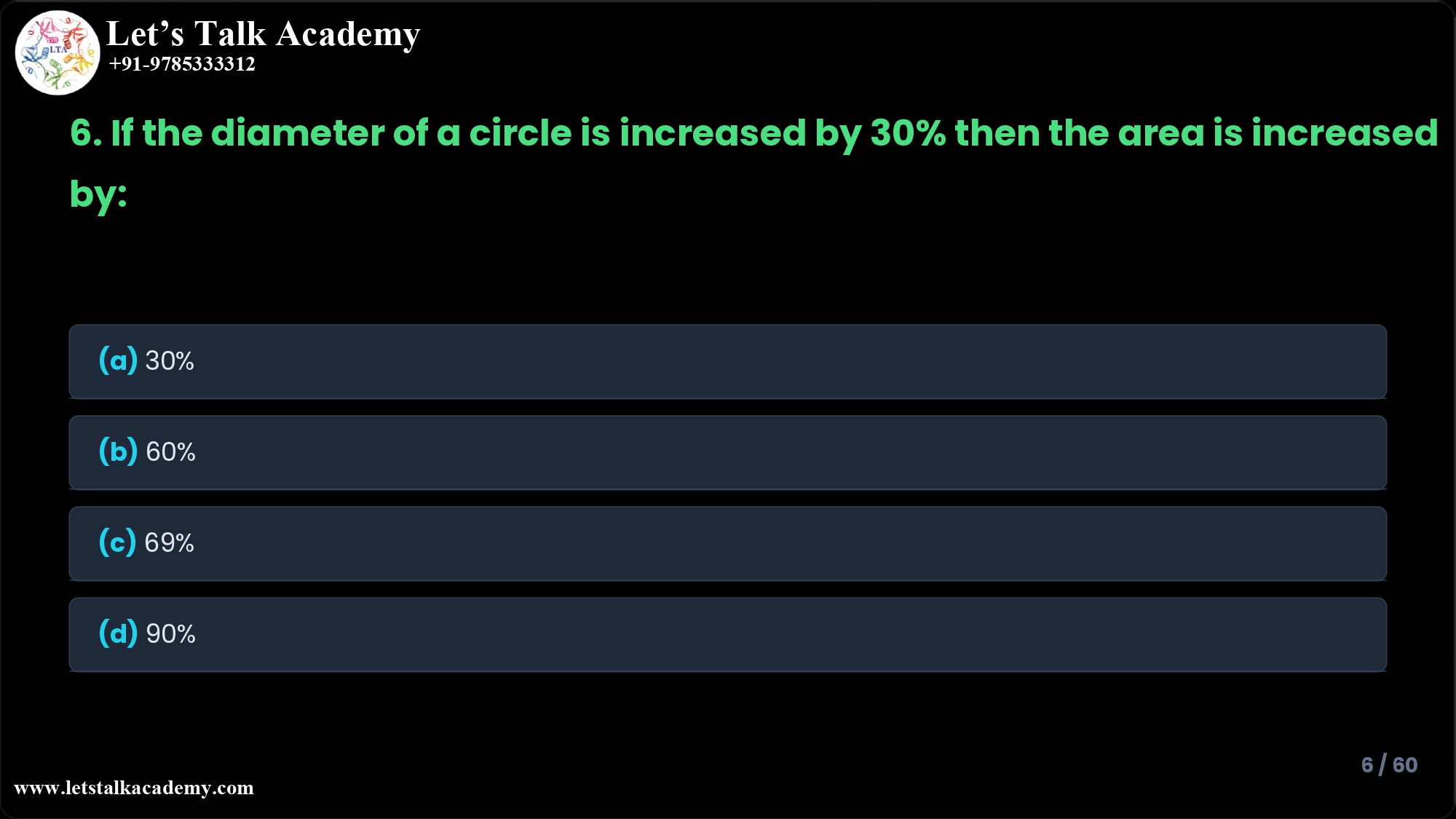
6. If the diameter of a circle is increased by 30% then the area is increased by:
(a) 30%
(b) 60%
(c) 69%
(d) 90%
Diameter of Circle Increased by 30% – Area Calculation
The correct answer is (c) 69%.
The area of a circle equals πr², where the radius (r) is half the diameter (d).
Thus, the area scales with the square of the diameter:
A = π(d/2)² = (πd²)/4
A 30% increase in diameter multiplies d by 1.3.
The new area factor equals (1.3)² = 1.69,
yielding a 69% increase since:
(1.69A − A) / A × 100% = 69%
Option Analysis
- (a) 30%: Incorrect.
This assumes linear scaling like circumference (πd increases by 30%),
but area depends on the square of the diameter. - (b) 60%: Incorrect.
This might come from mistakenly adding 30% twice (30% + 30% = 60%)
or confusing radius increase with area scaling. - (c) 69%: Correct.
Verified by calculation:
For d = 10, original area ≈ 78.54;
for d = 13, new area ≈ 132.73.
Increase = (132.73 − 78.54) / 78.54 × 100% = 69%. - (d) 90%: Incorrect.
This overestimates due to misreading (1 + 0.3)² − 1 = 0.69 as 0.9,
or confusing with a 50% diameter increase.
Exam Insight
Problems on “Diameter of circle increased by 30%, find percent increase in area”
test understanding of quadratic scaling in
CSIR NET Life Sciences quantitative aptitude.
The relationship Area ∝ d² allows rapid solving using:
(1 + x)² − 1 where x = 0.3, giving 69%.
Practice helps distinguish the correct quadratic result (69%)
from linear distractors like 30% or 60%.
CSIR NET aspirants can master this concept through ratio-square reasoning
and careful option elimination.


