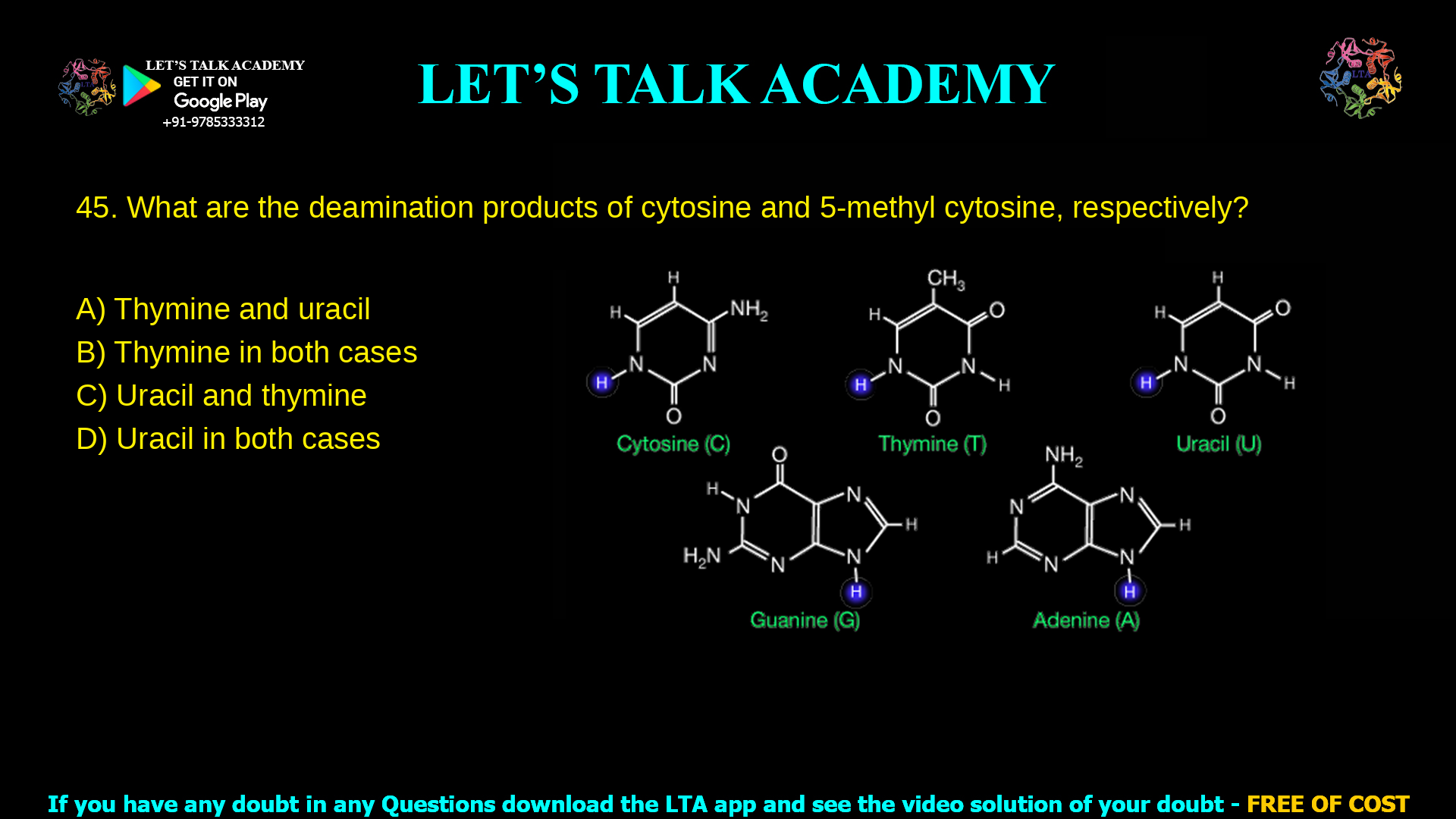
15. What are the deamination products of cytosine and 5-methyl cytosine, respectively?
a. Thymine and uracil
b. Thymine in both cases
c. Uracil and thymine
d. Uracil in both cases
The deamination products of cytosine and 5‑methylcytosine are uracil and thymine, respectively, so the correct option is C) Uracil and thymine.
Introduction
In DNA, spontaneous deamination products of cytosine and 5‑methylcytosine are a major source of point mutations and are frequently asked about in competitive exams. When cytosine loses its amino group, it becomes uracil, whereas 5‑methylcytosine deaminates to thymine, creating characteristic C→T transition hotspots in genomes.
Correct concept: deamination of cytosine vs 5‑methylcytosine
-
Cytosine → Uracil: Spontaneous hydrolytic deamination removes the exocyclic amino group at C4 of cytosine, converting it into uracil and releasing ammonia. This U in DNA is abnormal and normally excised by uracil‑DNA glycosylase, allowing largely error‑free repair.
-
5‑Methylcytosine → Thymine: When 5‑methylcytosine (cytosine with a methyl group at C5) undergoes the same deamination, the product is thymine, because thymine is chemically 5‑methyluracil. The resulting G:T mismatch is harder to recognize and repair, so 5‑methylcytosine sites become mutation hotspots, often leading to C→T transitions.
Therefore, the deamination products of cytosine and 5‑methylcytosine are uracil and thymine, matching option C.
Option‑wise explanation
Option A: Thymine and uracil
This option suggests that cytosine deaminates to thymine and 5‑methylcytosine to uracil, which is the reverse of the real chemical outcomes. Cytosine lacks a C5 methyl group, so deamination yields unmethylated uracil, not thymine, while 5‑methylcytosine already carries that methyl and thus deaminates to thymine. Hence option A is incorrect.
Option B: Thymine in both cases
If both cytosine and 5‑methylcytosine deaminated to thymine, there would be no uracil generated by deamination in DNA, contradicting extensive biochemical and mutational evidence. Experiments clearly show cytosine deamination produces uracil, and 5‑methylcytosine specifically yields thymine, so option B is also incorrect.
Option C: Uracil and thymine (correct)
This option correctly states that cytosine deaminates to uracil and 5‑methylcytosine deaminates to thymine. These changes cause CG→TA transitions if not properly repaired, making them central to understanding spontaneous mutation and exam questions on DNA damage and repair.
Option D: Uracil in both cases
This option assumes that methylation at C5 has no effect on the deamination product, which is chemically incorrect. Because thymine is 5‑methyluracil, deamination of 5‑methylcytosine must yield thymine, not uracil, so option D is incorrect.
Key takeaways for exams
-
Remember the simple rule: Cytosine → Uracil; 5‑methylcytosine → Thymine.
-
These reactions are common sources of C→T transition mutations at CpG and other methylated sites in DNA.
-
Repair systems efficiently remove uracil from DNA but detect G:T mismatches from 5‑methylcytosine deamination less reliably, increasing mutation risk at methylated cytosines.


