21. Which of the following statements about site-specific recombinases is NOT true? (1) The Cre recombinase is believed to mediate the circularization of the Pl phage genome during infection of the bacterial host. (2) The A integrase cannot mediate integration of the A genome into the host genome without the help of accessory proteins. (3) The Hin invertase-mediated recombination event is stimulated by protein-DNA interactions at a 60 bp enhancer sequence. (4) In Xer recombinase-mediated monomerization of chromosomal dimers, the interaction of FtsK with XerCD activates Xerc and initiates the re- combination process.

Understanding Site-Specific Recombinases

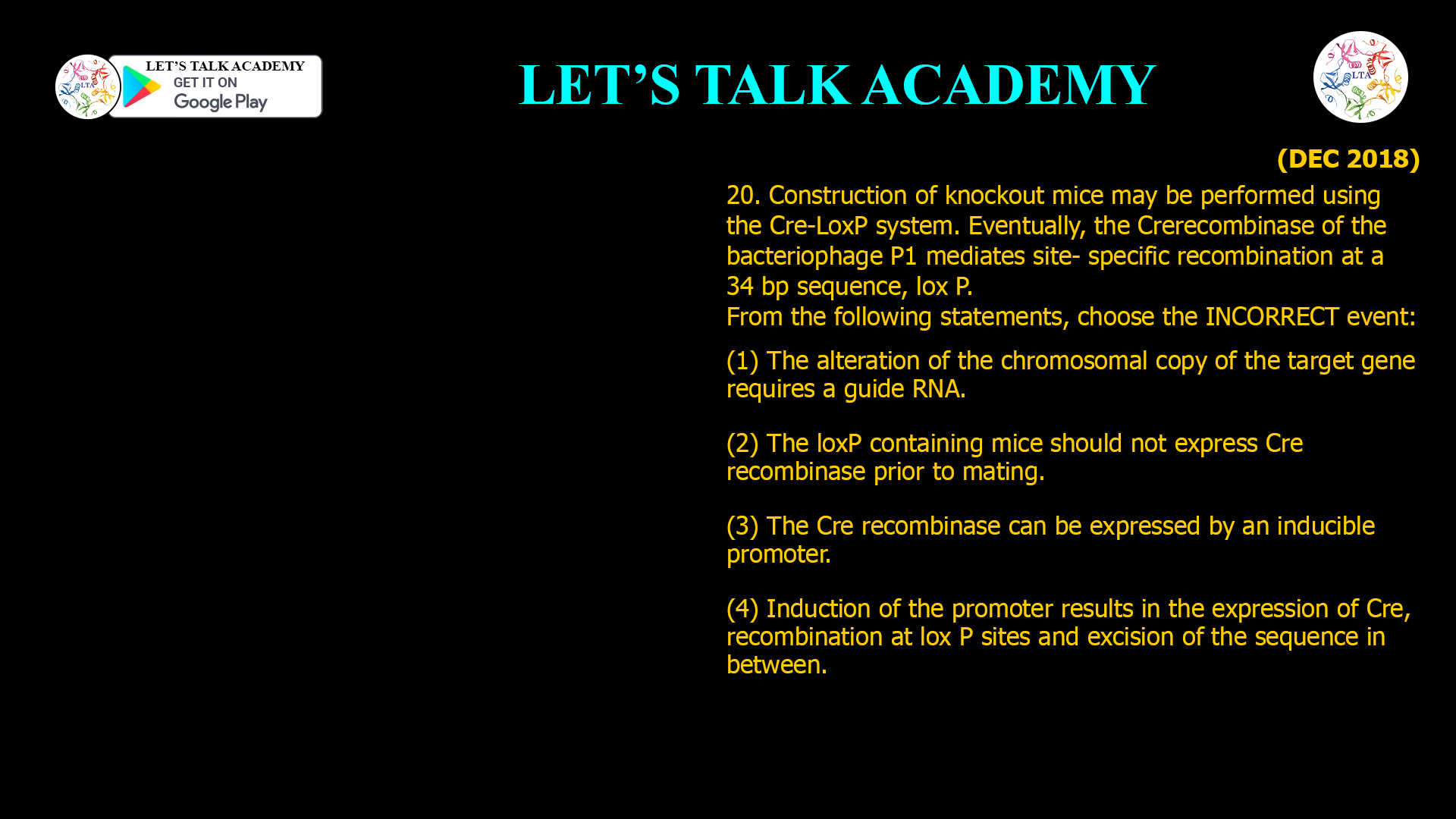
20. Construction of knockout mice may be performed using the Cre-LoxP system. Eventually, the Cre recombinase of the bacteriophage P1 mediates site- specific recombination at a 34 bp sequence, lox P. From the following statements, choose the INCORRECT event: (1) The alteration of the chromosomal copy of the target gene requires a guide RNA. (2) The loxP containing mice should not express Cre recombinase prior to mating. (3) The Cre recombinase can be expressed by an inducible promoter. (4) Induction of the promoter results in the expression of Cre, recombination at lox P sites and excision of the sequence in between.

Cre-LoxP System in Knockout Mice

19. Cre/loxP system is used by phage Pl to remove terminally redundant sequences that arise during packaging of the phage DNA. Cre-lox system can be used to create targeted deletions, insertion and inversion in genome of transgenic animals and plants. Consider a series of genetic markers A to K. How should the Lox P sites be positioned in order that Cre recombinase can create an inversion in the EFG segment relative to ABCD and HIJK?

How LoxP Orientation Controls Inversion of the EFG Segment

18. Site specific recombination results in precise DNA rearrangements, which is limited to specific sequences. The enzymes that are important to carry out the process are (1) Restriction endonuclease and ligase (2) nuclease and ligase (3) DNA polymerase and ligase (4) DNA polymerase and DNA gyrase

 Enzymes Involved in Site-Specific Recombination

17. In order to create an animal whose prostate gland is devoid of the p53 gene, engineered animals were created by cloning specially designed knock-out cassettes. Identify the most appropriate cassette combination for creating the knock out animal by breeding.

Cre‑Lox Strategy to Create Prostate‑Specific p53 Knockout Mice

16. In a transgenic mice line, lox P sites are introduced in the target A in the following manner This transgenic mice line was mated with another transgenic mice line where Cre recombinase is expressed only in B cells. What will be the expression profile of gene A in Cre/lox recombinant mice? (1) Gene will not be expressed in B cells, as orientation of exon I will be inverted by Cre. (2) Gene will not be expressed in B cells, as exon 2 will be deleted by Cre. (3) Gene will only be expressed in B cells of the recombinant mice where Cre removes the two lox P sites. (4) Gene will not be expressed in B cells as orientation of exon 2 will be inverted.

Cre–loxP Mediated Exon Deletion

15. A student was asked to design a knockout cassette for specifically deleting the p53 gene from the prostate gland of mice. Which one of the following pairs of cassettes will ensure deletion of the gene?

Tissue‑Specific p53 Knockout in Mouse Prostate Using Cre‑LoxP System

14. In transgenic mice, the orientation an location of the loxP sites determine whether Cre recombinase induces a deletion, an inversion or a chromosomal translocation. If a researcher wants to put loxP sites in such a manner that only inversion will take place, which one of the following construct best justifies their intension. Gene X is the target gene.

Cre‑loxP System

13. Which one of the following statements about Cre- mediated site-specific recombination at loxP sites is INCORRECT? (1) When loxP sites flanking a test sequence are oriented in same direction, Cre mediates the excision of the intervening sequence (2) LoxP sites in inverted orientation around an intervening sequence lead to inversion upon action by Cre recombinase (3) LoxP sites recognized by the Cre recombinase ar palindromic around a spacer sequence (4) LoxP-Cre system cannot be used to generate translocation between chromosomes.

Understanding Cre-LoxP Site-Specific Recombination and loxP Site Orientation Effects

12. In the following diagram, segments A and C are copies of 10 base pair repeat DNA sequences, flanking a unique stretch shown as B, A and C are in inverted orientation as indicated by arrows. Intramolecular recombination between A and C leads to which event: (1) The complete region encompassing A to C will be inverted (2) Only A and B will be inverted (3) Only B will be inverted (4) Only regions A and C will be inverted

Intramolecular recombination between inverted repeats

11. The following cassette was designed to create estrogen receptor knock-out mice: SoH: site of homology; Gol: gene of interest What would ensure that proper recombination has taken place? (1) Cells survive when cultured in presence of only G418 (2) Cells survive when cultured in presence of G418 followed by ganciclovir (3) Cells die when cultured in presence of G418 (4) Cells survive when cultured with G418 and die when cultured with ganciclovir

Positive‑negative selection in knockout mice

10. A student while constructing knock-out mice isolated mouse embryonic, stem cells and introduced an engineered DNA into the cells. However, none of the mice were transgenic. On checking the cells containing DNA construct, he found that he had made a mistake in constructing the DNA since the cells were resistant to gancyclovir but sensitive to G418. Which one of the following constructs had he

Common mistake in knockout‑mouse targeting vectors

9. In an effort to produce gene knockout mice, a gene targeted homologous recombination was tried, with the exogenous. DNA containing neor gene (confer G-418 resistance) and tkHsv gene (confers sensitivity to the cytotoxic nucleotide analog ganciclovir). If the neor gene was inserted within the target gene in the exogenous DNA and considering that both homologous and non- homologous recombination (random integration) is taking place, which one of the following statements is NOT correct about the possible outcome of the experiment? (1) Cells with non-homologous insertion will be sensitive to ganciclovir. (2) Non-recombinant cells will be sensitive towards G-418 and resistant to ganciclovir. (3) Homologous recombination will ensure that cells will be resistant to both ganciclovir and G-418. (4) Homologous recombinants will grow in G-418 containing media but will be sensitive towards anciclovir.

Gene Knockout Mice

8. To generate a knock-in or a knock-out mouse, it is essential to use antibiotic selection to select the stem cells that have putatively integrated the construct accurately. Each construct will have 5 homology arm and 3' homology arm to help in homologous recombination. A positive antibiotic selection cassette and a negative antibiotic selection cassette are also used. Negative selection cassette helps in de-selection of non- homologous recombinant stem cells. Choose one statement indicated below that reflects the correct position of the negative selection cassette. (1) Negative selection cassette is supplied in a separate construct. (2) Negative selection cav,ette i'. placed between the two homology arms, (3) Negative selection cassette is placed 3' to the 3'- homology arm. (4) Negative selection cassette is inserted between the promoter Exon I of positive selection cassette.

Correct Position of Negative Selection Cassette in Knock-in and Knock-out Mouse Models

7. Following statements have been made about recombination in a diploid organism: A. Recombination could be identified by genotyping parents and offspring’s for a pair of loci. B. Recombination frequency does not exceed 0.5, and therefore, 50cM would be the maximum distance between two loci. C. Recombination is a reciprocal process. However, a non-reciprocal exchange may cause gene conversion. D. Occasionally non-homologous recombination happens and this functions as a source of chromosomal rearrangement. Select the combination with all correct statements. (1) A, B, C (2) A, B, D (3) B, C, D (4) A, C, D

Recombination in Diploid Organisms

6. During an experiment, an Investigator found that the cell line used are RecA -/-. What could be the probable finding which led him to such observation? (1) Low of recombination. (2) Showing aberrant cell morphology. (3) Cells developed phagocytic properly. (4) Cells were aggregating.

RecA-/- Cell Line

5. A Holliday junction js a branched nucleic acid structure that contains four double stranded arms joined together. After strand invasion and branch migration the function must then be resolved into two separate duplexes, restoring either the parental configuration or a crossed-over configuration. According to double strand break model, crossover products are generated when (1) There no resolution (2) both the cut are in parental strand (3) both the cut are in crossover strands (4) One cut is in parental strand while another in crossover strand

Holliday Junction Resolution in Double Strand Break Model

4. To obtain recombinant products during meiosis, a double-strand break in the DNA yields crossovers needed for chiasmata formation. The progression of the non-crossover and crossover pathways begins with the formation of D loop, however, it may not result in the production of recombinant gametes. Following statements are made regarding recombination: A. Expansion of D-loop takes place in non-crossover pathway, but not in the crossover pathway. B. Expansion of D-loop takes place in crossover pathway, but not in the non-crossover pathway. C. Ejection of elongating strand takes place in the non- crossover pathway, but not in the crossover pathway. D. Ejection of elongating strand takes place in the crossover pathway, but not in the non- crossover pathway. Which one of the following options represents the correct combination of statements that explain the formation of recombinant gametes? (1) A and B (2) B and C (3) C and D (4) D and A

D-Loop Expansion and Ejection Mechanisms in Meiotic Recombination

3.Column X lists proteins that play a role in mediating DNA recombination processes and Column Y lists the possible functions of these proteins. Column X Proteins Column Y Functions A. Rad 51 i. Assembly of strand exchange proteins B. Spo11 ii. Resection of ends of DNA strands at double strand break sites to create single strand overhangs C. Rad 52 and Rad 59 iii. Cause double strand breaks in meiosis D. MRX/N Complex iv. Strand invasion Which one of the following options represents all correct matches between Column X and Column Y? (1) A (i), B (ii), C (iv), D (iii) (2) A (iv), B (i), C (ii), D (iii) (3) A (iv), B (iii), C (i), D (ii) (4) A (iii), B (iv), C (ii), D (i)

DNA Recombination Proteins Rad51, Spo11, Rad52/Rad59 and MRX Complex

2. In Neurospora crasa tetrad analysis showed following result + : m :: 6 : 2. The phenomenon involved for above result would be (1) Branch migration (2) Gene conversion (3) Recombination (4) DNA replication

Neurospora Crassa Tetrad Analysis 6:2 Ratio Gene Conversion

1. Holiday junction is observed during: (1) Mitosis (2) Interphase (3) Recombination (4) DNA damage

Holiday Junction Is Observed During Which Process?

Latest Courses