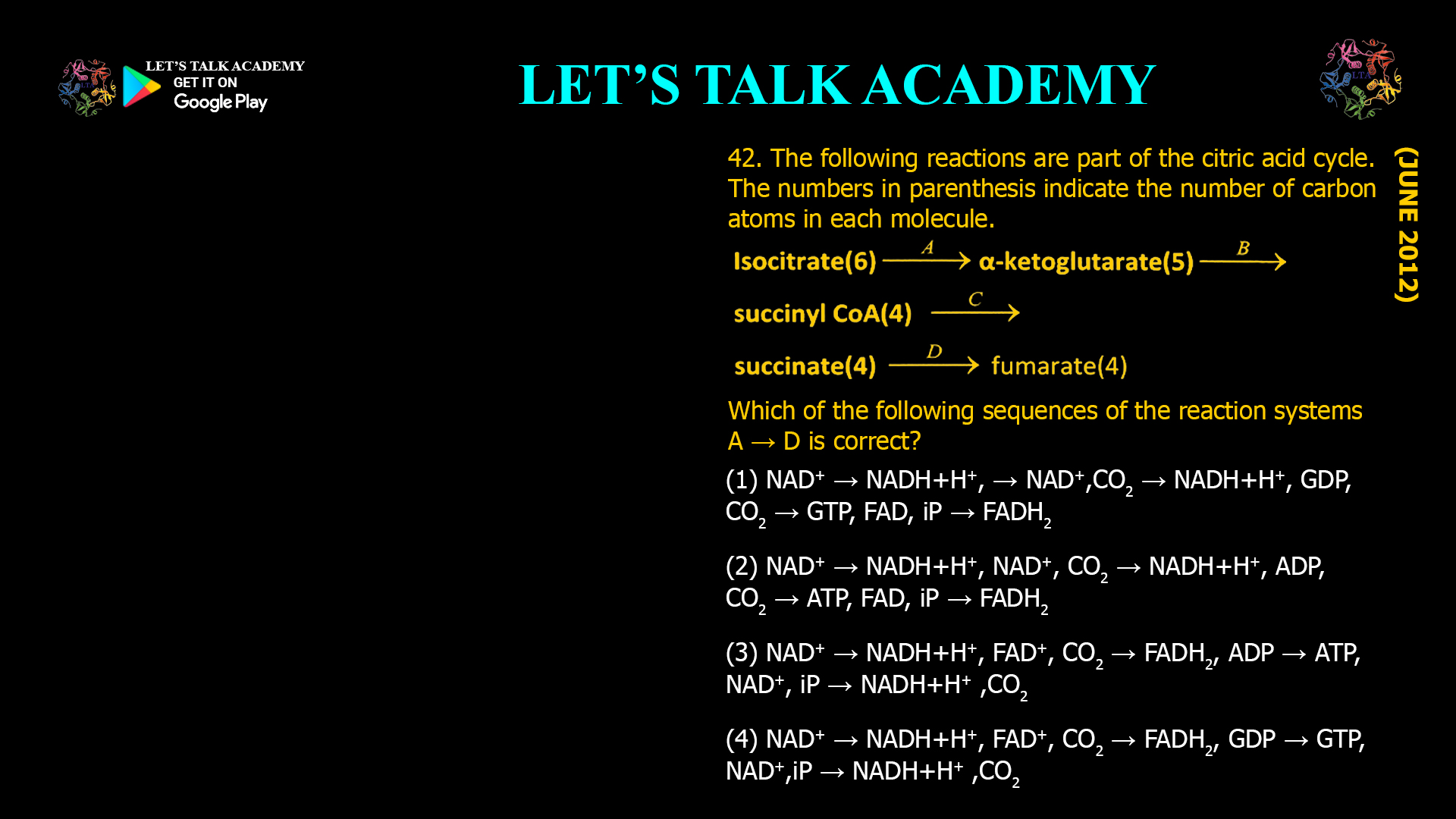
- The following reactions are part of the citric acid cycle. The numbers in parenthesis indicate the number of carbon atoms in each molecule.
Which of the following sequences of the reaction systems A → D is correct?
(1) NAD+ → NADH+H+, → NAD+,CO2 → NADH+H+, GDP, CO2 → GTP, FAD, iP → FADH2
(2) NAD+ → NADH+H+, NAD+, CO2 → NADH+H+, ADP, CO2 → ATP, FAD, iP → FADH2
(3) NAD+ → NADH+H+, FAD+, CO2 → FADH2, ADP → ATP, NAD+, iP → NADH+H+ ,CO2
(4) NAD+ → NADH+H+, FAD+, CO2 → FADH2, GDP → GTP, NAD+,iP → NADH+H+ ,CO2
The citric acid cycle (TCA cycle) is a series of enzymatic reactions that oxidize acetyl-CoA to CO₂ while generating energy-rich molecules such as NADH, FADH₂, and GTP. Each step involves specific changes in electron carriers and substrate molecules. Correctly sequencing these changes is essential for understanding the cycle’s function.
This article identifies the correct sequence of conversions involving NAD+, FAD, GDP, and CO₂ during the TCA cycle.
Key Points About the Citric Acid Cycle Reactions
-
NAD+ → NADH + H⁺: Occurs in three oxidative decarboxylation steps:
-
Isocitrate to α-ketoglutarate (releases CO₂)
-
α-Ketoglutarate to succinyl-CoA (releases CO₂)
-
Malate to oxaloacetate
-
-
GDP → GTP: Occurs during the conversion of succinyl-CoA to succinate (substrate-level phosphorylation).
-
FAD → FADH₂: Occurs during the oxidation of succinate to fumarate.
-
CO₂ release: Happens during the oxidative decarboxylation steps (isocitrate to α-ketoglutarate and α-ketoglutarate to succinyl-CoA).
Evaluating the Options
Option Sequence Summary Correctness (1) NAD+ → NADH + H⁺ → NAD+, CO₂ → NADH + H⁺, GDP, CO₂ → GTP, FAD, iP → FADH₂ Correct sequence of NADH, CO₂ release, GTP production, and FADH₂ formation (2) NAD+ → NADH + H⁺, NAD+, CO₂ → NADH + H⁺, ADP, CO₂ → ATP, FAD, iP → FADH₂ Incorrect (ADP/ATP instead of GDP/GTP) (3) NAD+ → NADH + H⁺, FAD+, CO₂ → FADH₂, ADP → ATP, NAD+, iP → NADH + H⁺, CO₂ Incorrect order and ADP/ATP instead of GDP/GTP (4) NAD+ → NADH + H⁺, FAD+, CO₂ → FADH₂, GDP → GTP, NAD+, iP → NADH + H⁺, CO₂ Incorrect order of NADH and CO₂ steps Explanation
-
The cycle begins with NAD+ reduction coupled with CO₂ release (isocitrate and α-ketoglutarate steps).
-
Succinyl-CoA synthetase converts succinyl-CoA to succinate, producing GTP (from GDP).
-
Succinate dehydrogenase oxidizes succinate to fumarate, reducing FAD to FADH₂.
-
Finally, malate dehydrogenase converts malate to oxaloacetate, reducing NAD+ to NADH.
Option (1) best reflects this sequence.
Conclusion
The correct sequence of electron carrier and energy molecule changes in the citric acid cycle is:
(1) NAD+ → NADH + H⁺ → NAD+, CO₂ → NADH + H⁺, GDP, CO₂ → GTP, FAD, iP → FADH₂
-


26 Comments
Kirti Agarwal
September 18, 2025Opt 1
Neha Yadav
September 20, 2025A. NAD+ → NADH + CO2
B. NAD+ → NADH + CO2
C . GDP→ GTP
D. FAD→ FADH₂
Bhawna Choudhary
September 21, 2025NAD+ →NADH +CO2 ,NAD+→NADH +CO2
GDP→GTP ,FAD→FADH2
Sonal Nagar
September 22, 2025Option 1
Aafreen Khan
September 23, 2025Option 1st is the correct answer
Dharmpal Swami
September 23, 2025Option 1 is write
Pallavi Ghangas
September 23, 2025NAD+ → NADH + H⁺ → NAD+, CO₂ → NADH + H⁺, GDP, CO₂ → GTP, FAD, iP → FADH₂
Aakansha sharma Sharma
September 23, 2025(1) NAD+ → NADH+H+, → NAD+,CO2 → NADH+H+, GDP, CO2 → GTP, FAD, iP → FADH2
Roopal Sharma
September 24, 2025Option is 1 correct .
Heena Mahlawat
September 24, 2025Option 1
Nilofar Khan
September 24, 2025Correct answer is (1) NAD+ → NADH + H⁺ → NAD+, CO₂ → NADH + H⁺, GDP, CO₂ → GTP, FAD, iP → FADH₂
Deepika sheoran
September 24, 2025Option 1 st is correct answer
Minal Sethi
September 24, 2025A.NAD+ → NADH+H+,
B.NAD+,CO2 → NADH+H+
C. GDP, → GTP
D.FAD, iP → FADH2
option 1
Manisha choudhary
September 24, 20251st is correct answer
Mohd juber Ali
September 25, 2025Option 1 is correct
Muskan singodiya
September 25, 2025Option 1 is correct
Kavita Choudhary
September 26, 2025Option A is right NAD+ ,NADH+ CO2
NAD+,NADH+CO2
GTP, GDP
FAD ,FADH
Avni
September 26, 2025The correct sequence : (1) NAD+ → NADH + H⁺ → NAD+, CO₂ → NADH + H⁺, GDP, CO₂ → GTP, FAD, iP → FADH₂
Varsha Tatla
September 27, 20251st
Arushi Saini
September 27, 2025NAD+ → NADH + H⁺ → NAD+, CO₂ → NADH + H⁺, GDP, CO₂ → GTP, FAD, iP → FADH₂
Payal Gaur
September 27, 2025Option 1st is correct
Kajal
October 2, 2025Option 1
Muskan Yadav
October 3, 2025(1) NAD+ → NADH + H⁺ → NAD+, CO₂ → NADH + H⁺, GDP, CO₂ → GTP, FAD, iP → FADH₂ is the correct answer.
Santosh Saini
October 5, 2025Option 1st is right
Khushi Vaishnav
October 7, 2025Option 1 is correct
Sakshi Kanwar
November 26, 2025A. NAD+ → NADH + CO2
B. NAD+ → NADH + CO2
C . GDP→ GTP
D. FAD→ FADH₂