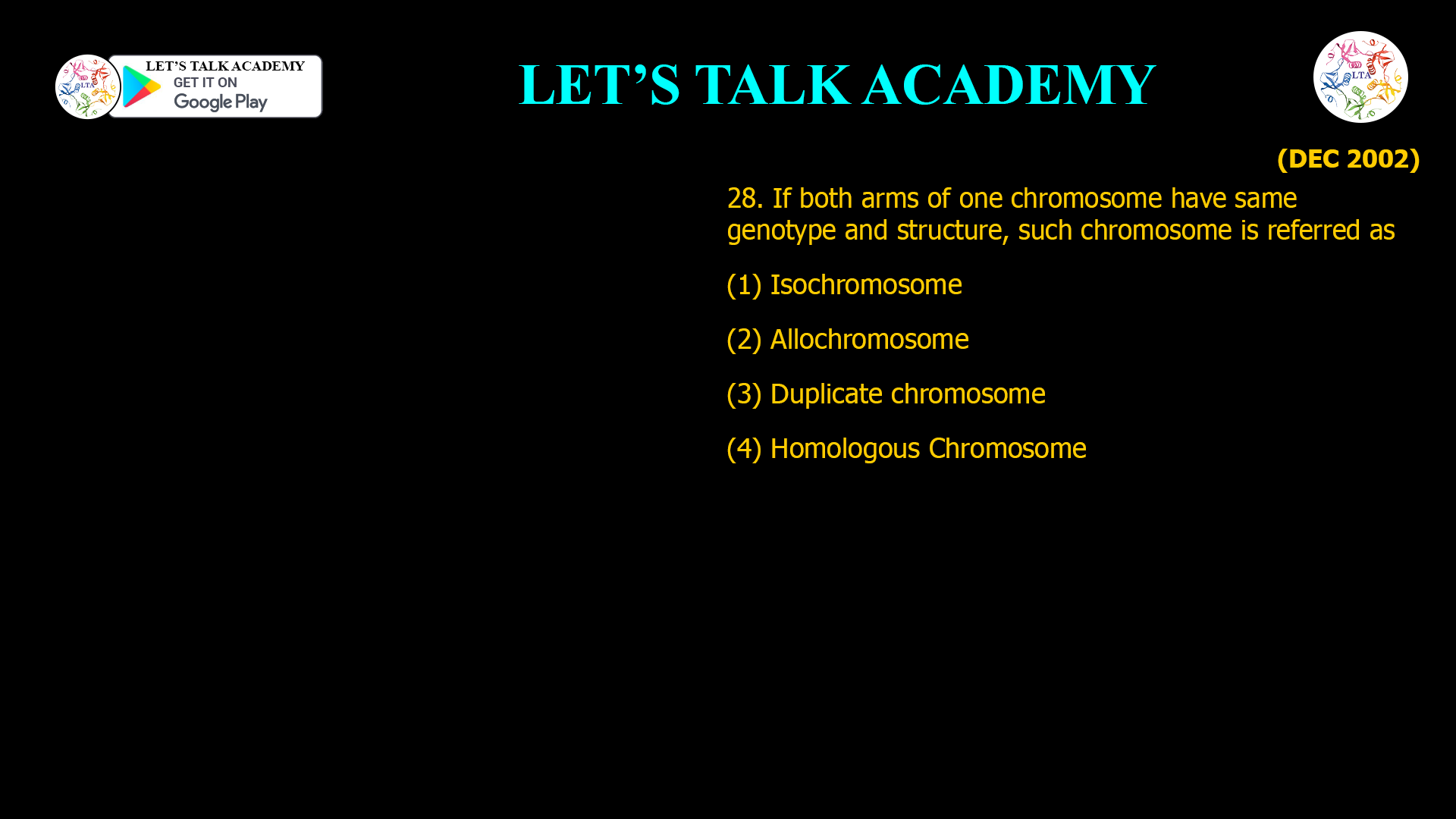
28. If both arms of one chromosome have same genotype and structure, such chromosome is referred as
(1) Isochromosome
(2) Allochromosome
(3) Duplicate chromosome
(4) Homologous Chromosome
The chromosome in which both arms have the same genotype and structure is referred to as an Isochromosome (Option 1).
Explanation of Options:
-
Isochromosome: This is a chromosome where the centromere divides horizontally instead of vertically during cell division, resulting in two identical arms that have the same genetic content and structure. Essentially, one arm is a mirror copy of the other, making the chromosome symmetrical in terms of genotype and structure.
-
Allochromosome: This refers to a chromosome that has undergone structural or genetic changes that make it distinct or different, often referring to chromosomes from different origins or unusual chromosomes, but does not imply identical arms.
-
Duplicate chromosome: This term generally refers to a chromosome or a chromosomal region that has been duplicated, meaning a segment of DNA is copied, but this does not necessarily mean both arms are identical. Duplication involves extra copies of DNA segments but does not describe symmetrical chromosome arms.
-
Homologous Chromosome: These are pairs of chromosomes (one from each parent) that have the same genes arranged in the same order, but their genetic content can vary because they are inherited from different parents. They do not have identical arms but have corresponding genes.
Introduction:
A chromosome with identical arms, known as an isochromosome, is a unique form featuring two genetically identical arms due to an abnormal centromere division. This article explains what an isochromosome is, how it differs from other chromosome types like homologous chromosomes, allochromosomes, and duplicate chromosomes, and its significance in genetics.
What Is an Isochromosome?
An isochromosome forms when the centromere splits transversely instead of longitudinally during cell division. This leads to two chromosome arms that are mirror images in terms of genetic information, making the structure and genotype identical on both arms. Isochromosomes are important in genetic studies and can be linked to certain genetic disorders.
Differences Among Chromosome Types
-
Isochromosome: Symmetrical chromosome with identical arms.
-
Allochromosome: Chromosome with structural alterations; not necessarily symmetrical.
-
Duplicate Chromosome: Contains duplicated DNA segments but arms are not identical.
-
Homologous Chromosome: Pair of chromosomes inherited from each parent with corresponding genes but not identical arms.
Understanding these differences is crucial for genetics, cytogenetics, and diagnosing chromosomal abnormalities.
This explanation and article content explain the concept clearly for students and educators at the graduate level or those preparing for genetics-based examinations.
The correct answer to your question is (1) Isochromosome.


