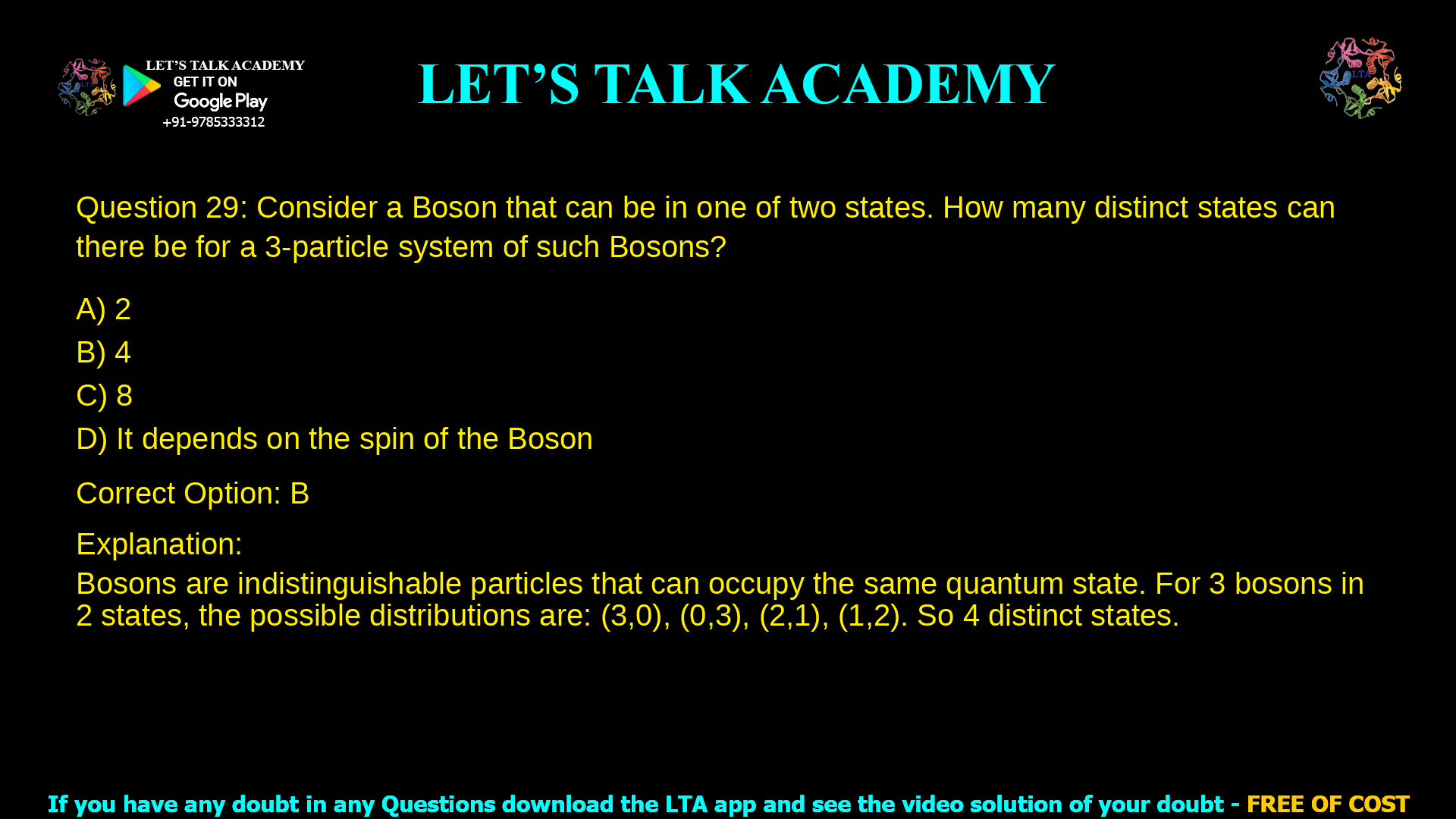
14. Consider a Boson that can be in one of two states. How many distinct states can
there be for a 3-particle system of such Bosons?
a. 2
b. 4
c. 8
d. It depends on the spin of the Boson
For a system of 3 identical bosons that can occupy one of two single-particle states (labeled state 1 and state 2), quantum statistics dictates symmetric wavefunctions under particle exchange, allowing multiple occupancy per state. The number of distinct states equals the ways to distribute 3 indistinguishable particles into 2 states, calculated via the “stars and bars” theorem as binom{N + k – 1}{N} = binom{3 + 2 – 1}{3} = 4, where N=3 particles and k=2 states.[web:4][execute_python]
Correct Answer: b. 4
The 4 distinct states correspond to occupation numbers (n_1, n_2): (3,0) all in state 1; (2,1) two in 1, one in 2; (1,2) one in 1, two in 2; (0,3) all in state 2. Each is a unique symmetric multi-particle state, independent of spin (integer for bosons).[web:1][web:2]
Option Analysis
a. 2: Incorrect; represents only extreme cases like all particles in one state ((3,0) and (0,3)), ignoring mixed distributions (2,1) and (1,2).[web:5]
b. 4: Correct, as derived from Bose-Einstein statistics using combinations with repetition for indistinguishable bosons.[web:21]
c. 8: Incorrect; this is 2^3, valid for 3 distinguishable particles (classical limit), but bosons are indistinguishable.[web:2]
d. It depends on the spin of the Boson: Incorrect; spin determines boson nature (integer spin), but with fixed 2 states, the count remains 4 regardless of specific spin value.[web:12]
Boson State Counting Method
Bosons follow Bose-Einstein statistics: unlimited occupancy per state, states specified by occupation numbers {n_i} where sum n_i = N. For 2 states and N=3, solve n_1 + n_2 = 3 with n_i ≥ 0, yielding 4 non-negative integer solutions. The symmetric wavefunction for mixed cases like (2,1) is frac{1}{sqrt{3}}[phi_1(x_1)phi_1(x_2)phi_2(x_3) + perms]</span).[web:11]