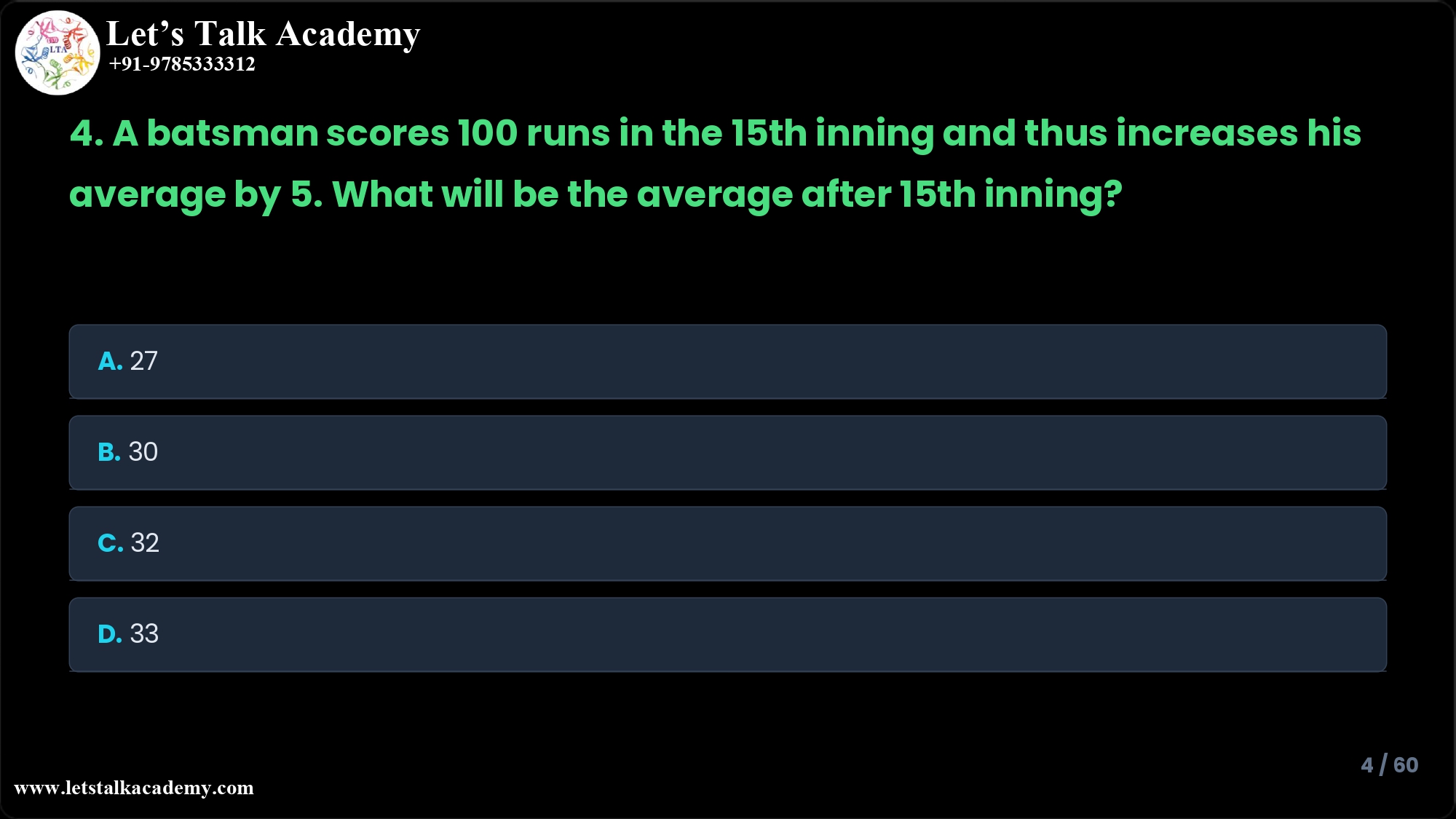
4. A batsman scores 100 runs in the 15th inning and thus increases his average by
5. What will be the average after 15th inning?
A. 27
B. 30
C. 32
D. 33
Average Calculation Problem – 15th Inning
The average after the 15th inning is 30 runs (Option B).
Let the previous average after 14 innings be x runs.
Total runs before the 15th inning = 14x.
Scoring 100 runs makes the new total 14x + 100,
and the new average becomes x + 5.
Therefore,
14x + 100 = 15(x + 5)
Simplifying gives: 14x + 100 = 15x + 75 → 100 − 75 = 15x − 14x → x = 25.
The final average is 25 + 5 = 30.
Verification
- Previous total = 25 × 14 = 350
- New total = 350 + 100 = 450
- New average = 450 ÷ 15 = 30
Option Analysis
- A. 27:
Assumes previous average 22.
22 × 14 + 100 = 308 + 100 = 408, and 408 ÷ 15 = 27.2 ≠ 27.
Increase = 5.2, not 5. Incorrect. - B. 30:
As calculated, previous average = 25 gives exactly 450 ÷ 15 = 30.
Increase = 5. Correct. - C. 32:
Assumes previous average 27.
27 × 14 + 100 = 378 + 100 = 478, and 478 ÷ 15 ≈ 31.87 ≠ 32.
Increase ≈ 6.87, not 5. Incorrect. - D. 33:
Assumes previous average 28.
28 × 14 + 100 = 392 + 100 = 492, and 492 ÷ 15 = 32.8 ≠ 33.
Increase ≈ 4.8, not 5. Incorrect.
Exam Insight
The problem where a batsman scores 100 runs in the 15th inning and the average increases by 5 tests conceptual clarity in
CSIR NET Life Sciences quantitative aptitude.
It uses the general equation:
n × (x + d) = (n − 1) × x + s
where
n = 15,
d = 5,
s = 100.
Such questions emphasize algebraic setup and logical verification of totals to eliminate distractors.
Consistent practice helps aspirants accurately identify valid answers like 30 through total-run validation.


