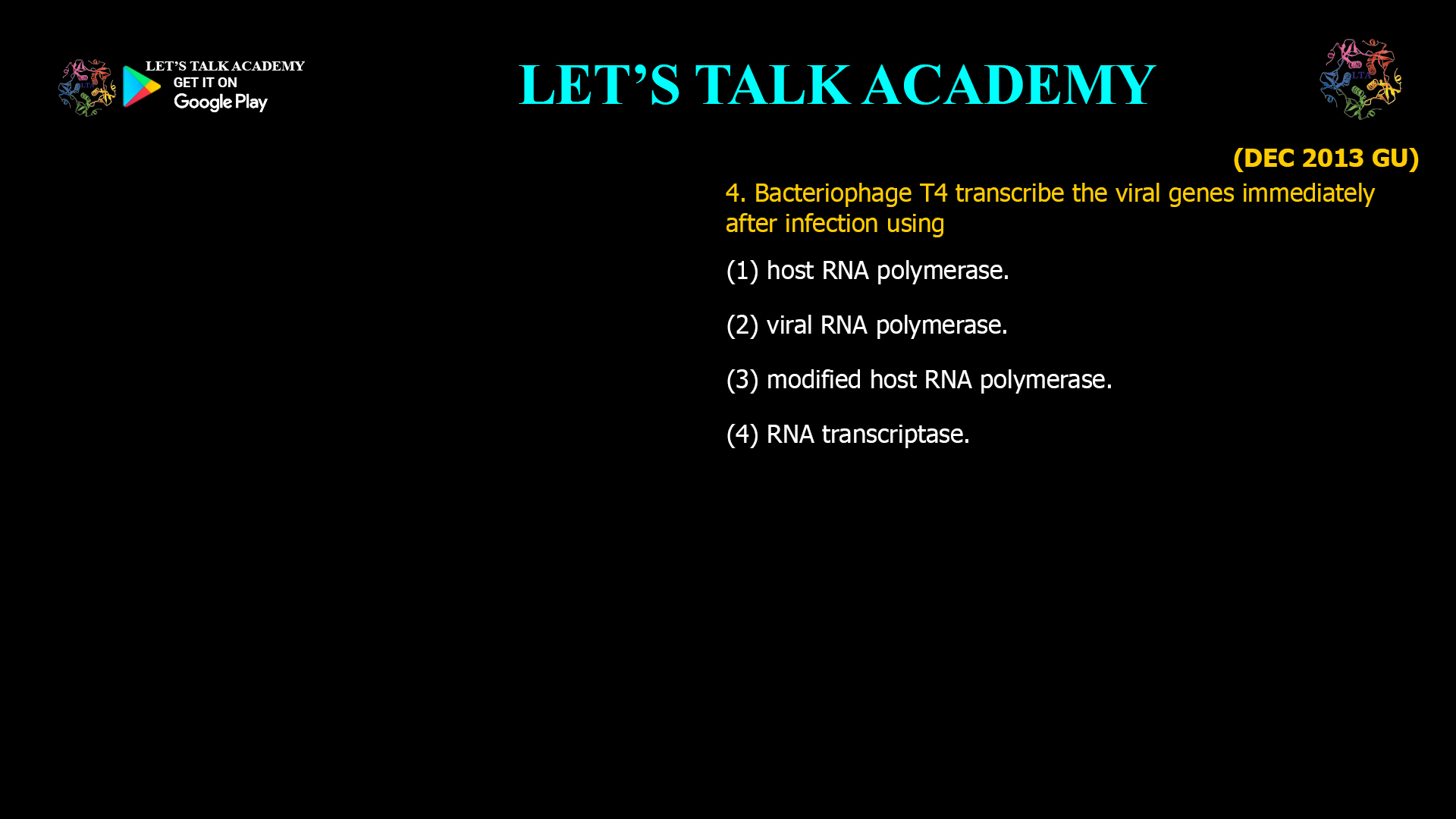
4. Bacteriophage T4 transcribe the viral genes immediately after infection using
(1) host RNA polymerase.
(2) viral RNA polymerase.
(3) modified host RNA polymerase.
(4) RNA transcriptase.
Discover how bacteriophage T4 uses host RNA polymerase to transcribe its viral genes immediately after infection. Learn the molecular mechanisms behind this process and its significance in viral replication.
Bacteriophages, or phages, are viruses that infect bacteria. Among them, Bacteriophage T4 is one of the most extensively studied viruses due to its complex life cycle and well-characterized molecular biology. A critical step in the T4 infection cycle is the transcription of viral genes immediately after the phage infects the host bacterium. Understanding how T4 initiates this transcription provides valuable insights into viral replication and gene regulation.
What Happens When Bacteriophage T4 Infects a Host?
When bacteriophage T4 infects a bacterial cell, typically Escherichia coli, it injects its DNA into the host cytoplasm. The phage genome then needs to be transcribed into RNA to produce viral proteins necessary for replication and assembly of new phage particles. This transcription process begins almost immediately after infection.
The Key Question: Which RNA Polymerase Does T4 Use?
The central question in the transcription of T4 viral genes is: Which RNA polymerase transcribes these genes immediately after infection?
-
Is it the host RNA polymerase?
-
Or does the phage bring its own viral RNA polymerase?
-
Could it be a modified host RNA polymerase?
-
Or an enzyme called RNA transcriptase?
The Answer: Host RNA Polymerase
The correct answer is that bacteriophage T4 uses the host RNA polymerase to transcribe its viral genes immediately after infection.
Why Host RNA Polymerase?
Bacteriophage T4 does not carry its own RNA polymerase enzyme in the viral particle. Instead, it relies on the host bacterium’s RNA polymerase to initiate transcription of early viral genes. This strategy allows the phage to quickly hijack the host’s transcription machinery without the need to package complex enzymes within its capsid.
How Does Host RNA Polymerase Recognize Viral Genes?
For the host RNA polymerase to transcribe viral genes, it must recognize the phage promoters—specific DNA sequences upstream of viral genes that signal the start of transcription.
-
T4 early genes have promoters that are similar enough to bacterial promoters that the host RNA polymerase can bind and initiate transcription.
-
This ensures rapid expression of early viral proteins immediately after infection.
What Happens After Early Gene Transcription?
Once the early viral genes are transcribed and translated, some of these early proteins modify the host RNA polymerase. These modifications alter the specificity of the host RNA polymerase, enabling it to recognize middle and late viral promoters, which differ from the early promoters.
This process is sometimes referred to as using a modified host RNA polymerase, but the enzyme itself is originally the host RNA polymerase that has been altered by viral proteins.
Why Not Viral RNA Polymerase or RNA Transcriptase?
-
Viral RNA polymerase: Unlike some other viruses, bacteriophage T4 does not encode or carry its own RNA polymerase enzyme. It depends entirely on the host enzyme for transcription.
-
RNA transcriptase: This term is less commonly used in modern molecular biology and is often synonymous with RNA polymerase. It does not refer to a distinct enzyme carried by T4.
Summary of the Transcription Process in Bacteriophage T4
| Stage | Enzyme Involved | Description |
|---|---|---|
| Immediate early phase | Host RNA polymerase | Transcribes early viral genes using host RNA polymerase recognizing phage promoters. |
| Middle and late phases | Modified host RNA polymerase | Viral proteins modify host RNA polymerase to transcribe middle and late genes. |
Importance of This Mechanism
The use of host RNA polymerase by bacteriophage T4 offers several advantages:
-
Efficiency: No need to package complex enzymes inside the phage particle.
-
Speed: Immediate access to transcription machinery allows rapid viral gene expression.
-
Control: Viral proteins can modify host RNA polymerase to sequentially express genes in a timely manner.
Conclusion
In conclusion, bacteriophage T4 transcribes its viral genes immediately after infection by utilizing the host RNA polymerase. This elegant strategy allows the virus to efficiently hijack the host’s transcription machinery, ensuring rapid production of viral proteins necessary for successful infection and replication. Understanding this process provides a fundamental insight into virus-host interactions and the molecular biology of phages.


