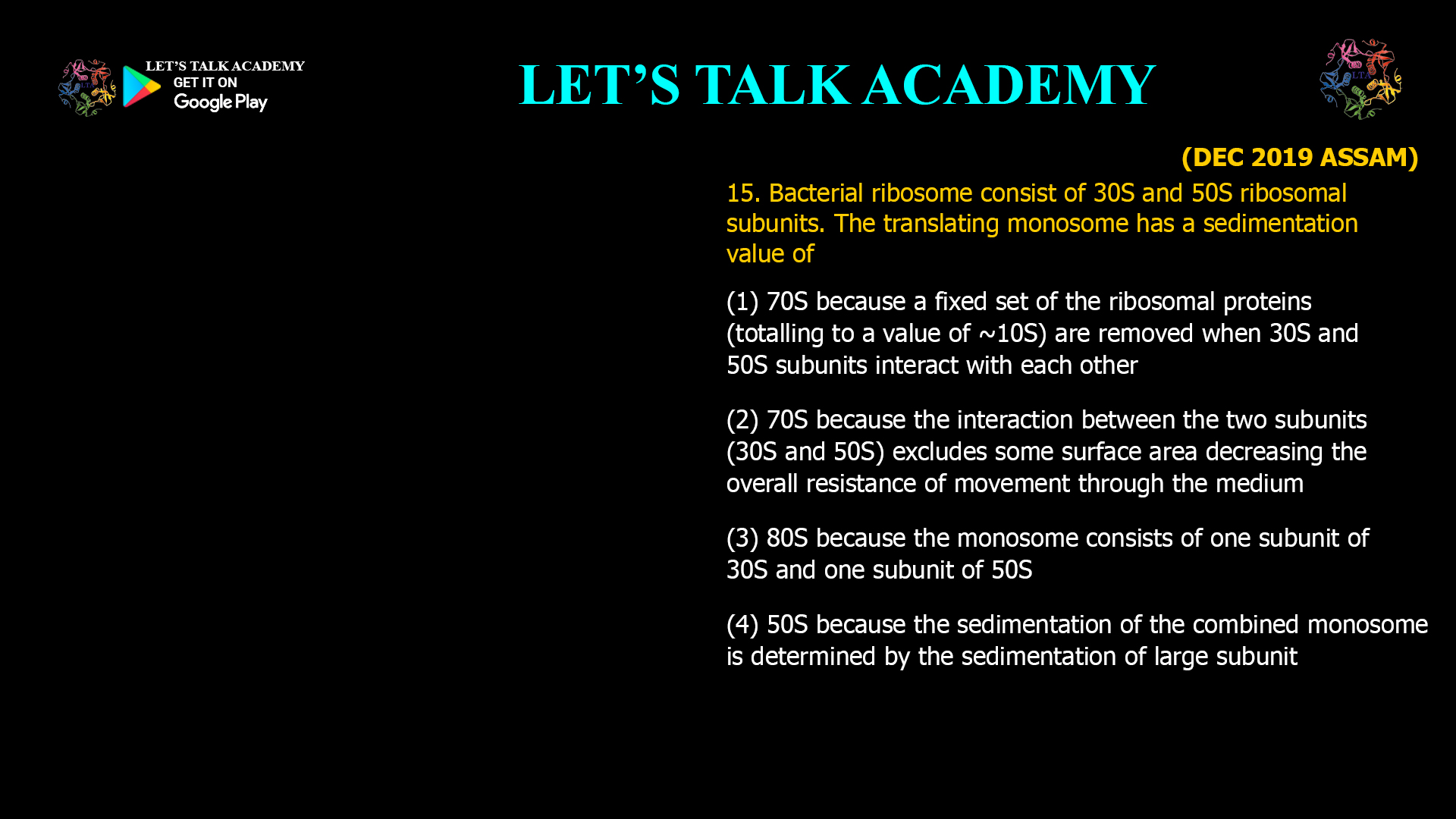
- Bacterial ribosome consist of 30S and 50S ribosomal subunits. The translating monosome has a sedimentation value of
(1) 70S because a fixed set of the ribosomal proteins (totalling to a value of ~10S) are removed when30S and 50S subunits interact with each other
(2) 70S because the interaction between the two subunits (30S and 50S) excludes some surface area decreasing the overall resistance of movement through the medium
(3) 80S because the monosome consists of one subunit of 30S and one subunit of 50s(4) 50S because the sedimentation of the combined monosome is determined by the sedimentation of large subunitUnderstanding the Sedimentation Value of the Bacterial Ribosome Monosome: Why It’s 70S, Not 80S
The bacterial ribosome is a complex molecular machine responsible for protein synthesis. It is composed of two subunits: the 30S small subunit and the 50S large subunit. When these two subunits come together during translation, they form the 70S monosome. Understanding why the sedimentation value is 70S, rather than a simple sum of the two subunits, is essential for students and researchers studying molecular biology and ribosome structure.
What Is Sedimentation Coefficient (S)?
-
The sedimentation coefficient (S) is a measure of how fast a particle sediments during ultracentrifugation.
-
It depends on the particle’s size, shape, and density, not just its mass.
-
The unit “S” stands for Svedberg unit, named after Theodor Svedberg, and is not additive because sedimentation depends on more than just molecular weight.
Why Is the Bacterial Ribosome Monosome 70S?
-
The bacterial ribosome consists of a 30S small subunit and a 50S large subunit.
-
When these subunits associate to form the functional ribosome during translation, the sedimentation coefficient is 70S, not 80S.
-
This is because the combined ribosome is more compact and streamlined than the sum of its parts, reducing frictional resistance during sedimentation.
-
The interaction between the two subunits excludes some surface area, which decreases the overall resistance to movement through the medium, making the sedimentation coefficient less than the sum of 30S and 50S.
Explanation of the Options
-
(1) 70S because a fixed set of the ribosomal proteins (totalling to a value of ~10S) are removed when 30S and 50S subunits interact:
-
This is incorrect. Ribosomal proteins are not removed during subunit association.
-
-
(2) 70S because the interaction between the two subunits (30S and 50S) excludes some surface area decreasing the overall resistance of movement through the medium:
-
This is correct. The compact structure formed reduces friction, so the sedimentation coefficient is less than the sum of the individual subunits.
-
-
(3) 80S because the monosome consists of one subunit of 30S and one subunit of 50S:
-
This is incorrect. Sedimentation coefficients are not additive; hence 80S is wrong.
-
-
(4) 50S because the sedimentation of the combined monosome is determined by the sedimentation of large subunit:
-
This is incorrect. The monosome sedimentation reflects the whole ribosome, not just the large subunit.
-
Summary Table
Option Explanation Correctness (1) Ribosomal proteins removed upon subunit association Incorrect (2) Interaction excludes surface area, reducing friction and sedimentation coefficient Correct (3) Sedimentation coefficient is additive (30S + 50S = 80S) Incorrect (4) Sedimentation determined only by large subunit Incorrect
Keywords for SEO Optimization
-
Bacterial ribosome sedimentation coefficient
-
70S ribosome structure
-
Ribosomal subunits 30S and 50S
-
Svedberg units and sedimentation
-
Ribosome assembly and ultracentrifugation
-
Protein synthesis machinery in bacteria
-
Ribosome monosome sedimentation
-
Molecular biology of ribosomes
-
Ribosomal protein interactions
-
Ribosome size and shape effects
Conclusion
The bacterial ribosome monosome sediments at 70S because the interaction between the 30S and 50S subunits creates a compact structure that excludes some surface area, reducing frictional resistance during sedimentation. This explains why the sedimentation coefficient is not a simple sum of the subunits’ values.
Correct answer: (2) 70S because the interaction between the two subunits (30S and 50S) excludes some surface area decreasing the overall resistance of movement through the medium
-


6 Comments
Kirti Agarwal
November 2, 202570 s because the interaction between the two sub units excludes some surface area decreasing the overall resistance of movement through the medium
Sakshi yadav
November 3, 202570S because the interaction between the two subunits (30S and 50S) excludes some surface area decreasing the overall resistance of movement through the medium
Kajal
November 4, 2025The Correct answer is : (2) 70S because the interaction between the two subunits (30S and 50S) excludes some surface area decreasing the overall resistance of movement through the medium
Dipti Sharma
November 4, 202570S because the interaction between the two subunits 30S and 50S excludes some surface area decreasing the overall resistance of movement through the medium.
Heena Mahlawat
November 5, 2025Option 2
Mohd juber Ali
November 7, 2025Option 2)
Ribosome complex play a role in protein synthesis. Bacterial rb consist of 30s small & 50s large sub units in pro.
So the sum of 30s & 50s sub units not 80s bcz sedimantation coffecient (s) measure size or shape not mass when 30s and 50s intrect then rb is more compact sadimantation coff. (S) is 70s .and exclude some surface area