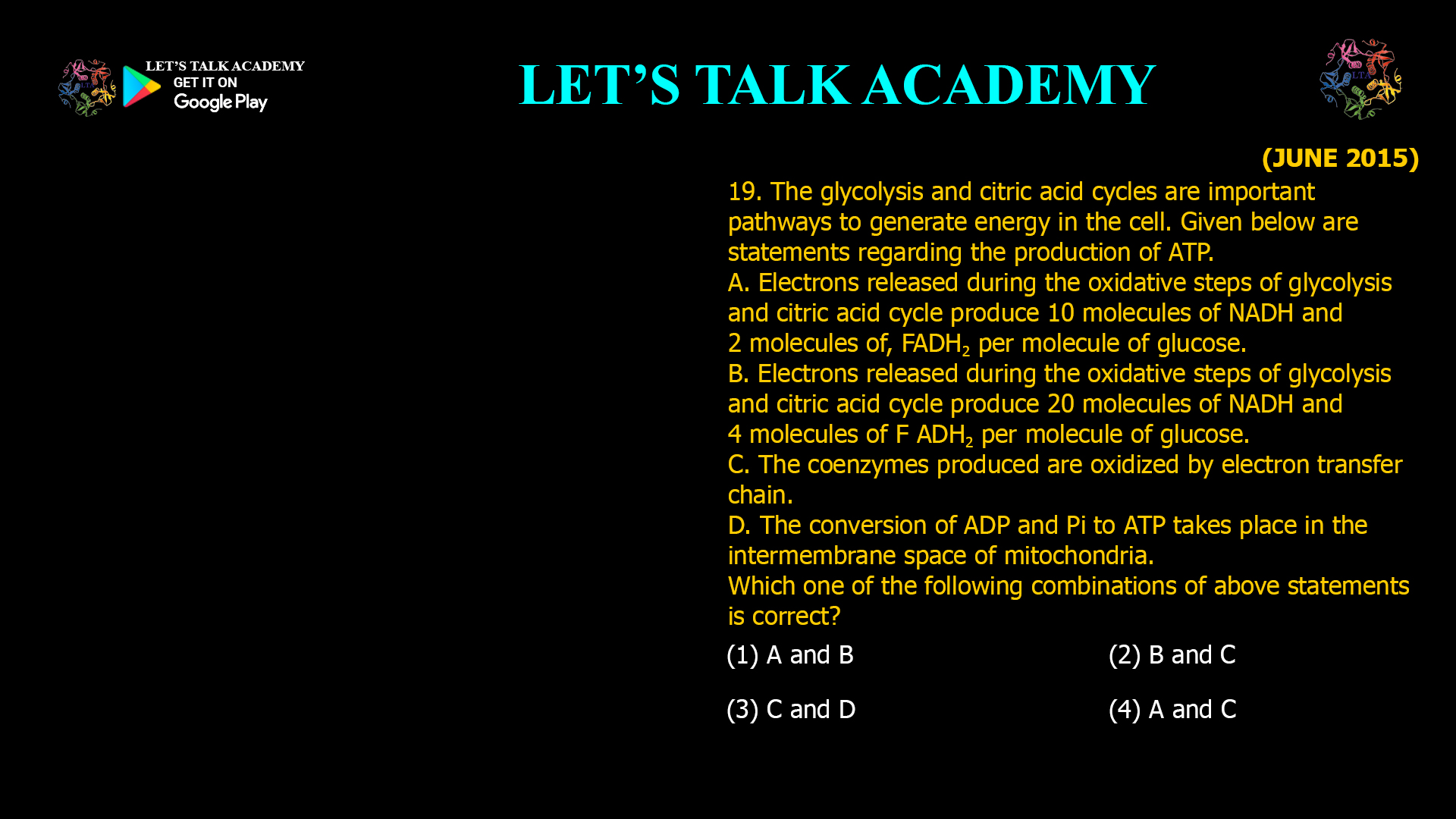
- The glycolysis and citric acid cycles are important pathways o generate energy in the cell. Given below are statements regarding the production of ATP.
A. Electrons released during the oxidative steps of glycolysis and citric acid cycle produce 10 molecules of NADH and 2 molecules of, FADH2 per molecule of glucose.
B. Electrons released during the oxidative steps of glycolysis and citric acid cycle produce 20 molecules of NADH and 4 molecules of F ADH2 per molecule of glucose.
C. The coenzymes produced are oxidized by electron transfer chain.
D. The conversion of ADP and Pi to ATP takes place in the intermembrane space of mitochondria.
Which one of the following combinations of above statements is correct?
(1) A and B (2) B and C
(3) C and D (4) A and C
Glycolysis and the citric acid cycle (also known as the Krebs cycle or TCA cycle) are fundamental metabolic pathways that cells use to extract energy from glucose. These pathways generate high-energy molecules like NADH and FADH2, which are then used in the electron transport chain to produce ATP, the cell’s energy currency.
This article examines key statements about ATP production related to glycolysis and the citric acid cycle, clarifies their accuracy, and explains where ATP synthesis actually occurs within the cell.
Statement A: Electrons Released During Glycolysis and Citric Acid Cycle Produce 10 NADH and 2 FADH2 per Glucose
This statement is correct.
-
For each molecule of glucose, glycolysis produces 2 NADH molecules.
-
The conversion of 2 pyruvate molecules (from glycolysis) to 2 acetyl-CoA molecules produces 2 NADH.
-
The citric acid cycle turns twice per glucose molecule (once per acetyl-CoA), producing 6 NADH and 2 FADH2.
-
Total NADH = 2 (glycolysis) + 2 (pyruvate oxidation) + 6 (citric acid cycle) = 10 NADH.
-
Total FADH2 = 2 (citric acid cycle).
These electron carriers then feed into the electron transport chain to generate ATP.
Statement B: Electrons Released Produce 20 NADH and 4 FADH2 per Glucose
This statement is incorrect.
-
The numbers given here are double the actual values.
-
The total NADH and FADH2 molecules produced per glucose are 10 and 2, respectively, not 20 and 4.
Statement C: The Coenzymes Produced Are Oxidized by the Electron Transport Chain
This statement is correct.
-
NADH and FADH2 donate electrons to the electron transport chain (ETC) located in the inner mitochondrial membrane.
-
As electrons pass through the ETC, energy is released and used to pump protons, creating a proton gradient.
-
This gradient drives ATP synthesis via ATP synthase.
Statement D: Conversion of ADP and Pi to ATP Takes Place in the Intermembrane Space of Mitochondria
This statement is incorrect.
-
ATP synthesis occurs in the mitochondrial matrix, not the intermembrane space.
-
The electron transport chain pumps protons from the matrix into the intermembrane space, creating a proton gradient.
-
Protons flow back into the matrix through ATP synthase, driving the conversion of ADP and inorganic phosphate (Pi) into ATP.
Summary Table of Statements
Statement Description Correctness A 10 NADH and 2 FADH2 produced per glucose Correct B 20 NADH and 4 FADH2 produced per glucose Incorrect C Coenzymes oxidized by electron transport chain Correct D ATP synthesis occurs in intermembrane space Incorrect Correct Combination of Statements
Based on the above analysis, the correct combination is:
(4) A and C
How ATP Is Produced in Cellular Respiration
-
Glycolysis (cytosol):
-
Glucose → 2 pyruvate + 2 ATP (net) + 2 NADH.
-
-
Pyruvate Oxidation (mitochondrial matrix):
-
2 pyruvate → 2 acetyl-CoA + 2 NADH + 2 CO2.
-
-
Citric Acid Cycle (mitochondrial matrix):
-
2 acetyl-CoA → 6 NADH + 2 FADH2 + 2 ATP (or GTP) + 4 CO2.
-
-
Electron Transport Chain and Oxidative Phosphorylation (inner mitochondrial membrane):
-
NADH and FADH2 donate electrons.
-
Proton gradient formed across inner membrane.
-
ATP synthase uses gradient to convert ADP + Pi → ATP in the matrix.
-
Conclusion
The production of ATP during glucose metabolism involves multiple steps and compartments. For each glucose molecule, 10 NADH and 2 FADH2 molecules are generated during glycolysis and the citric acid cycle. These coenzymes are oxidized by the electron transport chain, which drives ATP synthesis in the mitochondrial matrix—not the intermembrane space.
Correct answer: (4) A and C
-


25 Comments
Rohittt
June 24, 2025👍🏻👍🏻
Kirti Agarwal
September 19, 2025Statement A and D
Neha Yadav
September 20, 2025Statement A and C are correct about ATP production
Soniya Shekhawat
September 22, 2025Electrons released during glycolysis + citric acid cycle produce 10 NADH + 2 FADH₂ per glucose. ✅ And The coenzymes produced (NADH, FADH₂) are oxidized by ETC. ✅so Aand C IS CORRECT
Manisha choudhary
September 22, 2025Glycolysis s net gain 2NADH+2ATP
pyruvate oxydation s 2NADH +2CO2
krebs cycle s 6NADH+2FADH2+2GTP(ATP) +4CO2
NADH and FADH2. Apne electrone ETS cycle ko dete h
Statement A nad C is correct
Pallavi Ghangas
September 22, 2025a and d
Aakansha sharma Sharma
September 22, 2025Statement A and C are correct about ATP production
Heena Mahlawat
September 23, 2025A and c
Roopal Sharma
September 23, 2025Statement A Nd c
Aafreen Khan
September 23, 2025A and C is correct answer
Dharmpal Swami
September 23, 2025Glycolysis= 2NADH + 2ATP
Krebs cycle=10 NADH+2 FADH+2 GTP
Anurag Giri
September 23, 2025Statement A and C are correct about ATP production
Minal Sethi
September 24, 2025A. Electrons released during the oxidative steps of glycolysis and citric acid cycle produce 10 molecules of NADH and 2 molecules of, FADH2 per molecule of glucose.
C. The coenzymes produced are oxidized by electron transfer chain.
Option 4 – A and C are correct
Nilofar Khan
September 24, 2025Correct answer is A and C
Deepika sheoran
September 24, 2025A and C correct statement
Mohd juber Ali
September 24, 2025Statement A and c is correct
Devika
September 25, 2025A and C are correct
Payal Gaur
September 25, 2025A and C
Divya rani
September 25, 2025A and C are correct options because 10 NADH and 2 FADH2 produce in glycolysis and krebs cycle and NADH and FADH2 gives their electrons to ETS of mitochondrial inner membrane.
Avni
September 25, 202510 NADH and 2 FADH2 produced per glucose and The coenzymes produced are oxidized by electron transfer chain
Muskan Yadav
September 26, 2025Correct answer: (4) A and C
Arushi Saini
September 27, 2025Statement A and C are correct
Kajal
October 2, 2025Option A and C
Santosh Saini
October 5, 2025A. Electrons released during glycogenesis and citric acid cycle produce 10 NADH and 2 FADH2 pre glucose = Total NADH →2 glycolysis + 2 pyruvate oxidation + 6 citric acid= 10 NADH , Total FADH2→2 citric acid cycle , C. Coenzymes are oxidised by ETS, correct answer is 4 ( A and C statement )
Sakshi Kanwar
November 25, 2025Statement A and C are correct