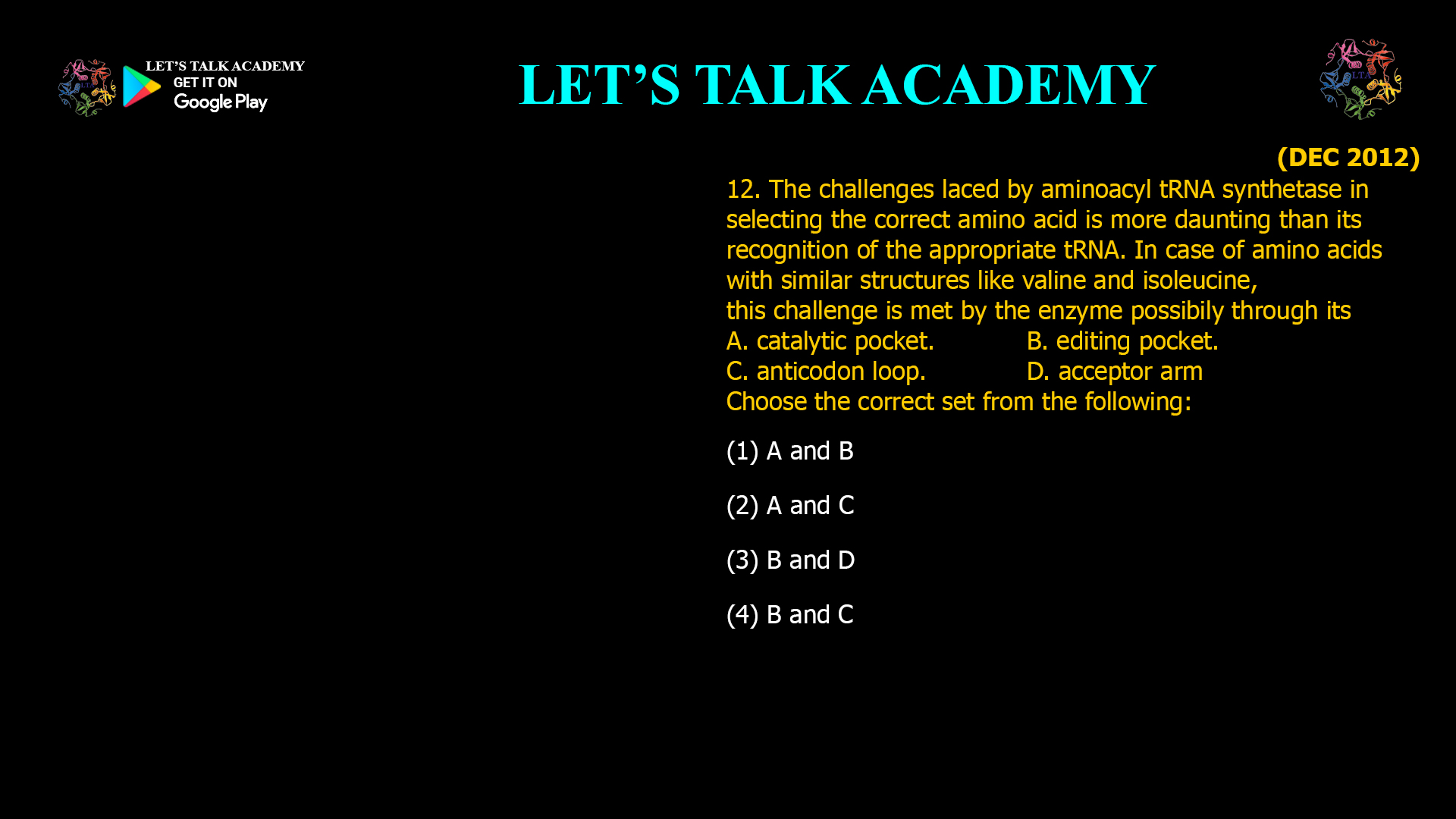
- The challenges laced by aminoacyl tRNAsynthetase in selecting the correct amino acid is more daunting than its recognition of the appropriate tRNA. In case of amino acids with similar structures like valine and isoleucine,this challenge is met by the enzyme possibily through its
A. catalytic pocket. B. editing pocket.
C. anticodon loop. D. acceptor arm
Choose the correct set from the following:
(1) A and B(2) A and C
(3) B and D (4) B and CHow Aminoacyl-tRNA Synthetases Ensure Accurate Amino Acid Selection: Roles of Catalytic and Editing Pockets
Aminoacyl-tRNA synthetases (aaRSs) are crucial enzymes that link specific amino acids to their cognate tRNAs, ensuring the fidelity of protein synthesis. One of the major challenges for aaRSs is to discriminate between amino acids with very similar structures, such as valine and isoleucine. This specificity is achieved through sophisticated molecular mechanisms involving distinct enzyme domains.
The Challenge of Amino Acid Discrimination
-
Amino acids like valine and isoleucine differ only slightly in size and shape, making it difficult for the aaRS to distinguish between them solely by binding affinity.
-
Incorrect amino acid attachment (mischarging) can lead to errors in protein sequences, which can be detrimental to cellular function.
Key Structural Features of Aminoacyl-tRNA Synthetases
-
Catalytic Pocket (A):
-
The primary site where the amino acid is activated and initially bound.
-
It provides the first level of specificity by preferentially binding the correct amino acid.
-
-
Editing Pocket (B):
-
A secondary site that serves as a proofreading domain.
-
If an incorrect amino acid is mistakenly activated or attached, it is transferred to the editing pocket where hydrolysis occurs, removing the wrong amino acid.
-
This editing function is essential for high fidelity, especially when amino acids are structurally similar.
-
-
Anticodon Loop (C) and Acceptor Arm (D):
-
These regions are primarily involved in tRNA recognition and binding rather than amino acid discrimination.
-
Correct Combination for Discriminating Similar Amino Acids
-
The catalytic pocket initially binds the amino acid, while the editing pocket provides a proofreading mechanism to hydrolyze misactivated or mischarged amino acids.
-
Therefore, the enzyme meets the challenge of discriminating similar amino acids through the combined action of A (catalytic pocket) and B (editing pocket).
Summary Table
Feature Role in Amino Acid Selection Catalytic Pocket (A) Initial amino acid binding and activation Editing Pocket (B) Proofreading and hydrolysis of incorrect amino acids Anticodon Loop (C) tRNA recognition, not amino acid discrimination Acceptor Arm (D) tRNA binding, not amino acid discrimination
Correct Answer
(1) A and B
Keywords for SEO Optimization
-
Aminoacyl-tRNA synthetase specificity
-
Catalytic pocket amino acid selection
-
Editing pocket proofreading
-
Valine and isoleucine discrimination
-
Amino acid mischarging correction
-
Protein synthesis fidelity
-
tRNA charging accuracy
-
Enzyme proofreading mechanisms
-
Amino acid activation and editing
-
Molecular basis of translation accuracy
Conclusion
The challenge of selecting the correct amino acid by aminoacyl-tRNA synthetases, particularly when amino acids have similar structures, is met through the coordinated action of the catalytic pocket and the editing pocket. The catalytic pocket provides initial specificity, while the editing pocket acts as a molecular proofreader to hydrolyze incorrectly attached amino acids, ensuring the accuracy of protein synthesis.
Correct answer: (1) A and B
-


9 Comments
Kirti Agarwal
November 1, 2025Catalytic and editing pocket
Sakshi yadav
November 3, 2025Catalytic pocket – bcz it’s binding and activation the aa editing pocket -proofreading and hydrolysis of incorrect aa
Neha Yadav
November 3, 2025Catalytic pocket and editing pocket
Kajal
November 4, 2025Correct answer is A and B
Deepika Sheoran
November 4, 2025Catalytic and Editing pocket
Dipti Sharma
November 4, 2025Catalytic and editing pocket helps in correct aa selection by aa trna synthetase.
Heena Mahlawat
November 5, 2025Catalytic and editing pocket
Mohd juber Ali
November 7, 2025Correct option is catalytic and editing pocket ( catalytic play role in addition of correct amino acid & when incorrect aa by mistake bind then editing pocket resolve it and bind correct aa )
Anticodon loop and acceptor stem role in recognise of trna
Sakshi Kanwar
December 6, 2025Catalytic pocket and editing pocket