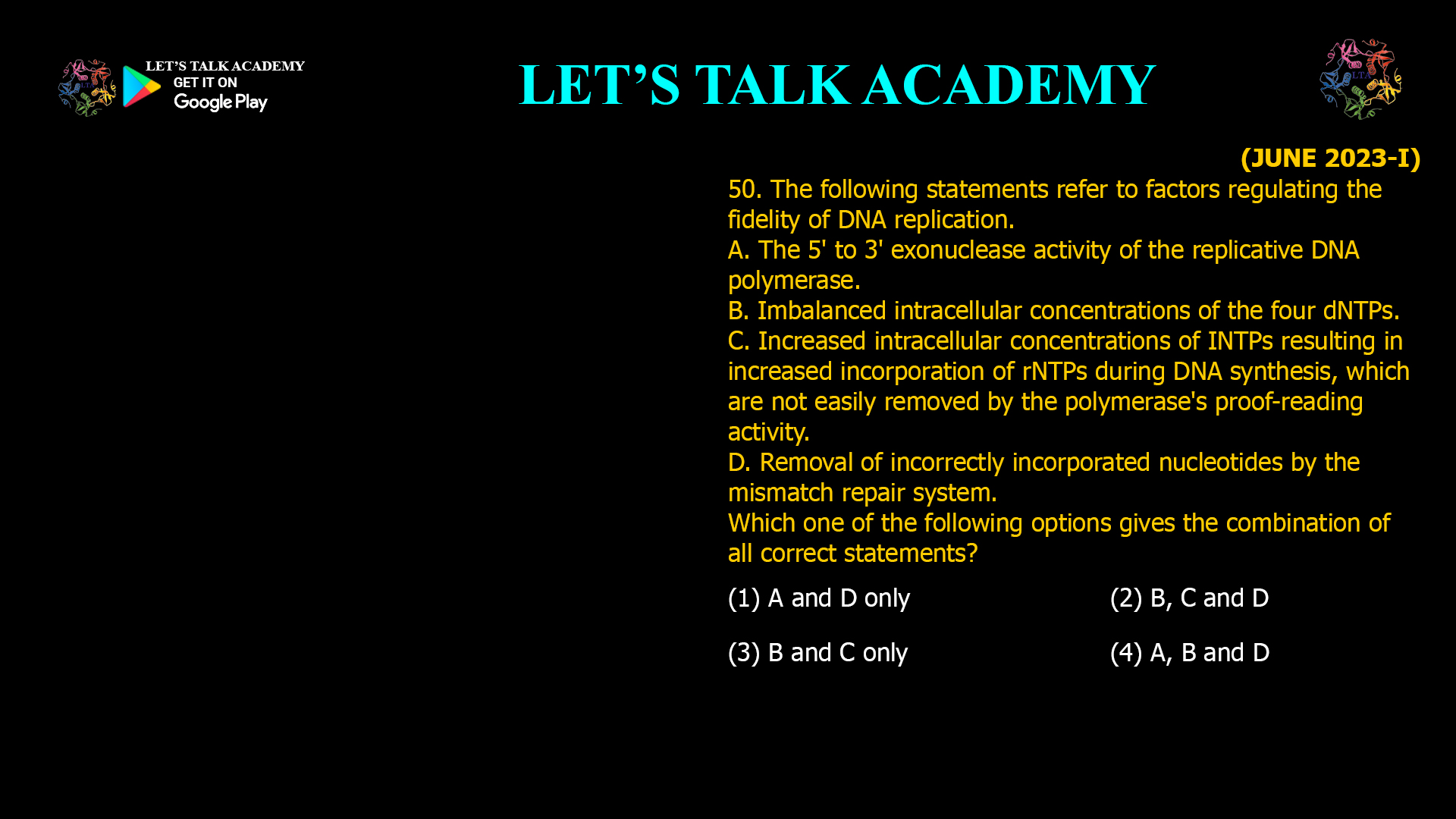
- The following statements refer to factors regulating the fidelity of DNA replication.
- The 5′ to 3′ exonuclease activity of the replicative DNA polymerase.
- Imbalanced intracellular concentrations of the four dNTPs.
- Increased intracellular concentrations of INTPs resulting in increased incorporation of rNTPs during DNA synthesis, which are not easily removed by the polymerase’s proof-reading activity.
- Removal of incorrectly incorporated nucleotides by the mismatch repair system.
Which one of the following options gives the
combination of all correct statements?
(1) A and D only (2) B, C and D
(3) B and C only (4) A, B and D
Introduction
Fidelity of DNA replication is essential for maintaining genetic stability and preventing mutations. Multiple mechanisms work together to ensure that DNA polymerases accurately copy the genome with minimal errors. These mechanisms include nucleotide selectivity, proofreading by DNA polymerases, balanced intracellular dNTP pools, and post-replicative mismatch repair.
Analysis of the Statements on Fidelity Regulation
A. The 5′→3′ exonuclease activity of the replicative DNA polymerase
-
This activity primarily removes RNA primers during lagging strand synthesis.
-
It is not directly involved in enhancing replication fidelity or correcting errors during DNA synthesis.
-
Therefore, statement A is not correct as a factor regulating fidelity.
B. Imbalanced intracellular concentrations of the four dNTPs
-
Imbalanced dNTP pools increase the likelihood of misincorporation due to altered nucleotide availability.
-
This imbalance reduces replication fidelity by increasing errors.
-
Thus, statement B is correct.
C. Increased intracellular concentrations of INTPs resulting in increased incorporation of rNTPs during DNA synthesis, which are not easily removed by the polymerase’s proofreading activity
-
Elevated rNTP (ribonucleotide) levels can lead to their incorporation into DNA.
-
DNA polymerases have limited ability to remove ribonucleotides, leading to increased errors and genome instability.
-
Statement C is correct.
D. Removal of incorrectly incorporated nucleotides by the mismatch repair system
-
The mismatch repair (MMR) system scans newly synthesized DNA to identify and correct mismatches missed by polymerase proofreading.
-
MMR significantly enhances replication fidelity post-synthesis.
-
Statement D is correct.
Summary of Correct Statements
-
B, C, and D are correct factors regulating replication fidelity.
-
A is not directly involved in error correction or fidelity enhancement.
Final Answer
(2) B, C and D
Supporting Insights
-
Proofreading and Mismatch Repair: DNA polymerases proofread via 3′→5′ exonuclease activity, but some errors escape this mechanism and are corrected by MMR.
-
Nucleotide Pool Balance: Balanced dNTP pools are crucial; imbalances can increase mutation rates.
-
Ribonucleotide Incorporation: High rNTP levels challenge DNA polymerase fidelity due to inefficient removal.
-
5′→3′ Exonuclease Role: Mainly involved in primer removal, not fidelity per se.
Summary Table
| Factor | Role in Fidelity Regulation | Correctness |
|---|---|---|
| A. 5′→3′ exonuclease activity | Removes RNA primers, not directly proofreading | No |
| B. Imbalanced dNTP concentrations | Increases misincorporation and errors | Yes |
| C. Increased INTPs leading to rNTP incorporation | Increases errors due to poor removal of ribonucleotides | Yes |
| D. Mismatch repair system | Corrects replication errors missed by proofreading | Yes |
Keywords
DNA replication fidelity, proofreading, 3′→5′ exonuclease, 5′→3′ exonuclease, dNTP pool balance, ribonucleotide incorporation, mismatch repair system, DNA polymerase accuracy, genome stability, replication errors
Summary:
The fidelity of DNA replication is regulated by multiple factors. Imbalanced dNTP pools and increased ribonucleotide incorporation reduce fidelity by increasing errors during synthesis. The mismatch repair system corrects errors missed by polymerase proofreading, significantly enhancing accuracy. The 5′→3′ exonuclease activity, while essential for primer removal, does not directly regulate replication fidelity.
Correct answer:
(2) B, C and D


11 Comments
Manisha choudhary
July 29, 2025Done sir 👍🏻
Sneha Kumawat
July 30, 2025B , c ,d is correct answer
Priya Khandal
July 29, 20252 is right
Swati Choudhary
July 30, 2025Understood sir!!
Mitali Saini
July 31, 2025Final answer is B, C, D
Soniya Shekhawat
July 31, 2025Understood by in simple language of explanation
Kajal
July 31, 2025Option B,C,D is right
Varsha Tatla
August 3, 2025Correct Option b c d
5′-3′ exonuclease activity directly not involved in dna replication fedality
Embalance dntps conc , High intp, mismatch repair system responsible for dna rep. Fedality
Aafreen Khan
August 23, 20252–B, C and D understand by explanation
Deepika Sheoran
November 7, 2025Option B C D
Komal Sharma
November 7, 2025DNA replication fidelity, proofreading, 3′→5′ exonuclease, 5′→3′ exonuclease, dNTP pool balance, ribonucleotide incorporation, mismatch repair system, DNA polymerase accuracy, genome stability, replication errors