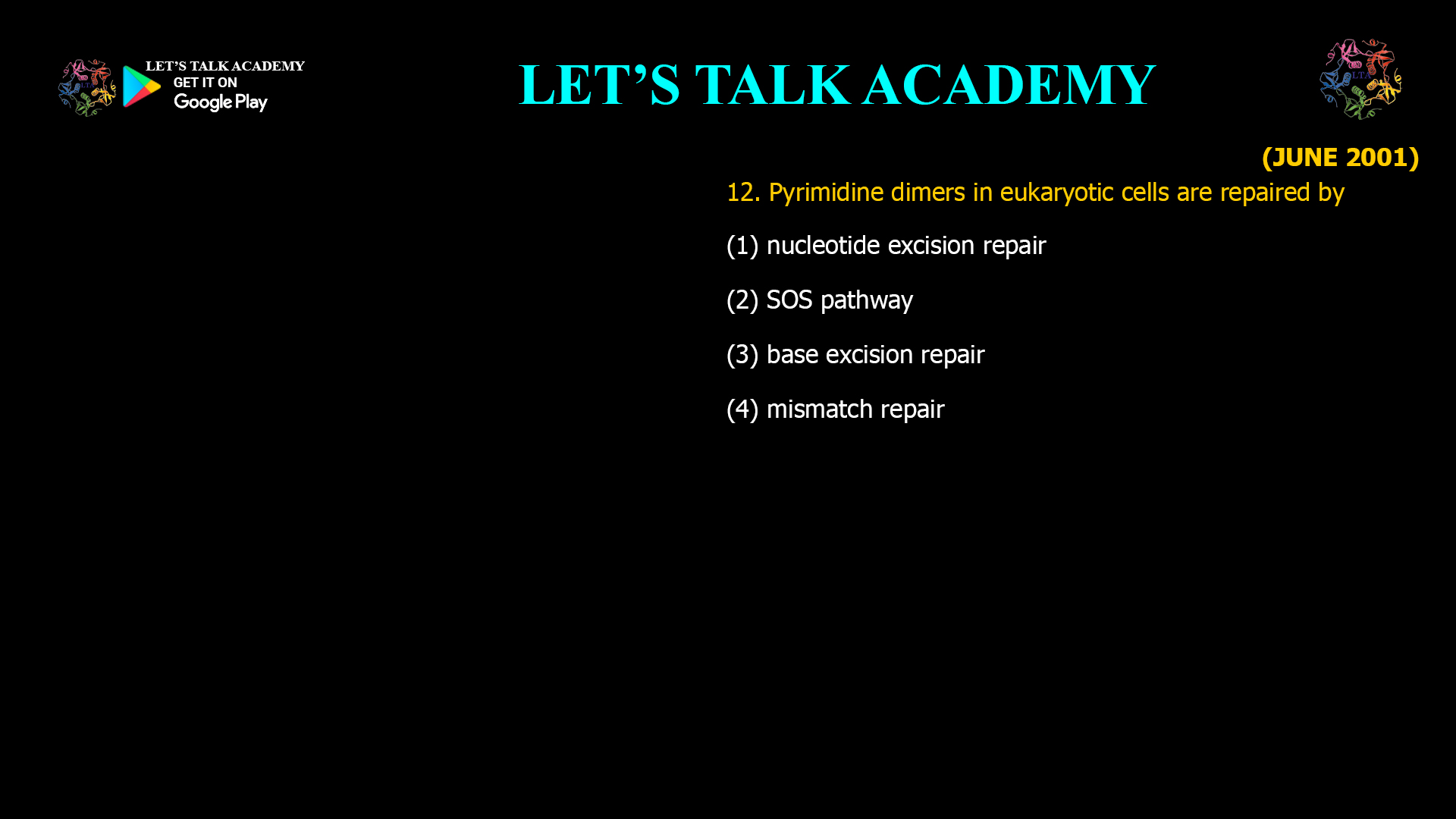
- Pyrimidine dimers in eukaryotic cells are repaired by
(1) nucleotide excision repair (2) SOS pathway
(3) base excision repair (4) mismatch repairPyrimidine Dimers in Eukaryotic Cells Are Repaired by Nucleotide Excision Repair
Pyrimidine dimers, primarily thymine dimers, are a common form of DNA damage caused by ultraviolet (UV) radiation. These dimers distort the DNA double helix, blocking replication and transcription, and if unrepaired, can lead to mutations and cell death. Eukaryotic cells have evolved efficient repair mechanisms to remove these lesions and maintain genomic integrity.
What Are Pyrimidine Dimers?
Pyrimidine dimers form when UV light induces covalent bonds between adjacent pyrimidine bases (usually thymine or cytosine) on the same DNA strand. The most frequent type is the cyclobutane pyrimidine dimer (CPD), which introduces a kink in the DNA helix.
How Do Eukaryotic Cells Repair Pyrimidine Dimers?
The primary repair mechanism for pyrimidine dimers in eukaryotic cells is Nucleotide Excision Repair (NER). This versatile pathway recognizes bulky DNA lesions that distort the helix, excises a short single-stranded DNA segment containing the damage, and fills the gap using the undamaged complementary strand as a template.
Key steps in NER include:
-
Damage Recognition: Specialized proteins detect the DNA distortion caused by the dimer.
-
Local DNA Unwinding: Helicases unwind the DNA around the lesion.
-
Dual Incision: Endonucleases cut the damaged strand on both sides of the lesion.
-
Excision: The damaged oligonucleotide is removed.
-
DNA Synthesis and Ligation: DNA polymerase fills the gap using the opposite strand, and DNA ligase seals the nick.
Why Not Other Repair Mechanisms?
-
SOS Pathway (Option 2):
-
This is a bacterial, error-prone DNA damage tolerance mechanism activated under severe stress. It is not a primary repair pathway in eukaryotes.
-
-
Base Excision Repair (Option 3):
-
Repairs small, non-helix-distorting base lesions such as oxidized or alkylated bases, not bulky lesions like pyrimidine dimers.
-
-
Mismatch Repair (Option 4):
-
Corrects replication errors such as base-base mismatches and insertion/deletion loops, not UV-induced pyrimidine dimers.
-
Supporting Evidence
-
Studies monitoring pyrimidine dimer removal in eukaryotic cells show rapid excision consistent with NER activity, completing within hours after UV exposure.
-
Defects in NER genes cause diseases like Xeroderma Pigmentosum (XP), characterized by extreme sensitivity to UV and high skin cancer risk, underscoring the importance of NER in dimer repair.
Related Keywords for SEO Optimization
-
Pyrimidine dimer repair
-
Nucleotide excision repair in eukaryotes
-
UV-induced DNA damage
-
Cyclobutane pyrimidine dimers
-
DNA repair mechanisms
-
Xeroderma Pigmentosum and NER
-
DNA damage recognition
-
DNA excision and synthesis
-
DNA helicases and endonucleases
-
DNA ligase and polymerase in repair
Conclusion
Among the given options, nucleotide excision repair (NER) is the primary mechanism by which eukaryotic cells repair pyrimidine dimers caused by UV radiation. This process efficiently removes bulky DNA lesions and restores the DNA to its original state, safeguarding cellular function and genomic integrity.
Correct answer: (1) nucleotide excision repair
-


16 Comments
Komal Sharma
November 7, 2025Among the given options, nucleotide excision repair (NER) is the primary mechanism by which eukaryotic cells repair pyrimidine dimers caused by UV radiation. This process efficiently removes bulky DNA lesions and restores the DNA to its original state, safeguarding cellular function and genomic integrity.
Roopal Sharma
November 7, 2025NER is the primary mechanism through which eukaryotic cells repair pyrimidine dimers
Deepika Sheoran
November 7, 2025Nucleotide excision repair
sakshivijay
November 7, 2025nucleotide excision repair is correct option
Sonal Nagar
November 7, 2025Nt. Excision repair
Neelam Sharma
November 7, 2025Nucleotide excision repair
Kirti Agarwal
November 8, 2025Nucleotide excision repair
Rishita
November 8, 2025nucleotide excision repair
Mohd juber Ali
November 8, 2025NER (nt excision repair )
1 global genomic ner
2 Tc coupled ner
Dipti Sharma
November 8, 2025Nucleotide excision repair
Anisha Beniwal
November 9, 2025Nucleotide excision repair
priti khandal
November 9, 2025nucleiotide excision repair
Heena Mahlawat
November 9, 2025Nucleotide excision repair
Neeraj Sharma
November 12, 2025Pyrimidine dimers in eukaryotes are repaired by nucleotide excision repair mechanism
Muskan Yadav
November 12, 2025Nucleotide excision repair (NER) is the primary mechanism by which eukaryotic cells repair pyrimidine dimers caused by UV radiation.
Bhawna Choudhary
November 14, 2025NER