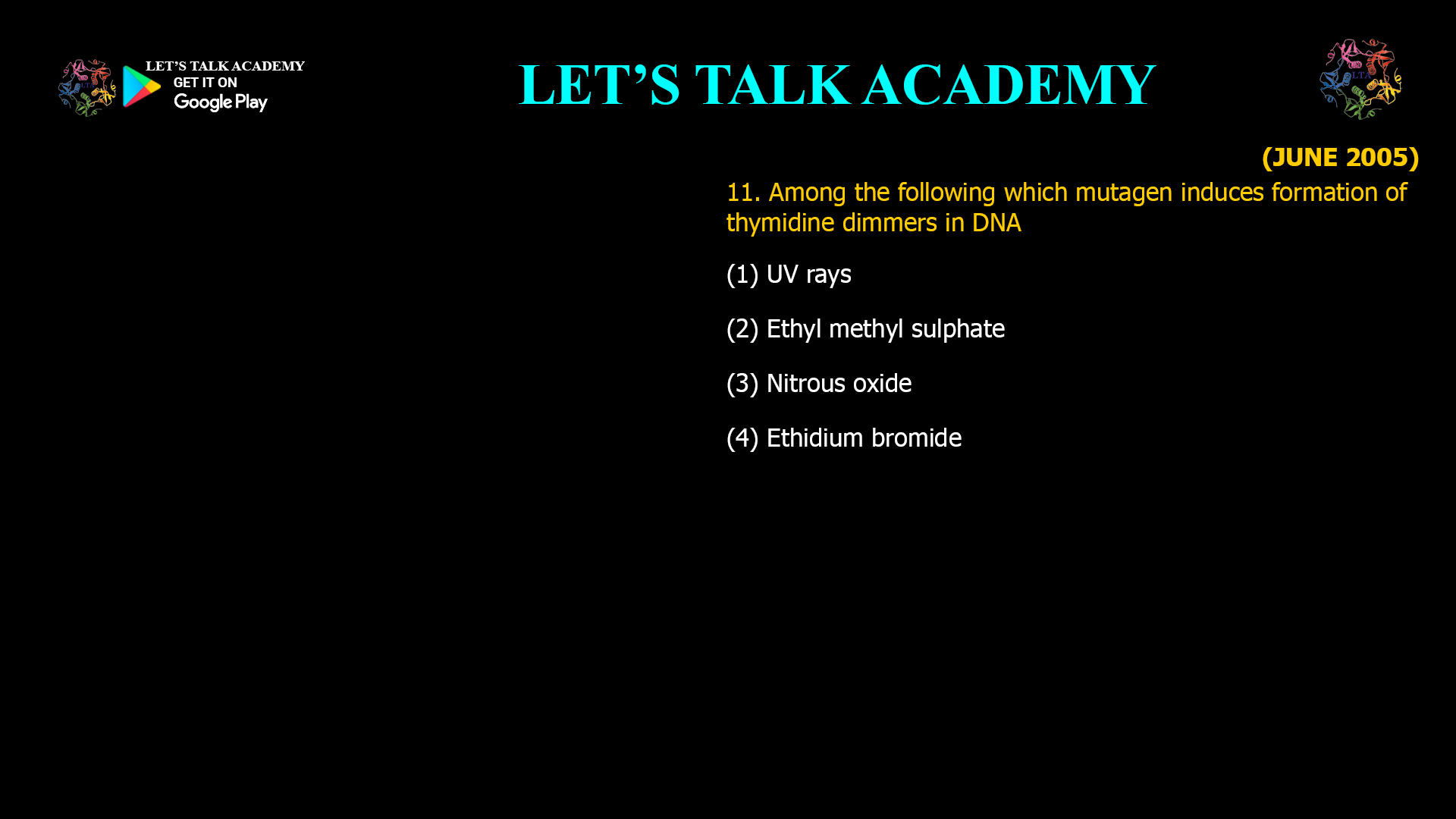
- Among the following which mutagen induces formation of thymidine dimmers in DNA
(1) UV rays (2) Ethyl methyl sulphate
(3) Nitrous oxide (4) Ethidium bromideWhich Mutagen Induces Formation of Thymine Dimers in DNA?
Thymine dimers are a specific type of DNA damage caused by covalent bonding between adjacent thymine bases in DNA. This lesion distorts the DNA double helix and can interfere with replication and transcription, leading to mutations and potentially causing cellular dysfunction or death. Understanding which mutagens induce thymine dimers is crucial for studying DNA damage and repair mechanisms.
What Causes Thymine Dimer Formation?
Thymine dimers predominantly form when DNA is exposed to ultraviolet (UV) radiation, especially UV-B and UV-C light. The energy from UV rays induces covalent bonds between the 5,6 carbon atoms of adjacent thymine bases, creating cyclobutane pyrimidine dimers (CPDs). These dimers cause a kink in the DNA structure, blocking normal cellular processes.
Analysis of Mutagens
-
UV Rays (Option 1):
-
UV radiation is the primary and well-established cause of thymine dimer formation.
-
UV exposure leads to the formation of cyclobutane rings between adjacent thymines, resulting in thymine dimers.
-
These lesions are the most common UV-induced DNA damage and are extensively studied for their mutagenic effects.
-
-
Ethyl Methyl Sulphate (EMS) (Option 2):
-
EMS is an alkylating agent that modifies DNA bases by adding alkyl groups, leading to base substitutions but does not induce thymine dimers.
-
-
Nitrous Oxide (Option 3):
-
Nitrous acid causes deamination of bases (e.g., cytosine to uracil) but does not cause thymine dimer formation.
-
-
Ethidium Bromide (Option 4):
-
Ethidium bromide intercalates between DNA bases, causing frameshift mutations but does not induce thymine dimers.
-
Correct Answer
(1) UV rays
Why UV Rays Are the Mutagen That Induces Thymine Dimers
-
UV rays have the right energy to excite electrons in DNA bases, causing adjacent thymine bases to form covalent bonds.
-
This leads to the formation of cyclobutane pyrimidine dimers, which distort the DNA helix and interfere with replication and transcription.
-
Persistent thymine dimers can cause mutations if not repaired, contributing to skin cancers and other UV-related diseases.
Related Keywords for SEO Optimization
-
Thymine dimer formation
-
UV-induced DNA damage
-
Cyclobutane pyrimidine dimers (CPDs)
-
DNA mutagens
-
UV radiation and DNA
-
DNA repair mechanisms
-
Alkylating agents and DNA damage
-
Nitrous acid DNA effects
-
Ethidium bromide mutagenicity
-
DNA photoproducts
-
DNA helix distortion
-
UV-B and UV-C DNA damage
Conclusion
Among the given options, UV rays are the mutagen that induces the formation of thymine dimers in DNA. Other mutagens like ethyl methyl sulphate, nitrous oxide, and ethidium bromide cause different types of DNA damage but do not lead to thymine dimer formation. Understanding this distinction is vital for studying DNA damage response and mutagenesis.
Correct answer: (1) UV rays
-


20 Comments
Dharmpal Swami
August 1, 2025Uv rays
Deepika Sheoran
November 6, 2025UV rays
Komal Sharma
November 7, 2025✅ done
Roopal Sharma
November 7, 2025Uv rays
Sneha kumawat
November 7, 2025Uv rays
sakshivijay
November 7, 2025u-v rays induce thymadine dimer by form cyclo butane ring
Sonal Nagar
November 7, 2025Uv rays
Neelam Sharma
November 7, 2025Uv ray
Kirti Agarwal
November 8, 2025UV rays
Rishita
November 8, 2025Uv rays
Mohd juber Ali
November 8, 2025Uv rays induce the formation of thimidin dimer (cyclo butane is dimer)
Dipti Sharma
November 8, 2025UV rays induce thymine dimers.
Divya rani
November 8, 2025Uv radiation induced the formation of thymidine dimer.
Anisha Beniwal
November 9, 2025UV rays
priti khandal
November 9, 2025uv rays
Heena Mahlawat
November 9, 2025UV rays
Neeraj Sharma
November 10, 2025UV rays will lead to formation of thymidine dimer
Avni
November 10, 2025UV rays
Muskan Yadav
November 12, 2025UV rays are the mutagen that induces the formation of thymine dimers in DNA.
Bhawna Choudhary
November 14, 2025Uv rays