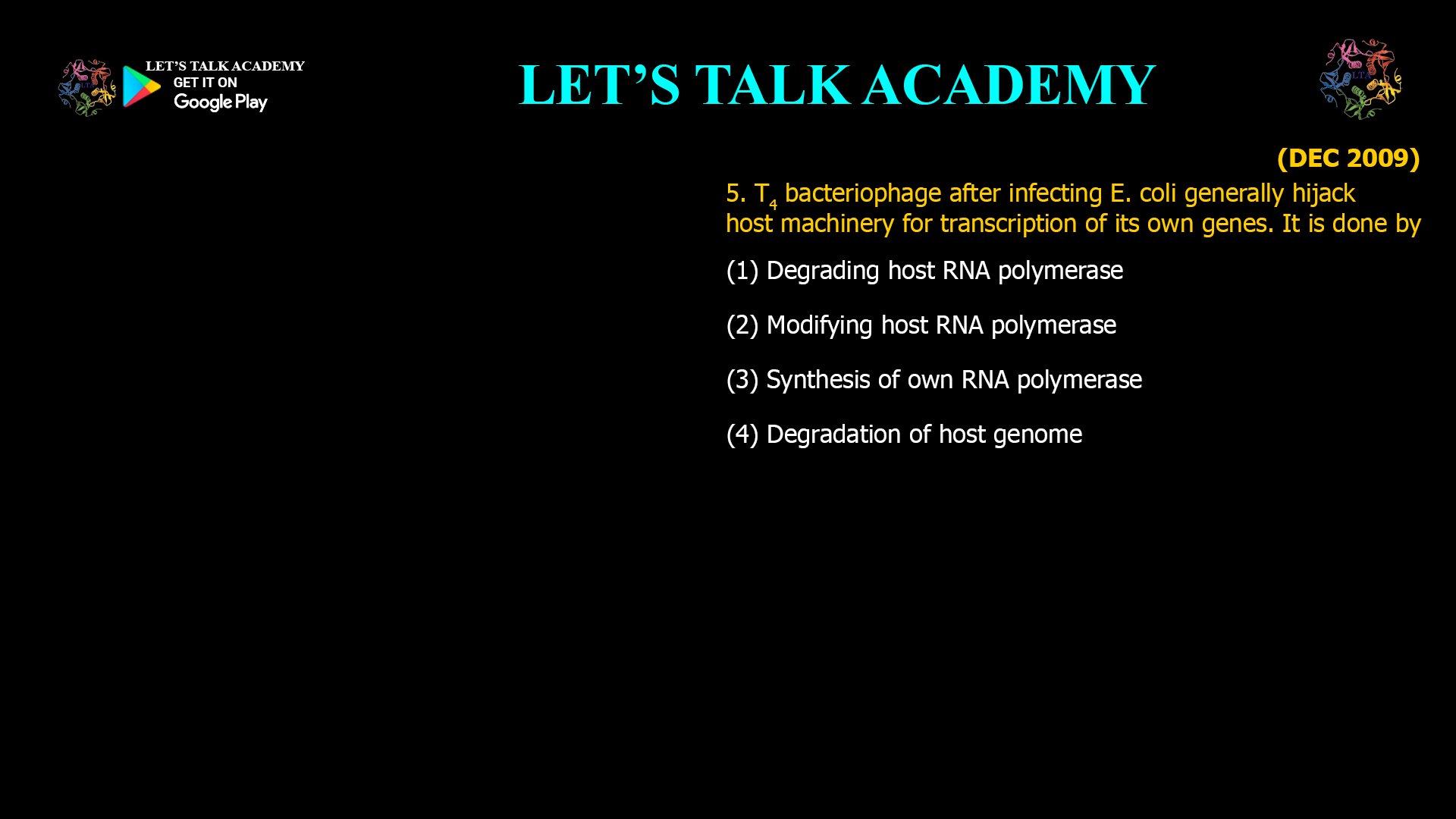
5. T4 bacteriophage after infecting E. coli generally hijack host machinery for transcription of its own genes. It is done by
(1) Degrading host RNA polymerase
(2) Modifying host RNA polymerase
(3) Synthesis of own RNA polymerase
(4) Degradation of host genome
The Mechanism: Modifying Host RNA Polymerase
The answer is that bacteriophage T4 modifies the host RNA polymerase to redirect it for transcription of viral genes146. This modification is a key tactic that allows T4 to hijack the host’s transcriptional machinery without needing to encode or bring its own RNA polymerase enzyme.
Why Not Degrade Host RNA Polymerase or Genome?
-
Degrading host RNA polymerase would be counterproductive since T4 relies on this enzyme to transcribe its genes.
-
Synthesizing its own RNA polymerase is not an option because T4 does not encode an RNA polymerase gene.
-
Degradation of the host genome does occur later in infection to suppress host functions and recycle nucleotides, but this is not the primary mechanism for hijacking transcription immediately after infection.
How Does T4 Modify Host RNA Polymerase?
Upon infection, T4 injects its DNA and certain proteins into the host cell. Among these is the Alt protein, which ADP-ribosylates the alpha subunits of the host RNA polymerase18. This chemical modification changes the enzyme’s properties, altering its promoter recognition and transcriptional specificity.
-
This modification enhances transcription from T4 early gene promoters.
-
It also inhibits transcription from many host promoters, effectively shutting down host gene expression.
-
Later, other phage-encoded factors such as AsiA and MotA further modify the host RNA polymerase to recognize middle and late viral promoters1.
Sequential Control of Viral Gene Expression
T4’s transcriptional program is tightly regulated in stages:
-
Early genes: Transcribed by the unmodified or initially modified host RNA polymerase recognizing early viral promoters.
-
Middle genes: Expression begins about one minute after infection, involving further modification of RNA polymerase by phage proteins AsiA and MotA, which remodel the sigma factor of the host enzyme to recognize middle gene promoters.
-
Late genes: Transcribed by a highly modified host RNA polymerase adapted to late promoters, ensuring production of structural proteins and assembly factors.
This stepwise modification of the host RNA polymerase allows T4 to precisely control the timing and order of gene expression necessary for efficient viral replication146.
Additional Effects on Host Transcription
Besides modifying RNA polymerase, T4 also causes rapid degradation of host mRNAs soon after infection, which helps clear the way for viral transcripts to dominate the cellular environment6. However, this mRNA degradation complements rather than replaces the central role of RNA polymerase modification.
Summary Table: How T4 Hijacks Host Transcription
| Mechanism | Description | Role in T4 Infection |
|---|---|---|
| Degrading host RNA polymerase | Not used; would prevent transcription of viral genes | Not applicable |
| Modifying host RNA polymerase | ADP-ribosylation and association with phage proteins alter host RNA polymerase specificity | Primary mechanism for viral gene transcription |
| Synthesizing own RNA polymerase | T4 does not encode its own RNA polymerase | Not applicable |
| Degradation of host genome | Occurs later to suppress host functions and recycle nucleotides | Secondary effect, not for transcription hijack |
Importance of This Strategy
By modifying the host RNA polymerase rather than replacing it, bacteriophage T4 efficiently exploits the host’s existing transcription machinery. This strategy allows:
-
Rapid initiation of viral gene expression immediately after infection.
-
Sequential and regulated expression of viral genes in early, middle, and late phases.
-
Suppression of host gene expression to prioritize viral replication.
Conclusion
Bacteriophage T4 hijacks the host transcription machinery primarily by modifying the host RNA polymerase through phage-encoded proteins and chemical modifications. This modification redirects the enzyme’s specificity towards viral promoters, enabling the efficient transcription of viral genes necessary for phage replication. This elegant molecular strategy exemplifies the intricate virus-host interactions that underpin bacteriophage infection cycles.
Understanding this process not only sheds light on viral gene regulation but also provides a foundation for biotechnological applications and antibacterial therapies leveraging phage biology.


