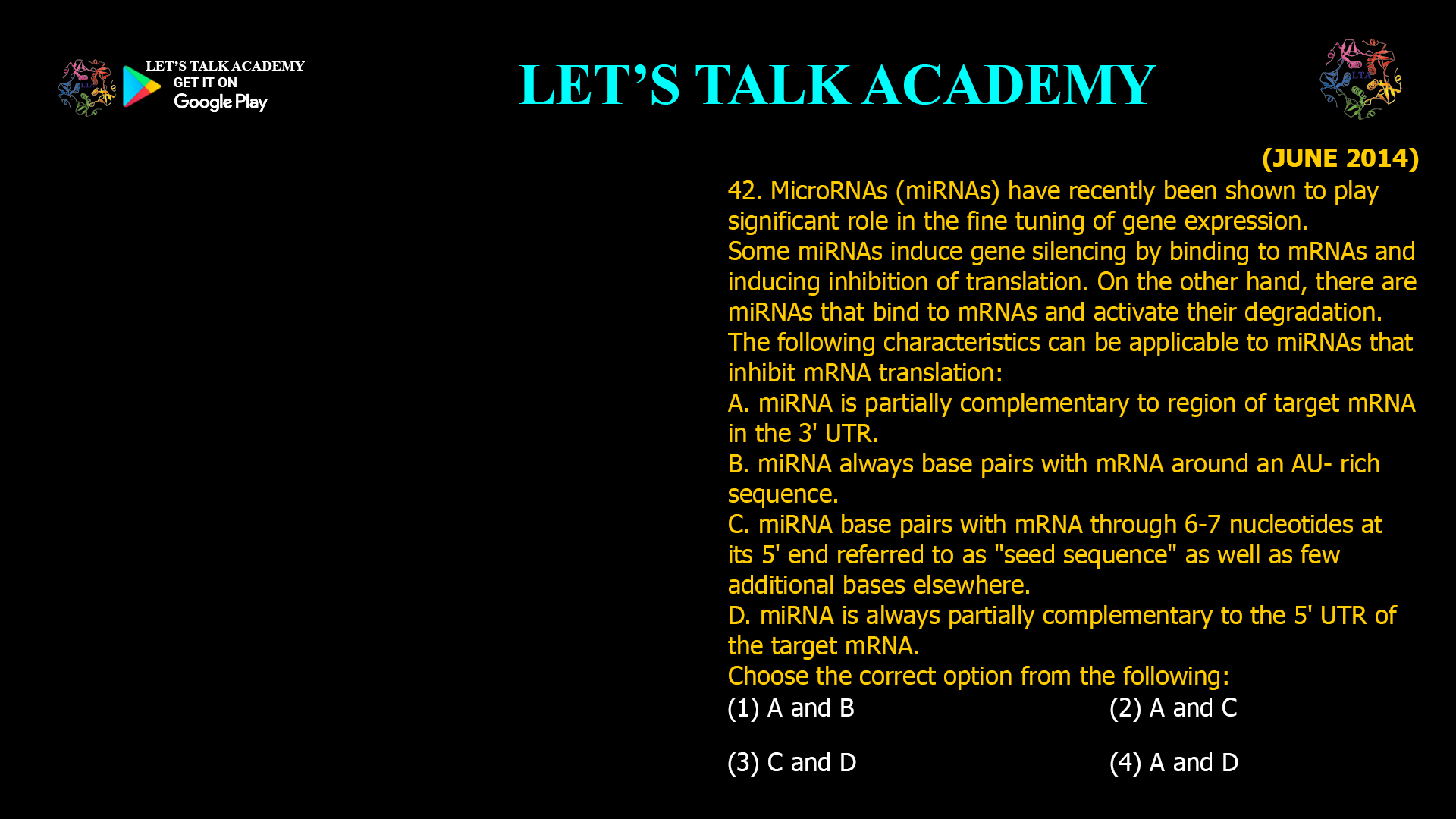
42. MicroRNAs (miRNAs) have recently been shown to play significant role in the fine tuning of gene expression. Some miRNAs induce gene silencing by binding to mRNAs and inducing inhibition of translation. On the other hand, there are miRNAs that bind to mRNAs and activate their degradation. The following characteristics can be applicable to miRNAs that inhibit mRNA translation:
A. miRNA is partially complementary to region of target mRNA in the 3′ UTR.
B. miRNA always base pairs with mRNA around an AU- rich sequence.
C. miRNA base pairs with mRNA through 6-7 nucleotides at its 5′ end referred to as “seed sequence” as well as few additional bases elsewhere.
D. miRNA is always partially complementary to the 5′ UTR of the target mRNA.
Choose the correct option from the following:
(1) A and B (2) A and C
(3) C and D (4) A and D
Introduction
MicroRNAs (miRNAs) are small non-coding RNAs that play a crucial role in post-transcriptional regulation of gene expression. They typically inhibit translation or induce degradation of target mRNAs by binding to specific regions, primarily in the 3′ untranslated region (3′ UTR). Understanding the characteristics of miRNAs that inhibit translation is essential for appreciating their regulatory complexity. This article focuses on the key features of such miRNAs, emphasizing the importance of the seed sequence and target site complementarity.
Characteristics of miRNAs That Inhibit mRNA Translation
A. Partial Complementarity to 3′ UTR of Target mRNA
miRNAs usually bind partially complementary sequences located in the 3′ UTR of target mRNAs. This imperfect base pairing is sufficient to recruit the miRNA-induced silencing complex (miRISC), which blocks translation without necessarily cleaving the mRNA.
B. Binding Around AU-Rich Sequences
While some regulatory elements in 3′ UTRs are AU-rich, miRNA binding is not always restricted to AU-rich sequences. The presence of AU-rich elements can influence mRNA stability but is not a universal requirement for miRNA binding.
C. The Seed Sequence: 6-7 Nucleotides at miRNA 5′ End
A defining feature of miRNA targeting is the “seed sequence”, typically nucleotides 2–7 or 2–8 at the 5′ end of the miRNA. This short sequence is critical for initial recognition and binding to the target mRNA. Additional base pairing outside the seed region can enhance binding stability and specificity.
D. Binding to 5′ UTR of Target mRNA
miRNAs do not generally bind to the 5′ UTR of target mRNAs to inhibit translation. The 3′ UTR is the predominant site of miRNA interaction in animals.
Evaluating the Statements
-
Statement A: True — miRNAs bind partially complementary sequences in the 3′ UTR.
-
Statement B: False — miRNA binding is not always centered on AU-rich sequences.
-
Statement C: True — the seed sequence at the 5′ end is essential for target recognition.
-
Statement D: False — miRNAs typically do not target the 5′ UTR.
Correct Option
The correct combination of true statements is:
(2) A and C
Conclusion
miRNAs that inhibit mRNA translation are characterized by partial complementarity to the 3′ UTR of target mRNAs and rely heavily on a critical seed sequence at their 5′ end for binding. Understanding these features is vital for deciphering miRNA-mediated gene regulation mechanisms.


