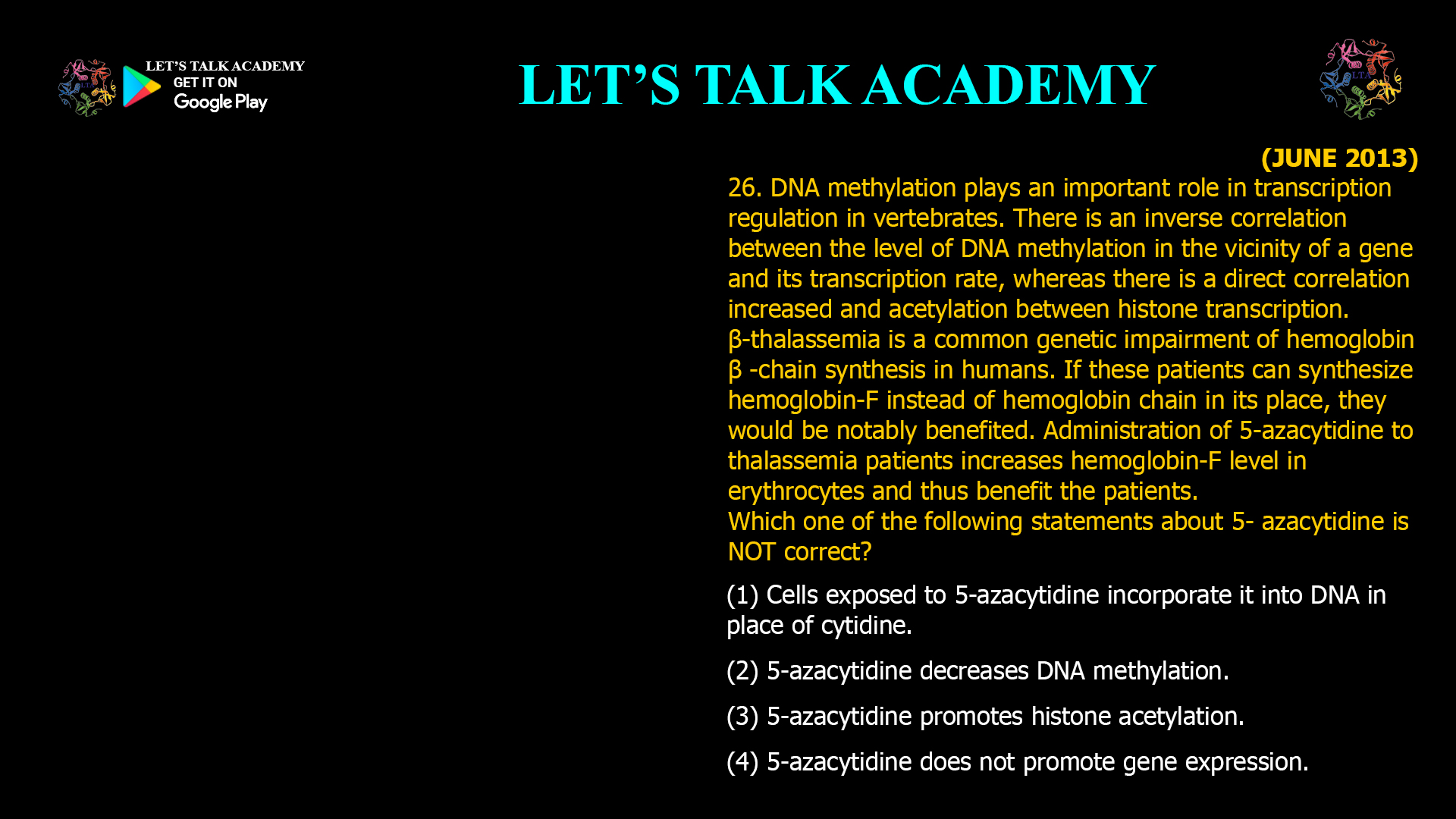
26. DNA methylation plays an important role in transcription regulation in vertebrates. There is an inverse correlation between the level of DNA methylation in the vicinity of a gene and its transcription rate, whereas there is a direct correlation increased and acetylation between histone transcription. β-thalassemia is a common genetic impairment of hemoglobin β -chain synthesis in humans. If these patients can synthesize hemoglobin-F instead of hemoglobin chain in its place, they would be notably benefited. Administration of 5-azacytidine to thalassemia patients increases hemoglobin-F level in erythrocytes and thus benefit the patients.
Which one of the following statements about 5- azacytidine is NOT correct?
(1) Cells exposed to 5-azacytidine incorporate it into DNA in place of cytidine.
(2) 5-azacytidine decreases DNA methylation.
(3) 5-azacytidine promotes histone acetylation.
(4) 5-azacytidine does not promote gene expression.
-
(1) Correct:
5-azacytidine is a cytidine analog that gets incorporated into DNA during replication, replacing cytidine158. -
(2) Correct:
Once incorporated, 5-azacytidine traps DNA methyltransferases (DNMTs), leading to their depletion and resulting in decreased DNA methylation (DNA hypomethylation)134678. -
(3) Partially correct but not primary:
While 5-azacytidine primarily acts as a DNA demethylating agent, it can indirectly promote histone acetylation by reactivating genes and altering chromatin structure. However, its main direct biochemical activity is DNA demethylation, not histone acetylation. Histone acetylation changes are generally secondary effects of DNA demethylation and gene reactivation2. -
(4) Incorrect:
5-azacytidine does promote gene expression by demethylating DNA and reactivating silenced genes, including fetal hemoglobin genes in β-thalassemia patients -
Final answer:
(4) 5-azacytidine does not promote gene expression.
Brief explanation:
5-azacytidine incorporates into DNA, inhibits DNA methylation by trapping DNMTs, and thereby reactivates silenced genes. This gene reactivation is the basis for its therapeutic effect in diseases like β-thalassemia and certain cancers. It may also indirectly promote histone acetylation, but its primary function is DNA demethylation and gene activation.
5-azacytidine is a cytidine analog that incorporates into DNA and inhibits DNA methyltransferases, leading to DNA hypomethylation. This results in the reactivation of silenced genes, including fetal hemoglobin genes in β-thalassemia patients. While it may indirectly promote histone acetylation, its primary role is to reduce DNA methylation and promote gene expression. Therefore, the statement that 5-azacytidine does not promote gene expression is incorrect.
Conclusion:
The statement that is NOT correct is:
(4) 5-azacytidine does not promote gene expression.


