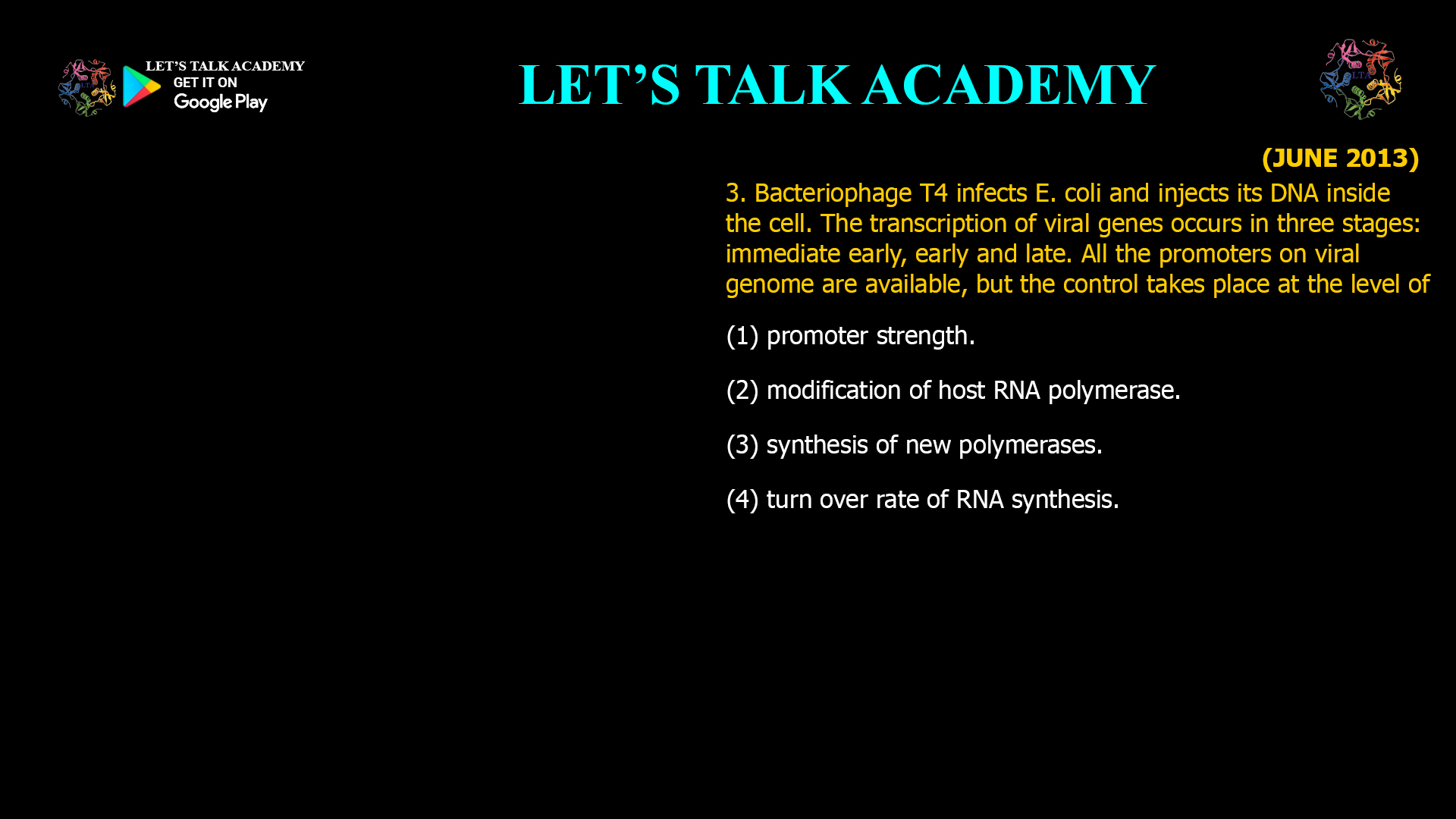
3. Bacteriophage T4 infects E. coli and injects its DNA inside the cell. The transcription of viral genes occurs in three stages: immediate early, early and late. All the promoters on viral genome are available, but the control takes place at the level of
(1) promoter strength.
(2) modification of host RNA polymerase.
(3) synthesis of new polymerases.
(4) turn over rate of RNA synthesis.
Bacteriophage T4 is a well-studied virus that infects Escherichia coli and orchestrates a tightly regulated program of viral gene expression. After injecting its DNA into the host cell, T4 must ensure that its genes are expressed in a specific temporal sequence—immediate early, early, middle, and late phases—to successfully replicate and assemble new viral particles.
Despite all viral promoters being present on the genome, the control of gene expression does not rely solely on promoter strength or DNA availability. Instead, the regulation occurs primarily at the level of modification of the host RNA polymerase (RNAP).
How Does T4 Control Gene Expression?
1. Host RNA Polymerase Initially Transcribes Early Genes
-
Upon infection, the host’s E. coli RNA polymerase recognizes and transcribes the viral early promoters.
-
Early gene products include proteins that modify the host RNAP and prepare the cell for viral takeover.
2. Modification of Host RNA Polymerase by Viral Proteins
-
T4 encodes proteins such as AsiA and MotA that bind to the host RNA polymerase, particularly interacting with the σ^70 subunit.
-
AsiA alters the conformation of σ^70, inhibiting transcription from bacterial and early viral promoters.
-
MotA, together with AsiA, redirects RNAP specificity toward middle promoters by binding specific DNA sequences (Mot boxes) upstream of these genes.
-
This modification effectively switches the host RNAP’s promoter recognition, enabling transcription of middle genes.
3. Activation of Late Gene Transcription
-
Late gene transcription requires additional phage-encoded factors such as gp55, gp33, and the sliding clamp gp45.
-
These proteins form a specialized transcription complex that recruits RNAP to late promoters.
-
This ensures that late genes, mostly encoding structural proteins and assembly factors, are expressed only after DNA replication.
Why Other Mechanisms Are Less Relevant
-
Promoter Strength:
While promoter sequences influence transcription efficiency, T4 promoters are all accessible. The primary regulatory mechanism is not promoter strength but RNAP modification. -
Synthesis of New Polymerases:
Unlike phages such as T3 and T7, which encode their own RNA polymerases, T4 relies on modifying the host RNAP rather than synthesizing a new phage-specific polymerase. -
Turnover Rate of RNA Synthesis:
Although RNA stability can affect gene expression, T4 regulation is mainly transcriptional via RNAP modification.
Summary Table of Control Mechanisms
| Option | Role in T4 Gene Expression Control | Correctness |
|---|---|---|
| (1) Promoter strength | Not the main regulatory mechanism | No |
| (2) Modification of host RNA polymerase | Central mechanism redirecting RNAP specificity | Yes |
| (3) Synthesis of new polymerases | Not applicable; T4 uses host RNAP with modifications | No |
| (4) Turnover rate of RNA synthesis | Secondary effect, not primary control | No |
Conclusion
In bacteriophage T4 infection, viral gene expression is intricately controlled by modification of the host RNA polymerase. This strategy allows the phage to sequentially express early, middle, and late genes by altering the specificity of the host transcription machinery. Viral proteins such as AsiA and MotA play essential roles in this process, ensuring efficient viral replication and assembly.
Correct Answer:
(2) Modification of RNA polymerase


1 Comment
Santosh Saini
November 3, 2025Modifications of RNA polymerase