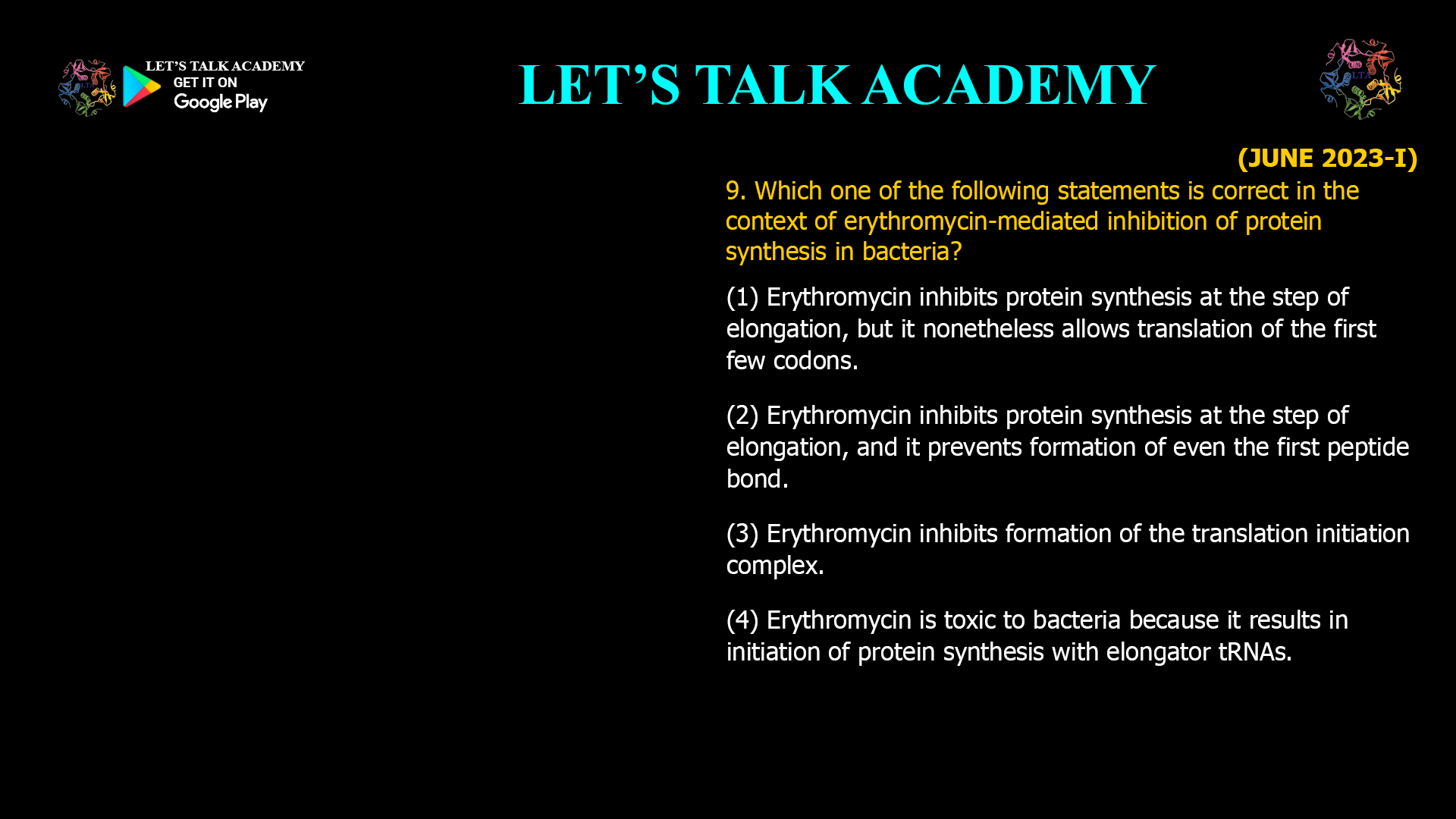
- Which one of the following statements is correct in the context of erythromycin-mediated inhibition of protein synthesis in bacteria?
(1) Erythromycin inhibits protein synthesis at the step of elongation, but it nonetheless allows translation of the first few codons.
(2) Erythromycin inhibits protein synthesis at the step of elongation, and it prevents formation of even the first peptide bond.
(3) Erythromycin inhibits formation of the translation initiation complex.
(4) Erythromycin is toxic to bacteria because it results in initiation of protein synthesis with elongatortRNAs.
Erythromycin is a macrolide antibiotic widely used to treat infections caused by Gram-positive bacteria and some Gram-negative species. Its antibacterial activity stems from its ability to inhibit protein synthesis, a critical process for bacterial growth and survival. However, the exact step at which erythromycin acts and how it affects the translation process is often misunderstood. This article clarifies erythromycin’s mechanism of action, focusing on its effect on bacterial translation elongation.
How Erythromycin Inhibits Protein Synthesis
Erythromycin binds specifically to the 23S rRNA of the 50S ribosomal subunit in bacteria. This binding site is located near the ribosomal exit tunnel, the channel through which the nascent polypeptide chain exits the ribosome during translation.
Unlike some antibiotics that block the initiation of translation or prevent the formation of the first peptide bond, erythromycin allows the ribosome to initiate protein synthesis and translate the first few codons. However, as the nascent peptide grows and attempts to pass through the exit tunnel, erythromycin physically obstructs its passage, causing the ribosome to stall during the elongation phase.
Key Points from Research
-
Translation Initiation Occurs Normally: The ribosome assembles on the mRNA, and translation begins without interference.
-
First Few Codons Are Translated: Erythromycin does not prevent the formation of the first peptide bond or the synthesis of the initial amino acids.
-
Elongation Is Stalled: The antibiotic blocks the translocation or passage of the nascent peptide through the exit tunnel, preventing further elongation.
-
Peptidyl-tRNA Dissociation: Erythromycin can stimulate the premature dissociation of peptidyl-tRNA from the ribosome, further inhibiting protein synthesis.
These findings are supported by molecular dynamics simulations and biochemical studies showing that erythromycin’s binding narrows the exit tunnel, causing steric clashes with certain nascent peptides and leading to ribosomal stalling.
Why Other Statements Are Incorrect
-
Preventing First Peptide Bond Formation: Erythromycin does not block the first peptide bond; this is characteristic of other antibiotics like chloramphenicol.
-
Inhibiting Initiation Complex Formation: Erythromycin does not inhibit the assembly of the translation initiation complex.
-
Toxicity Due to Initiation with Elongator tRNAs: This is not a recognized mechanism of erythromycin action.
Summary Table: Erythromycin’s Action on Translation
| Statement Description | Correctness | Explanation |
|---|---|---|
| Inhibits elongation but allows translation of first codons | Correct | Erythromycin stalls ribosome after initial elongation |
| Prevents formation of first peptide bond | Incorrect | First peptide bond forms normally |
| Inhibits formation of initiation complex | Incorrect | Initiation proceeds unaffected |
| Causes toxicity by initiating with elongator tRNAs | Incorrect | No evidence supports this mechanism |
Correct Answer
(1) Erythromycin inhibits protein synthesis at the step of elongation, but it nonetheless allows translation of the first few codons.
Conclusion
Erythromycin’s inhibition of bacterial protein synthesis is nuanced: it permits the initiation of translation and the synthesis of the first few amino acids but blocks elongation by obstructing the ribosomal exit tunnel. This mechanism effectively stalls bacterial growth by preventing the completion of essential proteins. Understanding this action is vital for appreciating erythromycin’s clinical use and for developing strategies to overcome bacterial resistance


10 Comments
Kirti Agarwal
November 1, 2025Statement 1 is correct
MOHIT AKHAND
November 3, 2025Done sir ✅
Sakshi yadav
November 3, 2025Erythromycin inhibits protein synthesis at the step of elongation, but it nonetheless allows translation of the first few codons.
Neha Yadav
November 3, 2025Erythromycin inhibits protein synthesis at the step of elongation, but it nonetheless allows translation of the first few codons.
Kajal
November 4, 2025Correct answer is (1) Erythromycin inhibits protein synthesis at the step of elongation, but it nonetheless allows translation of the first few codons.
Dharmpal swami
November 4, 2025Erythromycin=Inhibit elongation step
Peptide exit channel block
Deepika Sheoran
November 4, 2025Erythromycin stalls ribosome After initial elongation. Allow translocation of the first few codon.
Sonal Nagar
November 7, 2025Option 1st
Sakshi Kanwar
November 7, 2025Inhibits elongation but allows translation of first codons
Santosh Saini
November 9, 2025Erythromycin inhibits protein synthesis at the step of elongation, but it nonetheless allows translation of the first few codons