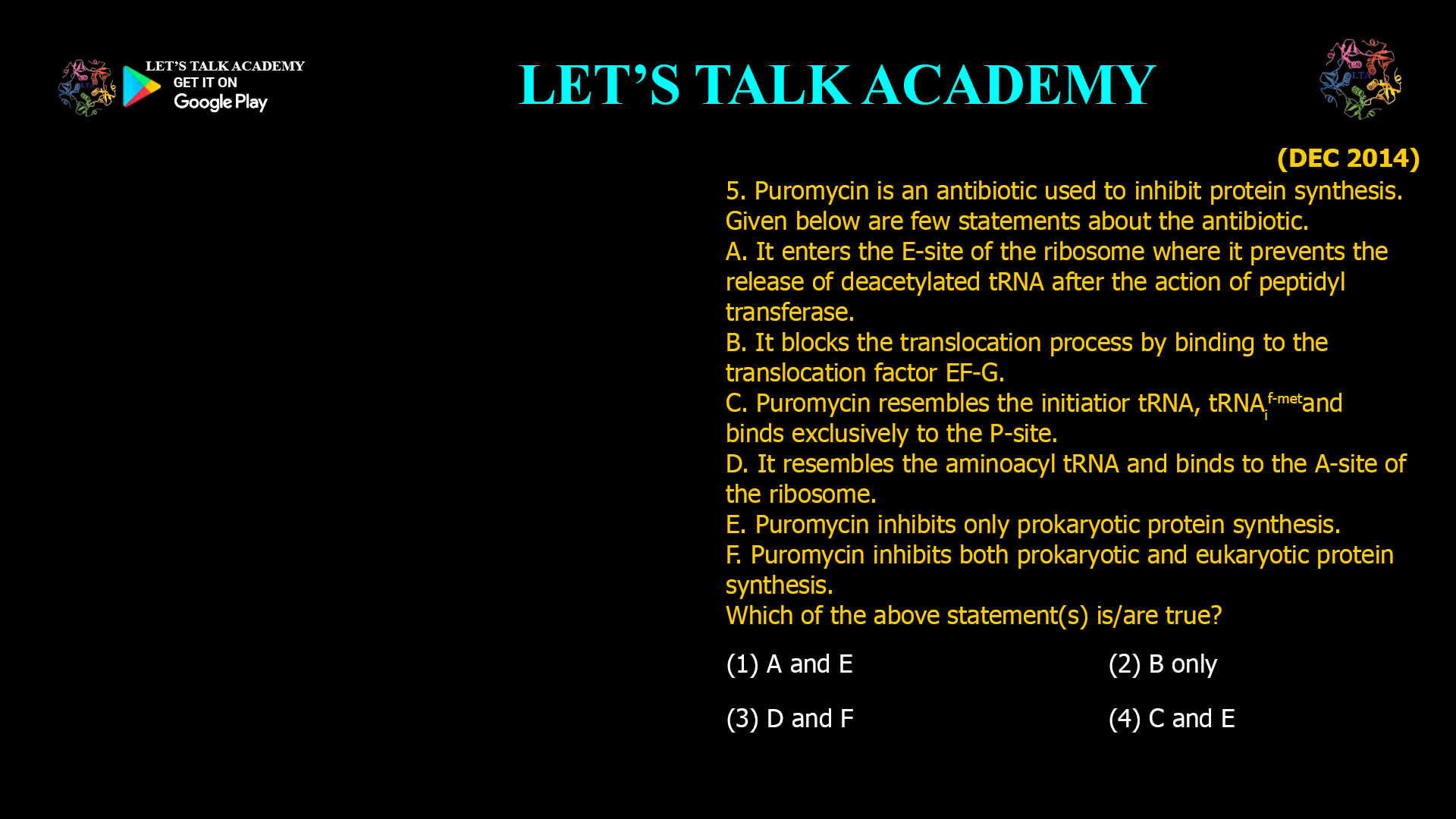
5. Puromycin is an antibiotic used to inhibit protein synthesis. Given below are few statements about the antibiotic.
A. It enters the E-site of the ribosome where it prevents the release of deacetylatedtRNA after the action of peptidyl transferase.
B. It blocks the translocation process by binding to the translocation factor EF-G.
C. Puromycin resembles the initiatiortRNA, tRNAif-metand binds exclusively to the P-site.
D. It resembles the aminoacyl tRNA and binds to the A-site of the ribosome.
E. Puromycin inhibits only prokaryotic protein synthesis.
F. Puromycin inhibits both prokaryotic and eukaryotic protein synthesis.
Which of the above statement(s) is/are true?
(1) A and E (2) B only
(3) D and F (4) C and E
..
Puromycin is a well-known antibiotic that has played a pivotal role in molecular biology and antibiotic research due to its unique ability to inhibit protein synthesis. Understanding how puromycin works at the molecular level is crucial for students, researchers, and professionals in life sciences. This article examines several statements about puromycin’s mechanism and clarifies which are accurate, based on current scientific knowledge.
Understanding Puromycin’s Mechanism of Action
Puromycin is an aminonucleoside antibiotic derived from Streptomyces alboniger. Its structure closely mimics the 3’ end of aminoacyl-tRNA, allowing it to interact directly with the ribosomal A site during translation. When puromycin enters the A site, it accepts the growing polypeptide chain from the P-site tRNA. However, unlike normal tRNA, the resulting peptidyl-puromycin cannot participate in further elongation, leading to the premature release of the incomplete polypeptide and halting protein synthesis1245.
Puromycin’s action is not limited to prokaryotes; it inhibits protein synthesis in both prokaryotic and eukaryotic cells because the A site of the ribosome is conserved across these domains24.
Evaluating the Statements About Puromycin
Let’s analyze the provided statements:
-
A. It enters the E-site of the ribosome where it prevents the release of deacetylated tRNA after the action of peptidyl transferase.
False. Puromycin does not interact with the E-site. Its action is specific to the A site, where it mimics aminoacyl-tRNA1245. -
B. It blocks the translocation process by binding to the translocation factor EF-G.
False. Puromycin does not target EF-G or the translocation process. Instead, it causes premature termination by accepting the peptide chain in the A site1245. -
C. Puromycin resembles the initiator tRNA, tRNAif-met, and binds exclusively to the P-site.
False. Puromycin does not resemble initiator tRNA nor does it bind to the P-site. It mimics aminoacyl-tRNA and binds to the A site1245. -
D. It resembles the aminoacyl tRNA and binds to the A-site of the ribosome.
True. This is the core of puromycin’s mechanism. Its structural similarity to aminoacyl-tRNA allows it to bind the A site, accept the nascent peptide, and cause premature chain termination1245. -
E. Puromycin inhibits only prokaryotic protein synthesis.
False. Puromycin inhibits protein synthesis in both prokaryotic and eukaryotic cells24. -
F. Puromycin inhibits both prokaryotic and eukaryotic protein synthesis.
True. Because the ribosomal A site is conserved, puromycin acts on both types of cells24.
Summary Table: Puromycin Statements
| Statement | True/False | Explanation |
|---|---|---|
| A | False | Does not interact with E-site |
| B | False | Does not target EF-G or translocation |
| C | False | Does not resemble initiator tRNA or bind P-site |
| D | True | Mimics aminoacyl-tRNA and binds A-site |
| E | False | Not limited to prokaryotes |
| F | True | Inhibits both prokaryotic and eukaryotic protein synthesis |
Correct Answer
(3) D and F
Why This Matters
The ability of puromycin to inhibit translation in both prokaryotes and eukaryotes makes it a versatile tool in research, especially for studying protein synthesis and ribosome function. Its unique mechanism—binding to the A site and causing premature chain release—has also made it valuable in techniques like mRNA display and ribosome profiling.
Conclusion
Puromycin is a powerful inhibitor of protein synthesis, acting by mimicking aminoacyl-tRNA and binding to the ribosomal A site. It causes premature termination of translation in both prokaryotic and eukaryotic cells. Among the statements provided, only statements D and F are true. Understanding these details is essential for anyone working in molecular biology, genetics, or antibiotic research.


6 Comments
Sakshi yadav
November 3, 2025D and F correct answer
Sakshi Kanwar
November 3, 2025It is structurally similar to t rna binds at A site
And it cause inhibition in both prokaryotes and eukaryotes
Santosh Saini
November 3, 2025Statement D and F will be correct. D→it recembles the amino acyl t-RNA and binds to the A site of the ribosome , F→puromycin inhibit both prokaryotic and eukaryotic protein synthesis
Sonal Nagar
November 4, 2025Option 3rd
Muskan Yadav
November 7, 20253) D and F are the correct statement.
Divya rani
November 8, 2025D and F are correct statements about Puromycin act both in prokaryotes as well as eukaryotes and it bind with aminocyle tRNA and bind at A site of the ribosome.