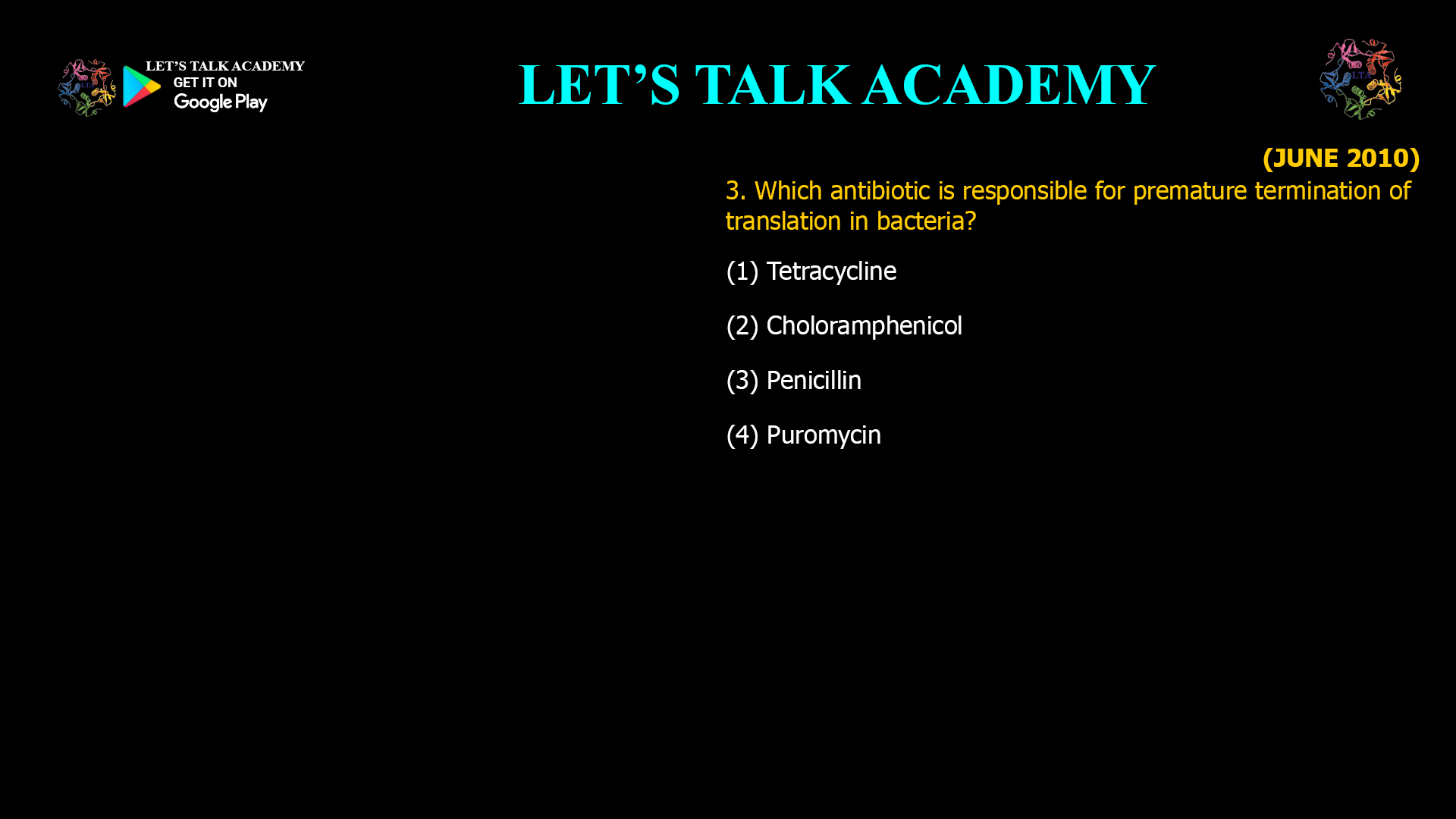
3. Which antibiotic is responsible for premature termination of translation in bacteria?
(1) Tetracycline (2) Choloramphenicol
(3) Penicillin
(4) Puromycin
Translation is a fundamental biological process in all living cells, responsible for synthesizing proteins from mRNA templates. In bacteria, this process is a prime target for antibiotics, as disrupting protein synthesis can halt bacterial growth and survival. Among the various antibiotics that interfere with translation, some act at the initiation or elongation phase, while others can cause the premature termination of translation. Understanding which antibiotic has this unique effect is crucial for both clinical applications and molecular biology research.
Overview of Translation in Bacteria
Translation in bacteria occurs on 70S ribosomes and involves three main stages:
-
Initiation: Assembly of the ribosome on the mRNA with the initiator tRNA.
-
Elongation: Sequential addition of amino acids to the growing polypeptide chain.
-
Termination: Release of the completed polypeptide when a stop codon is encountered.
Antibiotics can target any of these stages, but only a select few can cause premature chain termination.
Antibiotics in Question
Let’s examine the four antibiotics listed and their effects on bacterial translation:
1. Tetracycline
-
Mechanism: Binds to the 30S ribosomal subunit and blocks the attachment of aminoacyl-tRNA to the A site.
-
Effect: Inhibits elongation but does not cause premature termination.
2. Chloramphenicol
-
Mechanism: Binds to the 50S ribosomal subunit and inhibits peptidyl transferase activity.
-
Effect: Blocks peptide bond formation, halting elongation, but does not directly cause premature chain termination.
3. Penicillin
-
Mechanism: Inhibits cell wall synthesis by targeting peptidoglycan cross-linking enzymes.
-
Effect: Does not interfere with protein synthesis or translation.
4. Puromycin
-
Mechanism: Puromycin is a structural analog of aminoacyl-tRNA. It enters the A site of the ribosome and becomes incorporated into the growing polypeptide chain. However, because it cannot form further peptide bonds, it causes the release of an incomplete (prematurely terminated) polypeptide.
-
Effect: Directly causes premature termination of translation in bacteria by mimicking the 3′ end of aminoacyl-tRNA and leading to the release of incomplete proteins3.
How Puromycin Causes Premature Termination
Puromycin’s unique structure allows it to bind to the ribosomal A site, where it accepts the growing polypeptide chain from the P site tRNA. However, once the chain is transferred to puromycin, the ribosome cannot continue elongation, resulting in the release of a truncated, nonfunctional polypeptide. This disrupts protein synthesis and leads to bacterial cell death.
Why This Matters
The ability of puromycin to induce premature termination of translation is not only significant for its antibacterial properties but also makes it a valuable tool in molecular biology. Researchers use puromycin to study protein synthesis, ribosome function, and translation regulation in both prokaryotic and eukaryotic systems.
Summary Table: Antibiotics and Their Effects on Bacterial Translation
| Antibiotic | Main Target/Action | Causes Premature Termination? |
|---|---|---|
| Tetracycline | Blocks aminoacyl-tRNA binding to A site | No |
| Chloramphenicol | Inhibits peptidyl transferase | No |
| Penicillin | Inhibits cell wall synthesis | No |
| Puromycin | Mimics aminoacyl-tRNA, causes early release | Yes |
Correct Answer
(4) Puromycin
Puromycin is the antibiotic responsible for premature termination of translation in bacteria by mimicking aminoacyl-tRNA and causing the release of incomplete polypeptides


6 Comments
Sakshi yadav
November 3, 2025Puromycin antibiotic is responsible for premature termination of translation in bacteria
Sakshi Kanwar
November 3, 2025Puromycin is very structurally similar to t rna binds to A site of ribosome and form peptide bond and cause termination having puromycin as a tail of polypeptide chain
Santosh Saini
November 3, 2025Puromycin is the antibiotic responsible for premature termination of translation by mimics aminoacyl t-RNA, causes early release of polypeptide chain
Sonal Nagar
November 4, 2025Option 4th
Muskan Yadav
November 7, 2025Puromycin is the antibiotic responsible for premature termination of translation in bacteria by mimics aminoacyl-tRNA and causing the release of incomplete polypeptides.
Divya rani
November 8, 2025Puromycin antibiotic ia responsible for the premature termination of translation in prokaryotes.