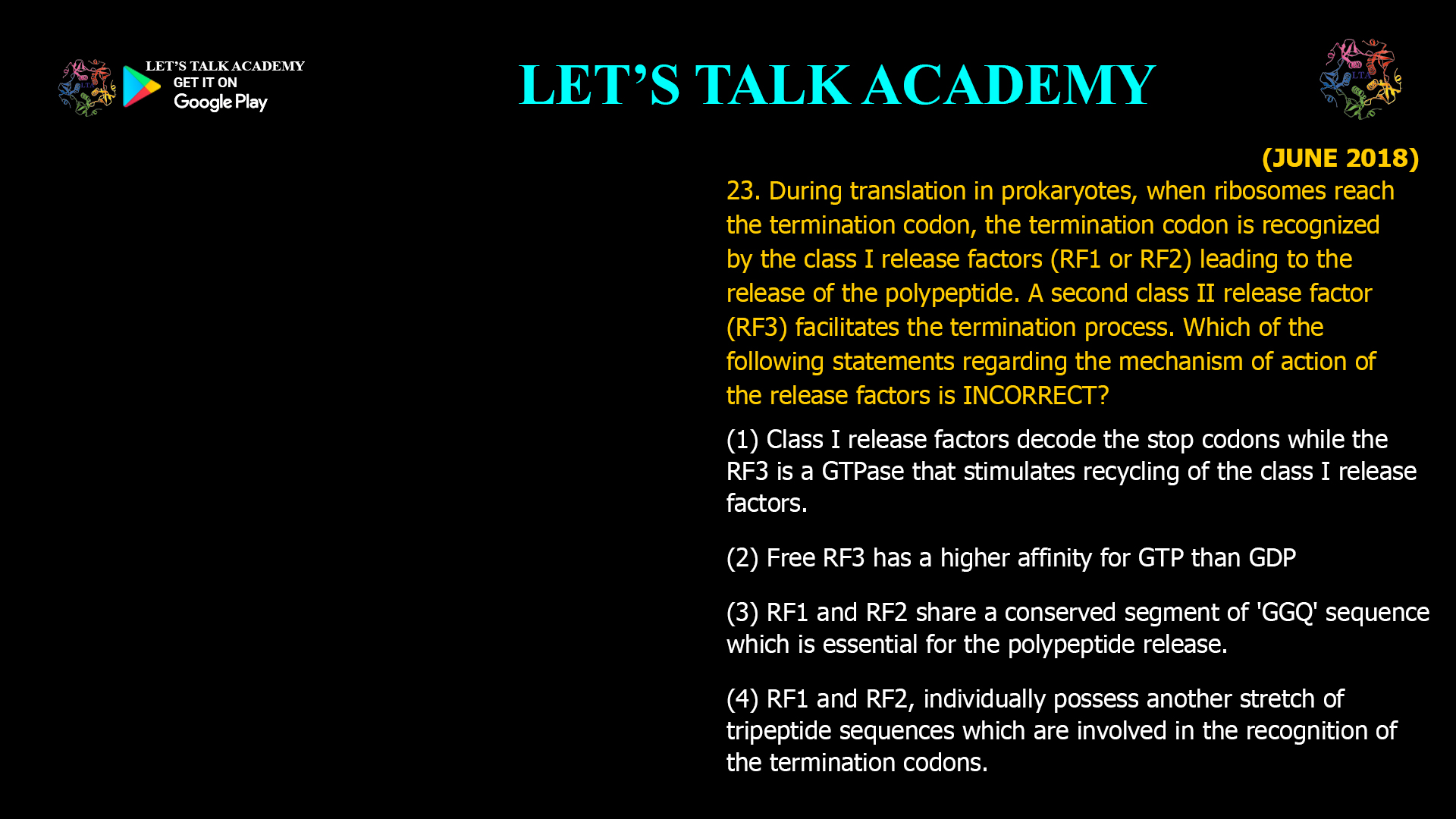
- During translation in prokaryotes, when ribosomes reach the termination codon, the termination codon is recognized by the class I release factors (RF1 or RF2) leading to the release of the polypeptide. A second class II release factor (RF3) facilitates the termination process. Which of the following statements regarding the mechanism of action of the release factors is INCORRECT?
(1) Class I release factors decode the stop codons while the RF3 is a GTPase that stimulates recycling of the class I release factors.
(2) Free RF3 has a higher affinity forGTP than GDP
(3) RF1 and RF2 share a conserved segment of ‘GGQ’ sequence which is essential for the polypeptide release.
(4) RF1 and RF2, individually possess another stretch of tripeptide sequences which are involved in the recognition of the termination codons.
Introduction to Translation Termination in Prokaryotes
Translation is the process by which ribosomes synthesize proteins using messenger RNA (mRNA) as a template. In prokaryotes, translation termination occurs when the ribosome encounters a stop codon (UAA, UAG, or UGA) in the mRNA. Unlike sense codons, stop codons are not recognized by transfer RNAs (tRNAs) but by specialized proteins called release factors. The termination process involves two main classes of release factors: class I (RF1 and RF2) and class II (RF3). These factors ensure the accurate and efficient release of the newly synthesized polypeptide and the recycling of the ribosomal machinery156.
Mechanism of Action of Release Factors
Class I Release Factors: RF1 and RF2
Class I release factors are responsible for recognizing stop codons and catalyzing the release of the polypeptide chain from the ribosome:
-
RF1: Recognizes the stop codons UAA and UAG.
-
RF2: Recognizes the stop codons UAA and UGA.
Both RF1 and RF2 bind to the A site of the ribosome when a stop codon is present. They mimic the structure of a tRNA, allowing them to interact with the stop codon and the ribosome. The presence of a highly conserved “GGQ” motif in both RF1 and RF2 is essential for the hydrolysis of the ester bond linking the polypeptide to the tRNA, resulting in the release of the nascent protein563.
Class II Release Factor: RF3
RF3 is a GTPase and belongs to the class II release factors. Its main function is to facilitate the recycling of class I release factors after polypeptide release:
-
RF3 binds to the ribosome after the class I release factor has performed its function.
-
GTP hydrolysis by RF3 promotes the dissociation of the class I release factor from the ribosome, allowing the ribosomal subunits to be recycled for another round of translation56.
-
RF3 does not directly recognize stop codons or catalyze polypeptide release itself.
The GGQ Motif and Stop Codon Recognition
The GGQ motif (glycine-glycine-glutamine) is a universally conserved sequence in class I release factors. This motif is critical for the catalytic activity that leads to the hydrolysis of the peptidyl-tRNA bond and the release of the polypeptide chain56. Mutations in the GGQ motif impair the release function, highlighting its importance in translation termination.
In addition to the GGQ motif, RF1 and RF2 contain specific tripeptide sequences that are involved in the recognition of the termination codons. These sequences allow the release factors to distinguish between the different stop codons and ensure accurate termination35.
The Role of GTP in Release Factor Function
RF3 is a GTPase, meaning it binds and hydrolyzes GTP. The binding of GTP to RF3 increases its affinity for the ribosome and is required for its function in releasing class I release factors. After GTP hydrolysis, RF3 dissociates from the ribosome, allowing the ribosome to be recycled56.
It is important to note that free RF3 has a higher affinity for GDP than GTP. This is a common feature of GTPases, where the GDP-bound form is stable in the absence of the ribosome, and the ribosome stimulates the exchange of GDP for GTP6. This mechanism ensures that RF3 is active only when needed at the termination complex.
Evaluating the Statements
Let’s analyze each statement regarding the mechanism of action of release factors:
-
Class I release factors decode the stop codons while the RF3 is a GTPase that stimulates recycling of the class I release factors.
-
Free RF3 has a higher affinity for GTP than GDP
-
Incorrect. Free RF3 actually has a higher affinity for GDP than GTP. The ribosome stimulates the exchange of GDP for GTP, but in the free state, RF3 is predominantly GDP-bound6.
-
-
RF1 and RF2 share a conserved segment of ‘GGQ’ sequence which is essential for the polypeptide release.
-
RF1 and RF2, individually possess another stretch of tripeptide sequences which are involved in the recognition of the termination codons.
Key Concepts and Keywords
-
Translation termination: The process by which protein synthesis is stopped at a stop codon.
-
Prokaryotes: Organisms such as bacteria that lack a nucleus.
-
Ribosome: The molecular machine that synthesizes proteins.
-
Stop codon: UAA, UAG, or UGA; signals the end of translation.
-
Release factors: Proteins that recognize stop codons and mediate polypeptide release.
-
Class I release factors: RF1 and RF2; recognize stop codons and catalyze polypeptide release.
-
Class II release factor: RF3; a GTPase that recycles class I release factors.
-
GGQ motif: A conserved sequence essential for the catalytic activity of class I release factors.
-
GTPase: An enzyme that hydrolyzes GTP to GDP.
-
Polypeptide release: The detachment of the newly synthesized protein from the ribosome.
-
Ribosome recycling: The process by which ribosomal subunits are separated and made available for new rounds of translation.
-
Stop codon recognition: The ability of release factors to distinguish between different stop codons.
Detailed Mechanism of Translation Termination
Step-by-Step Process
-
Ribosome encounters a stop codon: The ribosome moves along the mRNA until it reaches a stop codon (UAA, UAG, or UGA) in the A site.
-
Class I release factor binds: RF1 or RF2 recognizes the stop codon and binds to the A site of the ribosome.
-
Polypeptide release: The GGQ motif of the release factor catalyzes the hydrolysis of the peptidyl-tRNA bond, releasing the polypeptide chain.
-
Class II release factor binds: RF3, a GTPase, binds to the ribosome and facilitates the release of the class I release factor.
-
Ribosome recycling: The ribosomal subunits dissociate and are recycled for another round of translation561.
Importance of the GGQ Motif
The GGQ motif is critical for the catalytic activity of class I release factors. It positions a glutamine residue in the active site of the ribosome, allowing it to participate in the hydrolysis of the peptidyl-tRNA bond. Mutations in this motif impair the release function, leading to incomplete or stalled translation termination56.
Role of RF3 in Termination
RF3 is essential for the efficient recycling of class I release factors. By promoting their dissociation from the ribosome, RF3 ensures that the ribosome is ready for the next round of translation. The GTPase activity of RF3 is regulated by the ribosome, which stimulates the exchange of GDP for GTP and the subsequent hydrolysis of GTP6.
Conclusion
Translation termination in prokaryotes is a highly regulated process that ensures the accurate release of newly synthesized polypeptides and the recycling of the ribosomal machinery. Class I release factors (RF1 and RF2) recognize stop codons and catalyze polypeptide release, while the class II release factor (RF3) is a GTPase that facilitates the recycling of class I release factors. The GGQ motif is essential for the catalytic activity of class I release factors, and specific tripeptide sequences are involved in stop codon recognition. Importantly, free RF3 has a higher affinity for GDP than GTP, not the other way around.
Correct Answer:
Statement (2) is incorrect: Free RF3 does not have a higher affinity for GTP than GDP; it has a higher affinity for GDP than GTP. -


5 Comments
Suman bhakar
June 12, 2025Done sir 👍
Arushi
June 12, 2025👍✅
Kirti Agarwal
November 3, 2025Statement two is incorrect
Swati
November 3, 20252nd is incorrect only
Santosh Saini
November 8, 2025Statement 2nd is incorrect because free RF3 does not have a higher affinity for GTP than GDP, it has a higher affinity for GDP than GTP