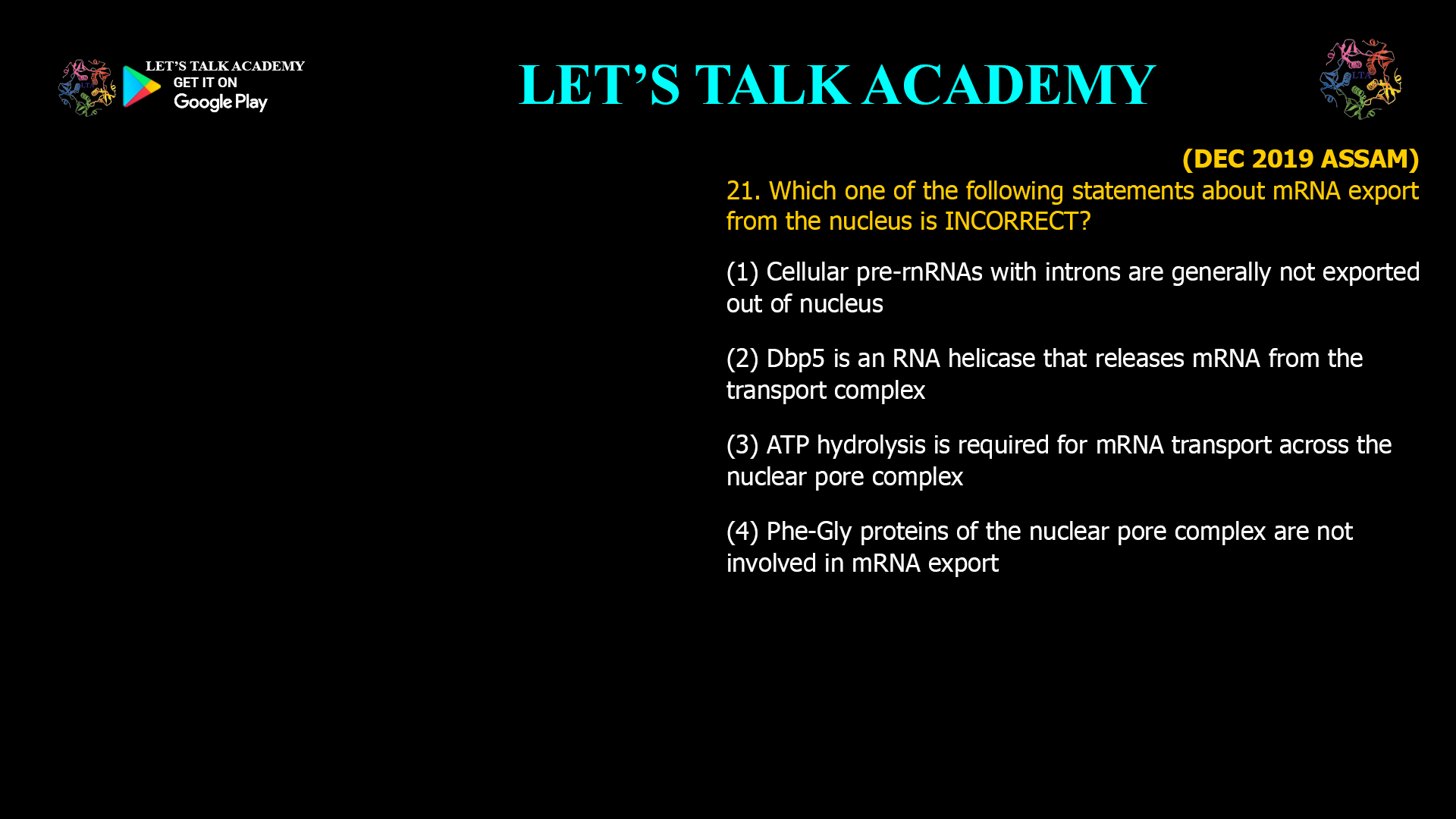
21. Which one of the following statements about mRNA export from the nucleus is INCORRECT?
(1) Cellular pre-rnRNAs with introns are generally not exported out of nucleus
(2) Dbp5 is an RNA helicase that releases mRNA from the transport complex
(3) ATP hydrolysis is required for mRNA transport across the nuclear pore complex
(4) Phe-Gly proteins of the nuclear pore complex are not involved in mRNA export
The incorrect statement is (4): “Phe-Gly proteins of the nuclear pore complex are not involved in mRNA export.”
Explanation:
1. Cellular pre-rRNAs with introns are generally not exported out of the nucleus
This is correct. Pre-rRNAs and pre-mRNAs containing introns are typically retained in the nucleus until proper processing, including splicing, is completed. Only fully processed, export-competent mRNAs are transported to the cytoplasm.
2. Dbp5 is an RNA helicase that releases mRNA from the transport complex
This is correct. Dbp5 is a DEAD-box ATPase (RNA helicase) localized at the cytoplasmic side of the nuclear pore complex (NPC). It facilitates the remodeling and release of mRNA-protein complexes (mRNPs) from the NPC into the cytoplasm by displacing export factors such as Mex67/NXF.
3. ATP hydrolysis is required for mRNA transport across the nuclear pore complex
This is correct. The directionality and remodeling of mRNPs during export depend on ATP hydrolysis by DEAD-box ATPases like Sub2/UAP56 in the nucleus and Dbp5/DDX19 at the cytoplasmic face of the NPC. These ATP-dependent steps are essential for the assembly, translocation, and disassembly of the mRNA export complex.
4. Phe-Gly proteins of the nuclear pore complex are not involved in mRNA export
This is incorrect. The nuclear pore complex contains nucleoporins rich in phenylalanine-glycine (FG) repeats, known as FG-nucleoporins or FG-nups. These FG domains form a selective barrier and interact directly with the mRNA export receptors (e.g., Mex67/NXF1) to facilitate mRNP translocation through the NPC channel. Thus, FG-nups are critical for mRNA export.
Summary Table
| Statement | Correctness | Explanation |
|---|---|---|
| Cellular pre-rRNAs with introns are generally not exported out of nucleus | Correct | Introns must be spliced before export; unspliced RNAs are retained in the nucleus. |
| Dbp5 is an RNA helicase that releases mRNA from the transport complex | Correct | Dbp5 remodels mRNPs at the cytoplasmic NPC side, releasing mRNA into cytoplasm. |
| ATP hydrolysis is required for mRNA transport across the NPC | Correct | ATP-dependent DEAD-box helicases drive mRNP remodeling and directionality of export. |
| Phe-Gly proteins of the NPC are not involved in mRNA export | Incorrect | FG-nucleoporins are essential for mRNP translocation through the NPC channel. |
Conclusion
The incorrect statement about mRNA export from the nucleus is that Phe-Gly proteins of the nuclear pore complex are not involved in mRNA export. In reality, these FG-nucleoporins play a crucial role in facilitating the transport of mRNA across the nuclear pore complex by interacting with export receptors and guiding mRNPs through the NPC channel.
This understanding highlights the intricate coordination of RNA processing, transport receptor function, ATP-driven remodeling, and nucleoporin interactions that ensure efficient and selective mRNA export from the nucleus to the cytoplasm, a fundamental step in eukaryotic gene expression.


7 Comments
Suman bhakar
June 4, 2025✅✅
Lokesh Kumawat
June 8, 2025Done
Santosh Saini
November 3, 2025Incorrect statement is “phe-Gly proteins of the nuclear pore complex are not involved in mRNA export
Manisha choudhary
November 4, 2025Nuclear pore complex Phenyl alanine and glycine rich hota h jo m RNA k export m help krta h
Dd5(death box ATPase RNA helicase hota h jo m RNA k export m involve hota h
Pooja
November 4, 2025Phe-Gly proteins of the nuclear pore complex are not involved in mRNA export
Heena Mahlawat
November 5, 2025Option 4
Sakshi Kanwar
November 8, 2025Phe-Gly proteins of the NPC are involved in mRNA export hence 4th is incorrect