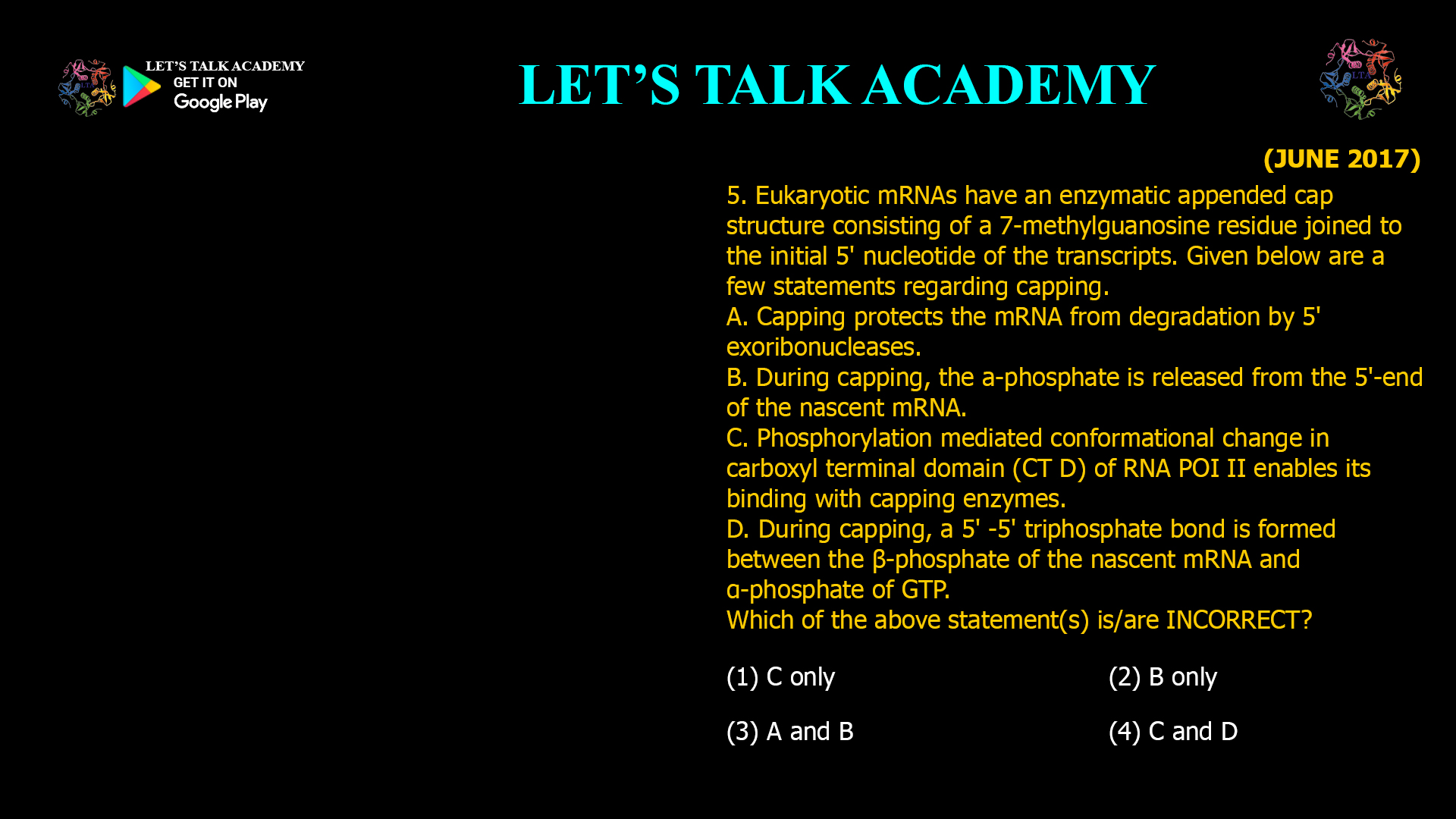
5. Eukaryotic mRNAs have an enzymatic appended cap structure consisting of a 7-methylguanosine residue joined to the initial 5′ nucleotide of the transcripts. Given below are a few statements regarding capping.
A. Capping protects the mRNA from degradation by 5′ exoribonucleases.
B. During capping, the a-phosphate is released from the 5′-end of the nascent mRNA.
C. Phosphorylation mediated conformational change in carboxyl terminal domain (CTD) of RNA POI II enables its binding with capping enzymes.
D. During capping, a 5′ -5′ triphosphate bond is formed between the β-phosphate of the nascent mRNA and α-phosphate of GTP.
Which of the above statement(s) is/are INCORRECT?
(1) C only (2) B only
(3) A and B (4) C and D
Correct Answer:
(2) B only
Detailed Explanation:
-
Statement A:
Correct. The 5′ cap protects mRNA from degradation by 5′ exonucleases by creating a unique 5′–5′ triphosphate linkage that blocks exonuclease access. -
Statement B:
Incorrect. During capping, the γ-phosphate (the outermost phosphate) is removed from the 5′ end of the nascent mRNA by an RNA triphosphatase. The α-phosphate remains attached to the mRNA. The guanylyltransferase then adds GMP to the diphosphate 5′ end, forming the 5′–5′ triphosphate linkage. Thus, the α-phosphate is not released. -
Statement C:
Correct. The phosphorylation of the CTD of RNA polymerase II, especially on serine residues, induces conformational changes that enable recruitment and binding of capping enzymes to the transcription complex, facilitating co-transcriptional capping47. -
Statement D:
Correct. The 5′ cap is formed by a 5′–5′ triphosphate bond between the β-phosphate of the nascent mRNA diphosphate end and the α-phosphate of GTP, catalyzed by guanylyltransferase.
Summary Table
| Statement | Description | Correct/Incorrect | Explanation |
|---|---|---|---|
| A | Capping protects mRNA from 5′ exonucleases | Correct | Cap blocks 5′ exonucleases, stabilizing mRNA. |
| B | α-phosphate is released from 5′ end during capping | Incorrect | γ-phosphate is removed; α-phosphate remains attached. |
| C | CTD phosphorylation enables binding of capping enzymes | Correct | Phosphorylated CTD recruits capping enzymes co-transcriptionally. |
| D | 5′–5′ triphosphate bond formed between β-phosphate of mRNA and α-phosphate of GTP | Correct | This unique linkage forms the cap structure. |
Conclusion
The only incorrect statement is B. During mRNA capping, the γ-phosphate at the 5′ end of the nascent RNA is removed, not the α-phosphate. The α-phosphate remains part of the RNA backbone and participates in forming the 5′–5′ triphosphate linkage with GTP.


8 Comments
Suman bhakar
June 4, 2025Done sir ✅
Prami Masih
June 4, 2025Very nice explanation sir ji
Divya rani
November 4, 2025Only B statement is wrong because the gamma phosphate pf 5′ end of nascent mRNA is released not alpha phosphate.
Manisha choudhary
November 4, 2025During capping 5′(alpha phosphate of G) -5′(beta phosphate m RNA ) bond formation hota h
Option B is incorrect
Gama phosphate of nascent m RNA relase hota h
Roopal Sharma
November 4, 2025B option is wrong gama phosphate of 5′ end of nascent mrna is released not alpha p.
Heena Mahlawat
November 4, 2025Only gamma phosphate is released not alpha phosphate f
Priti khandal
November 7, 2025Only B statement is wrong
Sakshi Kanwar
November 8, 2025During capping, the gamma -phosphate is released from the 5′-end of the nascent mRNA not aplha phosphate so option B is incorrect