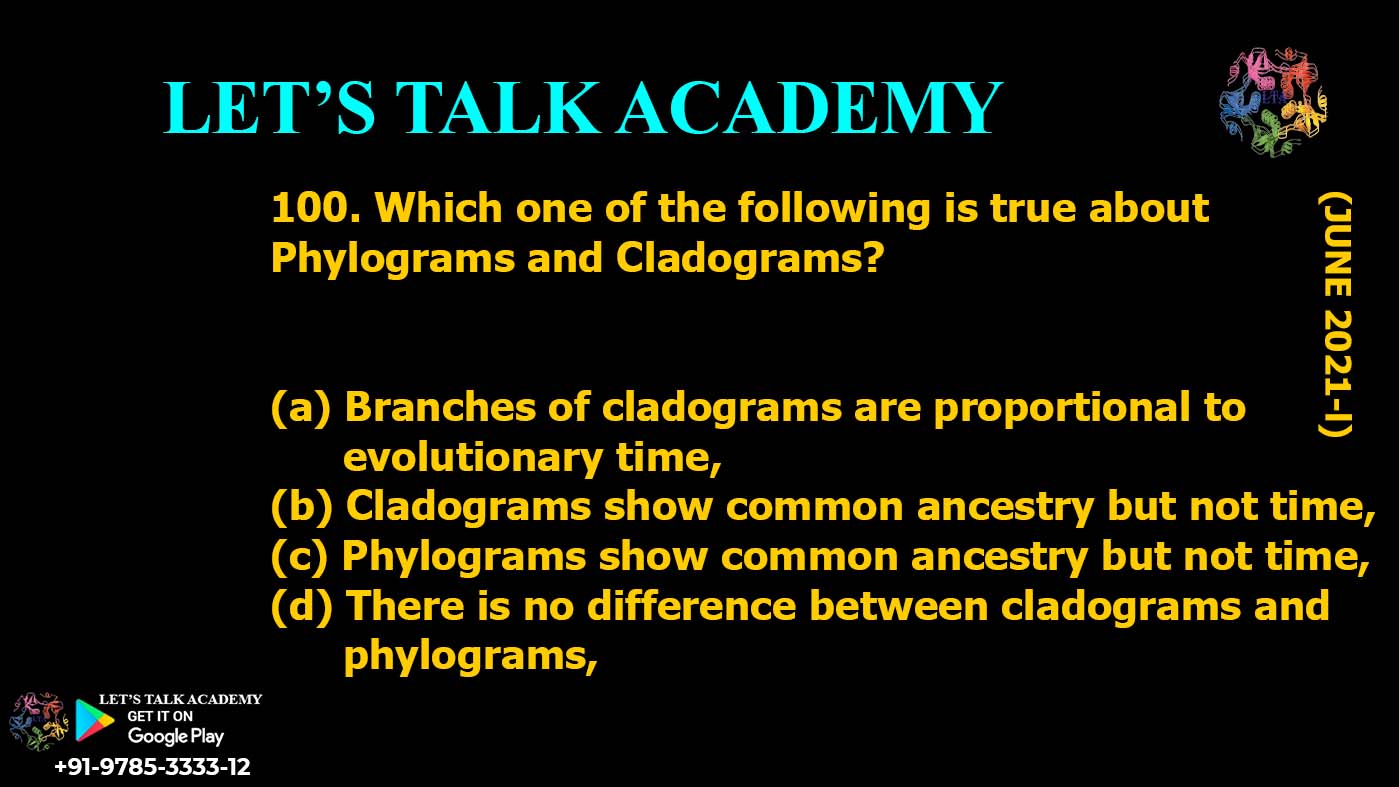
100. Which one of the following is true about Phylograms and Cladograms?
(a) Branches of cladograms are proportional to evolutionary time,
(b) Cladograms show common ancestry but not time,
(c) Phylograms show common ancestry but not time,
(d) There is no difference between cladograms and phylograms
Detailed Explanation:
In evolutionary biology, phylograms and cladograms are both tree-like diagrams used to represent the evolutionary relationships between species or groups. However, there is a key difference in what they represent, particularly regarding time and common ancestry.
Cladograms:
-
A cladogram is a tree-like diagram that illustrates the common ancestry among a group of organisms.
-
Cladograms do not show time or the amount of evolutionary change that has occurred between the species; they only focus on the branching pattern, representing the relative relationships between organisms.
-
The branches of a cladogram simply reflect evolutionary splits or divergences but are not proportional to time or the degree of divergence.
Phylograms:
-
A phylogram is a similar tree-like diagram, but it includes branch lengths that are proportional to evolutionary time or the amount of genetic change. The length of the branches indicates the extent of evolutionary divergence between the species.
-
Phylograms show both evolutionary relationships and time by using the branch lengths to represent the amount of evolutionary change.
Key Differences:
-
Cladograms focus on common ancestry but do not account for evolutionary time or change.
-
Phylograms show both common ancestry and evolutionary time, with branch lengths corresponding to the amount of genetic change.
Conclusion:
Therefore, the correct statement is (b) Cladograms show common ancestry but not time. Cladograms do not include the concept of evolutionary time, unlike phylograms, which do.


2 Comments
Vikram
April 19, 2025Submit
yogesh sharma
May 5, 2025Done sir ji 👍😄