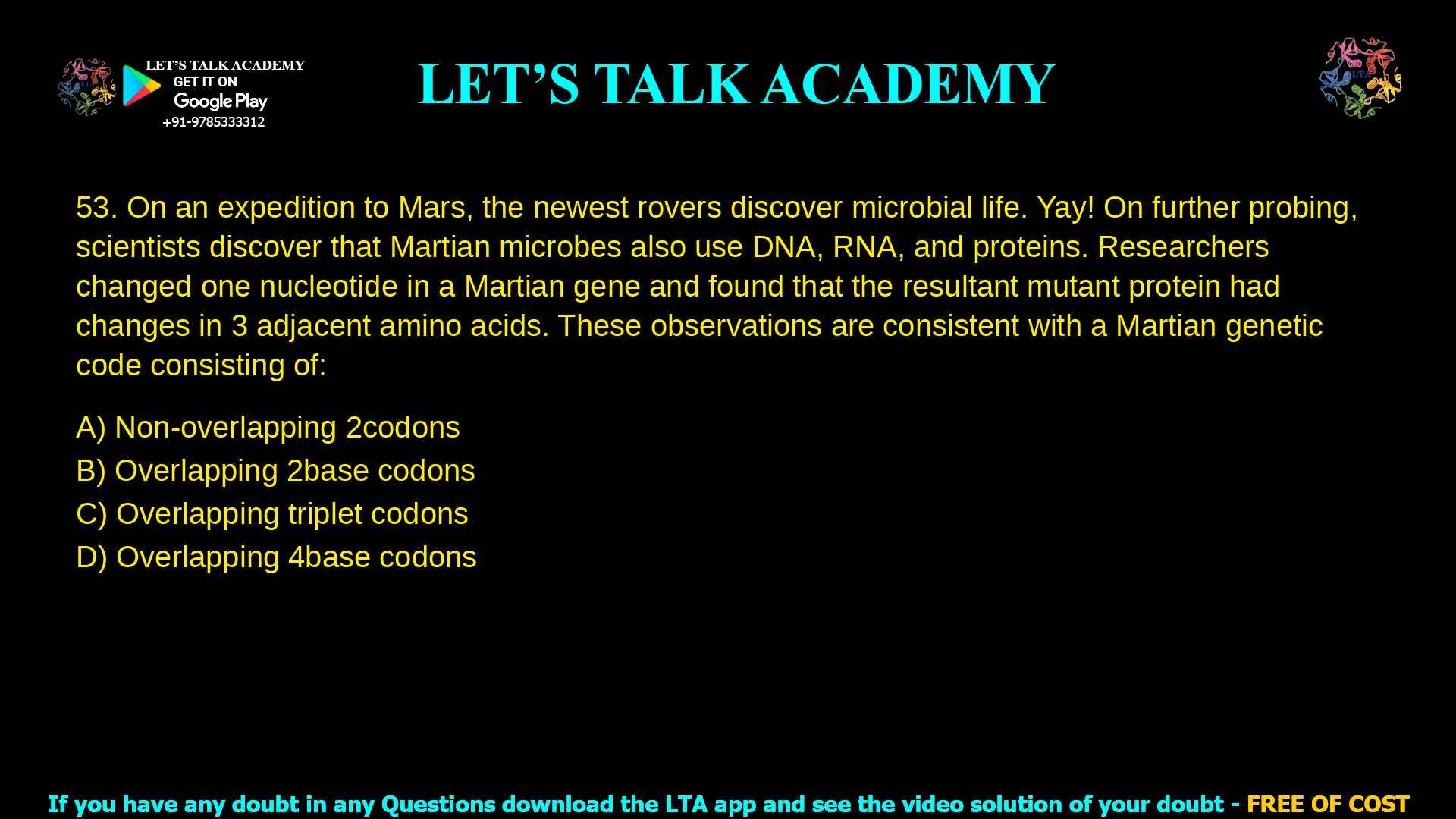
On an expedition to Mars, the newest rovers discover microbial life. Yay! On
further probing, scientists discover that Martian microbes also use DNA, RNA,
and proteins. Researchers changed one nucleotide in a Martian gene and found
that the resultant mutant protein had changes in 3 adjacent amino acids. These
observations are consistent with a Martian genetic code consisting of:
Non-overlapping 2 codons
Overlapping 2 base codons
Overlapping triplet codons
Overlapping 4 base codons
Direct Answer
The observations are consistent with overlapping triplet codons. In this Martian genetic code, a single nucleotide change affects three adjacent codons simultaneously, altering three consecutive amino acids, unlike the standard non-overlapping code where only one amino acid changes.
Option Analysis
Non-overlapping 2 codons: Each codon uses 2 nucleotides without sharing (e.g., bases 1-2, 3-4, 5-6). A single nucleotide substitution at position 3 affects only one codon (codon 2), changing just one amino acid. This fails to explain changes in 3 amino acids.
Overlapping 2 base codons: Codons overlap by 1 base (e.g., 1-2, 2-3, 3-4). Changing nucleotide 2 impacts codon 1 and codon 2, affecting 2 amino acids. This accounts for 2 changes maximum, not 3.
Overlapping triplet codons: Standard triplets (3 bases) overlap by 2 bases (e.g., codon 1: 1-2-3, codon 2: 2-3-4, codon 3: 3-4-5). A mutation at nucleotide 3 alters all three codons, changing 3 adjacent amino acids. This matches the observation precisely.
Overlapping 4 base codons: Quadruplet codons overlapping (e.g., by 3 bases) would impact 4 codons from one change, altering 4 amino acids. This exceeds the reported 3 changes.
Why Overlapping Codes Matter
Earth’s genetic code is non-overlapping triplets, where point mutations typically alter one amino acid due to degeneracy and frame integrity. Overlapping codes, seen in some viruses, impose stricter constraints—a single change affects multiple proteins, explaining the Martian result. Frameshift experiments historically confirmed non-overlapping nature by showing single insertions disrupt all downstream codons.
Martian Genetic Code Implications
This hypothetical Martian microbe scenario tests CSIR NET concepts on code properties: triplet, non-overlapping, degenerate. Overlapping triplet codons maximize genome efficiency but increase mutation sensitivity, potentially aiding compact alien genomes. Such questions highlight evolutionary trade-offs in genetic coding strategies.


