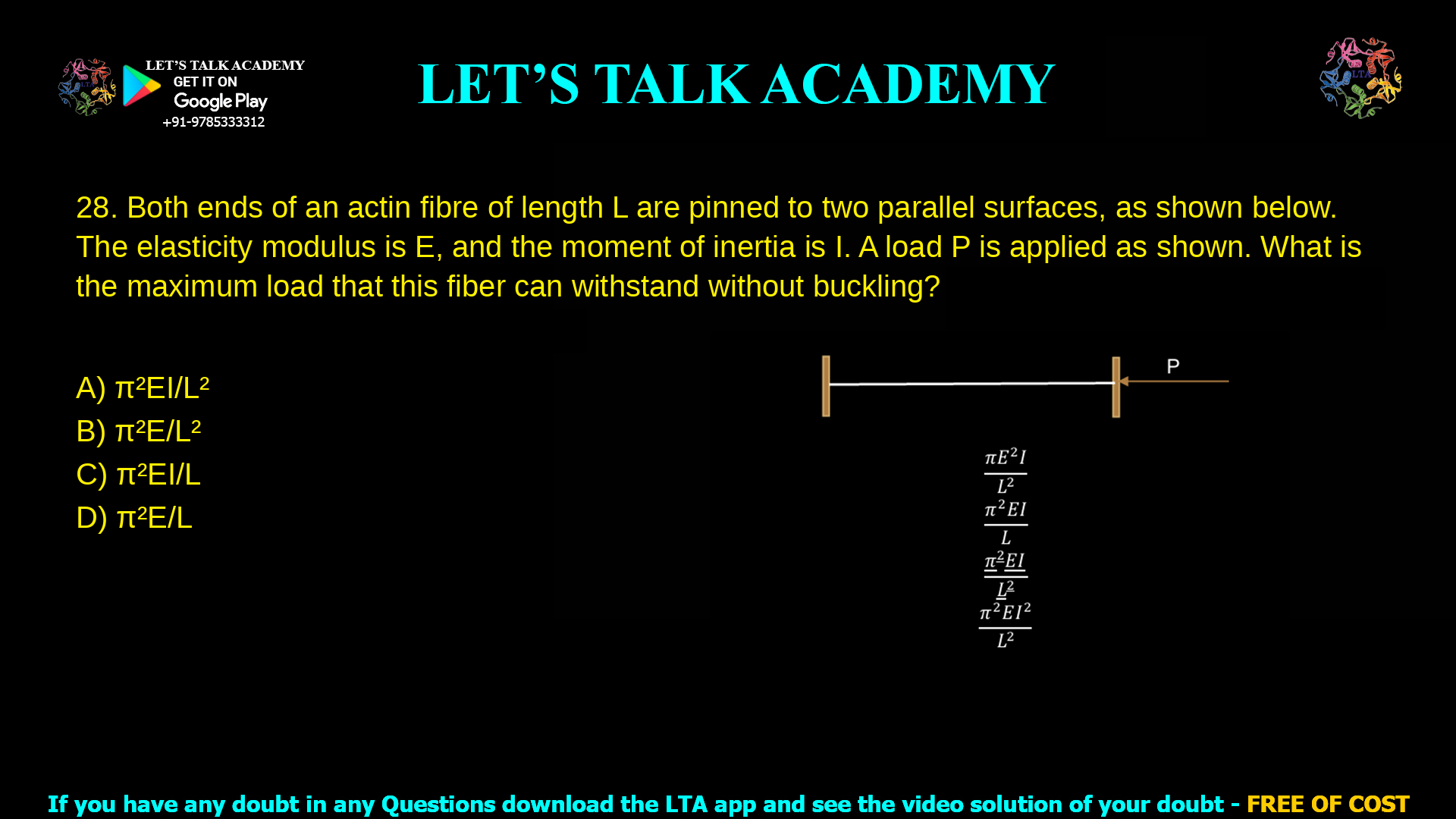
Both ends of an actin fibre of length L are pinned to two parallel surfaces, as
shown below. The elasticity modulus is E, and the moment of inertia is I. A load
P is applied as shown. What is the maximum load that this fiber can withstand
without buckling?
Introduction
When a question gives the energy E and momentum P of a moving particle and asks how its
velocity scales, it is really testing the relationship between these three quantities.
For a photon or any massless particle, the fundamental relation is that its velocity equals the ratio of its energy to its momentum,
leading to the answer v = E/P.
Step‑by‑step solution
For a photon, energy and momentum are related to frequency and wavelength as
E = hν and p = h/λ.
Using ν = c/λ, one can show that E/p = c, which is precisely the velocity of the photon.
Thus, the velocity v satisfies
v = E/P,
so the velocity scales directly as E divided by P.
Explanation of every option
Option A: E/P
For photons, the ratio of energy to momentum is equal to the speed of light, a constant velocity,
so the scaling of velocity with E and P is v ∝ E/P.
Therefore, Option A (E/P) is correct.
Option B: P/E
If velocity scaled as P/E, then taking the inverse of the earlier relation would imply
v ∝ 1/c for photons, which contradicts the known constant speed value.
Hence Option B (P/E) is incorrect.
Option C: √(E/P)
A square‑root dependence like √(E/P) does not emerge from the linear energy–momentum relation for photons,
where E is directly proportional to P.
Therefore Option C (√(E/P)) is incorrect.
Option D: E×P
A product E × P would give dimensions and magnitude completely inconsistent with velocity,
since velocity must involve a ratio of energy to momentum, not their product.
Thus Option D (E × P) is also incorrect.


