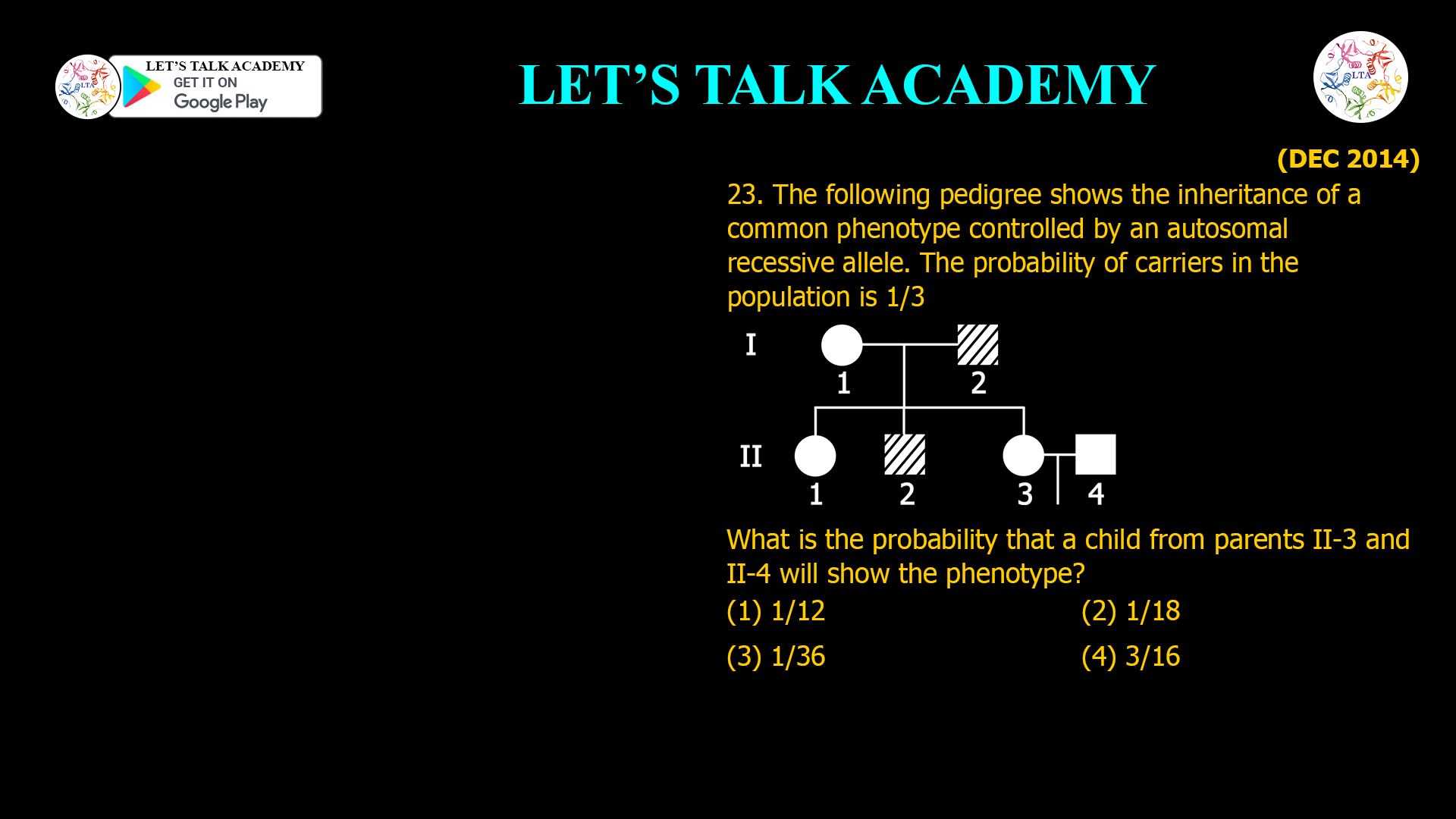
23. The following pedigree shows the inheritance of a common phenotype controlled by an autosomal recessive allele. The probability of carriers in the population is 1/3
What is the probability that a child from parents II-3 and II-4 will show the phenotype?
(1) 1/12 (2) 1/18
(3) 1/36 (4) 3/16
Understanding the Pedigree and Given Data
The pedigree shows a phenotype controlled by an autosomal recessive allele; shaded individuals are affected (aa), and unshaded are phenotypically normal (AA or Aa). The question states that the probability of carriers (heterozygotes, Aa) in the general population is 1/3, so for any randomly chosen phenotypically normal individual:
- P(carrier) = 1/3
- P(non‑carrier, AA) = 2/3
Individuals II‑3 and II‑4 are normal in the pedigree with no family indication of carrier status, so each is treated as a random normal from the population with the above carrier probability. An affected child must inherit two recessive alleles (aa), one from each parent, which occurs only if both parents are carriers for this autosomal recessive trait.
Stepwise Probability Calculation
- Probability that II‑3 is a carrier (Aa): 1/3.
- Probability that II‑4 is a carrier (Aa): 1/3.
- Probability that both are carriers:
P(II‑3 and II‑4 ) = (1/3) × (1/3) = 1/9. - When both parents are carriers (Aa × Aa), the Mendelian probability of an affected child (aa) is 1/4.
Therefore, overall probability that a child of II‑3 and II‑4 is affected:
P(affected child) = (1/9) × (1/4) = 1/36.
Correct answer: 1/36.
Why the Other Options Are Incorrect
- Option (1) 1/12: Corresponds to (1/3 × 1/4), which assumes only one parent’s carrier probability matters. This ignores that both must be carriers.
- Option (2) 1/18: Arises from mixing probabilities incorrectly, such as (2/3 × 1/3 × 1/4), which assumes one non‑carrier parent—no affected offspring possible.
- Option (4) 3/16: Overestimates risk by ignoring low carrier frequency and treating the cross as if carriers were almost certain.
Only option (3): 1/36 correctly combines the population carrier probability with the Mendelian segregation ratio required for an autosomal recessive phenotype.
SEO‑Friendly Introduction
Autosomal recessive pedigree probability problems are common in CSIR NET and other life science exams because they test understanding of both Mendelian ratios and population carrier frequencies. In this question, the carrier frequency is given as 1/3 in the population, and the task is to combine this information with an autosomal recessive cross to calculate the probability that a child from two phenotypically normal parents will be affected.


