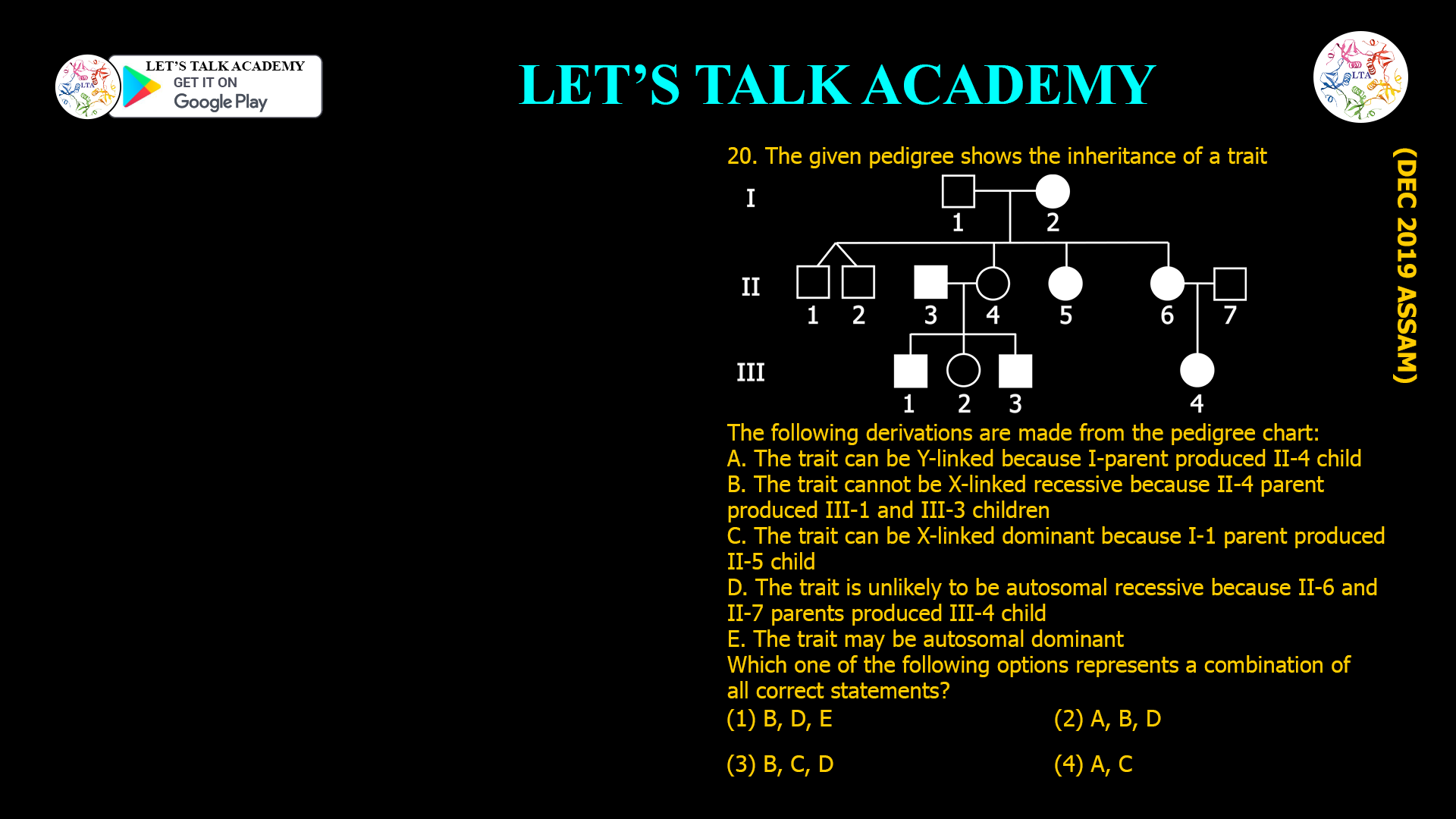
20. The given pedigree shows the inheritance of a trait
The following derivations are made from the pedigree chart:
A. The trait can be Y-linked because I-parent produced II-4 child
B. The trait cannot be X-linked recessive because II-4 parent produced III-1 and III-3 children
C. The trait can be X-linked dominant because I-1 parent produced II-5 child
D. The trait is unlikely to be autosomal recessive because II-6 and II-7 parents produced III-4 child
E. The trait may be autosomal dominant
Which one of the following options represents a combination of all correct statements?
(1) B, D, E (2) A, B, D
(3) B, C, D (4) A, C
Understanding the pedigree
In this pedigree, affected individuals are: II‑4 (female), III‑1 (male), III‑2 (female), III‑3 (male) and III‑4 (female). Unaffected parents in generation II (II‑6 and II‑7) have an affected daughter III‑4, which strongly suggests a dominant trait rather than autosomal recessive, while the sex distribution does not fit a clear X‑linked pattern.
Option A: Y‑linked trait
Statement A: “The trait can be Y‑linked because I‑1 parent produced II‑4 child.”
-
Y‑linked traits pass strictly from father to son, so only males are affected and there is no affected female in a true Y‑linked pedigree.
-
Here, the affected individual II‑4 is a female, and there are multiple affected females (II‑4, III‑2, III‑4), which makes a Y‑linked pattern impossible.
Therefore, statement A is incorrect.
Option B: Not X‑linked recessive
Statement B: “The trait cannot be X‑linked recessive because II‑4 parent produced III‑1 and III‑3 children.”
-
In X‑linked recessive inheritance, affected males usually inherit the mutant allele from a carrier or affected mother, and affected females are rare and generally require an affected father plus a carrier/affected mother.
-
In this pedigree, the affected female II‑4 has both affected sons and daughters (III‑1, III‑2, III‑3), which would require her to be homozygous recessive and the father to be at least a carrier; this does not agree with the absence of affected males in earlier generations and the overall pattern.
So, the pedigree does not support X‑linked recessive inheritance, and statement B is correct.
Option C: X‑linked dominant
Statement C: “The trait can be X‑linked dominant because I‑1 parent produced II‑5 child.”
-
In X‑linked dominant inheritance, an affected father passes the trait to all daughters and no sons.
-
In this pedigree, the affected parent does not transmit the trait to all daughters; moreover, there is no consistent criss‑cross pattern (father → all daughters → grandsons) expected of X‑linked dominant traits.
Hence, statement C is incorrect.
Option D: Unlikely autosomal recessive
Statement D: “The trait is unlikely to be autosomal recessive because II‑6 and II‑7 parents produced III‑4 child.”
-
Autosomal recessive traits typically appear when two carrier, unaffected parents produce affected offspring, often showing skipped generations and equal sex ratio.
-
Although II‑6 and II‑7 are unaffected with an affected child III‑4 (which superficially looks recessive), the same pedigree also shows vertical transmission and multiple affected individuals across generations, which does not fit a classic autosomal recessive pattern.
Therefore, statement D is regarded as correct: the trait is unlikely to be autosomal recessive.
Option E: May be autosomal dominant
Statement E: “The trait may be autosomal dominant.”
-
Autosomal dominant traits usually appear in multiple generations, affect both sexes, and an affected individual typically has at least one affected parent.
-
The distribution of affected males and females in this pedigree and the presence of affected individuals across generations are compatible with an autosomal dominant mode, especially once X‑linked and autosomal recessive patterns are ruled out.
So, statement E is correct, and the most acceptable mode is autosomal dominant.
Final answer
Correct combination of statements: (1) B, D, E.
SEO‑optimized introduction
This article explains a CSIR NET pedigree analysis autosomal dominant problem in which test‑takers must evaluate statements A–E about a given family tree and select the correct combination. By applying standard rules that distinguish autosomal, X‑linked, and Y‑linked inheritance, it becomes clear why options B, D and E fit the pedigree pattern while A and C do not.


