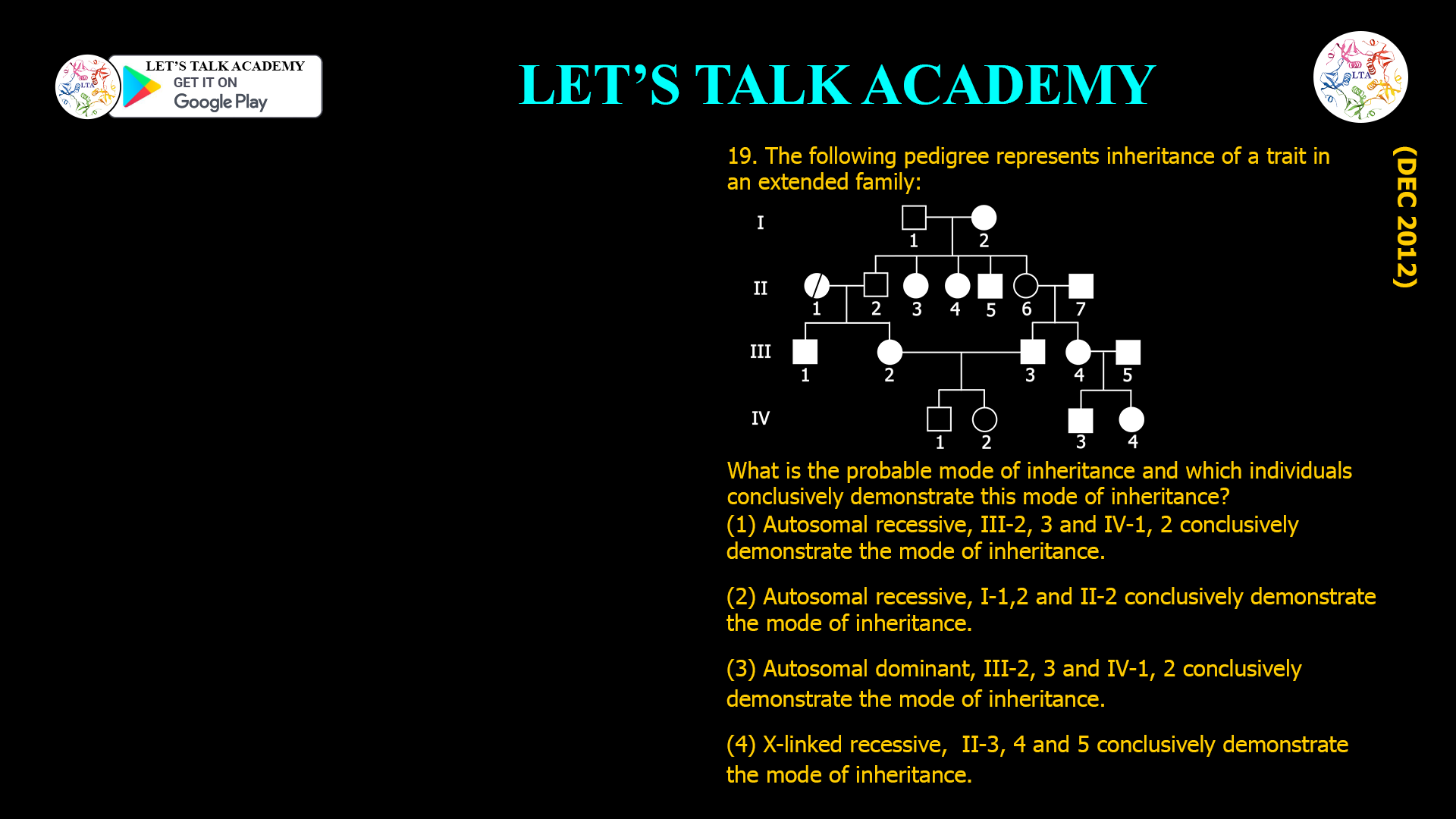
19. The following pedigree represents inheritance of a trait in an extended family:
What is the probable mode of inheritance and which individuals conclusively demonstrate this mode of inheritance?
(1) Autosomal recessive, III-2, 3 and IV-1, 2 conclusively demonstrate the mode of inheritance.
(2) Autosomal recessive, I-1,2 and II-2 conclusively demonstrate the mode of inheritance.
(3) Autosomal dominant, III-2, 3 and IV-1, 2 conclusively demonstrate the mode of inheritance.
(4) X-linked recessive, II-3, 4 and 5 conclusively demonstrate the mode of inheritance.
The pedigree shows an autosomal dominant pattern of inheritance, and individuals III-2, III-3 and IV-1, IV-2 conclusively demonstrate this mode of inheritance, so option (3) is correct.
Understanding the pedigree
In the pedigree, affected individuals appear in every generation, indicating vertical transmission, which is characteristic of autosomal dominant traits. Both males and females are affected, excluding Y‑linked inheritance and arguing against a sex‑linked pattern. When an affected individual mates with an unaffected spouse, approximately half of the children are affected, matching the expectation for a heterozygous autosomal dominant parent married to a homozygous normal partner.
Why option (3) is correct
Option (3): “Autosomal dominant, III‑2, 3 and IV‑1, 2 conclusively demonstrate the mode of inheritance” matches the pedigree. In generation III, an affected female (III‑2) and an affected male (III‑3) marry and have two affected children (IV‑1 and IV‑2), which is fully consistent with autosomal dominant inheritance where both parents are affected, most likely heterozygous (Aa × Aa) giving affected offspring with high probability. The presence of affected individuals in consecutive generations, including this nuclear family, rules out a purely recessive pattern and fits autosomal dominant transmission.
Why option (1) is incorrect
Option (1) assumes autosomal recessive with III‑2, 3 and IV‑1, 2 as decisive individuals, but this contradicts key recessive expectations. In autosomal recessive inheritance, affected offspring often arise from unaffected carrier parents, and the trait tends to skip generations rather than appearing in every generation as seen here. In the given pedigree, affected parents produce multiple affected children and there is clear vertical transmission, which is not typical for a rare autosomal recessive trait; thus option (1) is rejected.
Why option (2) is incorrect
Option (2) proposes autosomal recessive supported by I‑1, 2 and II‑2, but the founding pair shows an affected parent transmitting the trait directly to offspring across generations. If the trait were autosomal recessive, an affected individual would usually be homozygous recessive and often born to two phenotypically normal carrier parents; instead, here an affected parent produces affected children with an unaffected spouse, which fits an autosomal dominant, not recessive, model. Therefore, the individuals named in option (2) do not conclusively fit autosomal recessive inheritance, making this option incorrect.
Why option (4) is incorrect
Option (4) suggests X‑linked recessive with II‑3, 4 and 5 as decisive individuals, but the sex distribution and parent‑to‑child transmission pattern do not fit X‑linked recessive rules. In X‑linked recessive inheritance, affected females must have an affected father, and affected males often arise from carrier mothers with no father‑to‑son transmission; yet in this pedigree both males and females are affected across generations without the characteristic excess of affected males or strict dependence on maternal transmission. Hence the pattern cannot be explained as X‑linked recessive, so option (4) is excluded.


