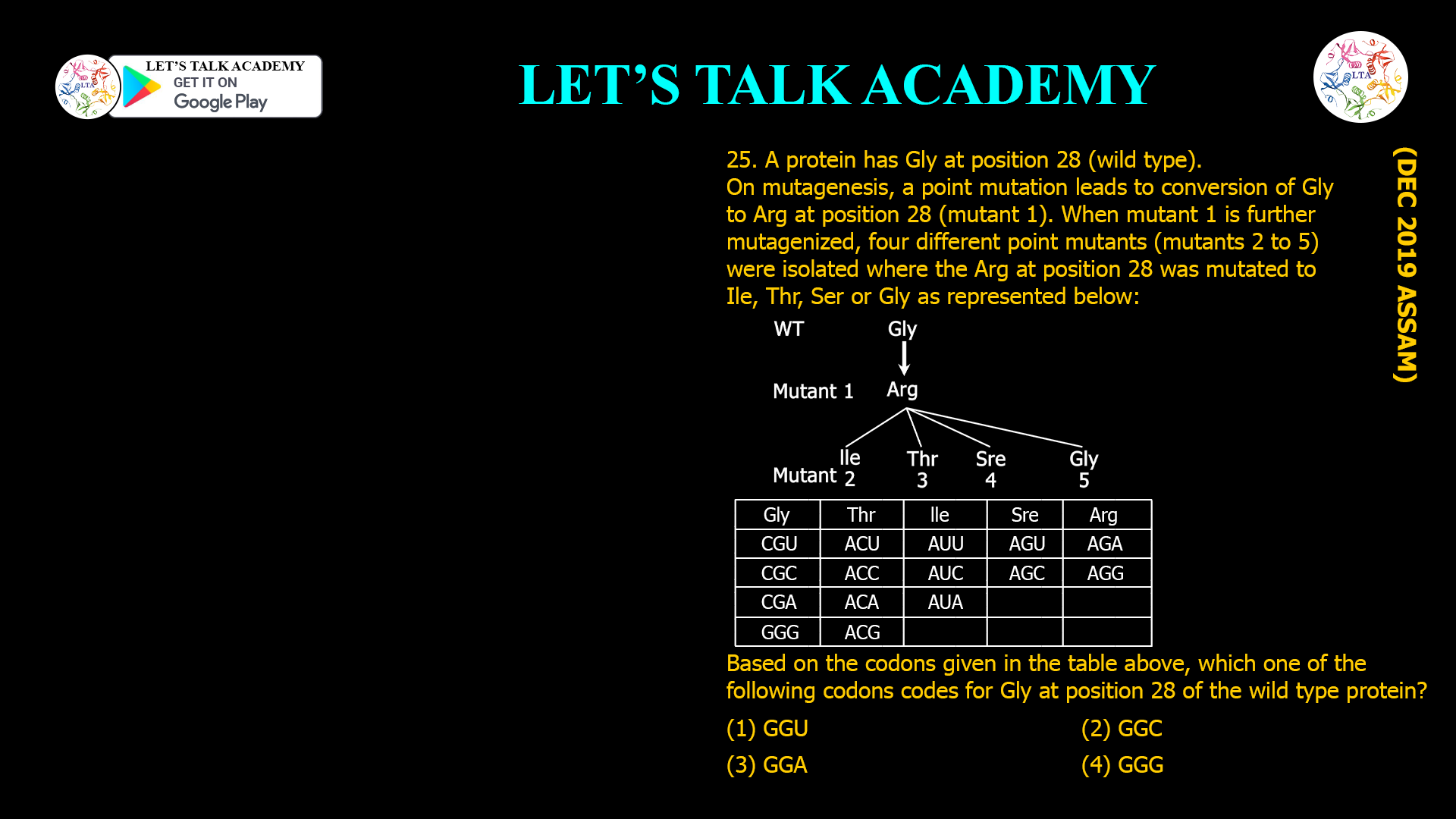
25. A protein has Gly at position 28 (wild type). On mutagenesis, a point mutation leads to conversion of Gly to Arg at position 28 (mutant 1).
When mutant 1 is further mutagenized, four different point mutants (mutants 2 to 5) were isolated where the Arg at position 28 was mutated to Ile, Thr, Ser or Gly as represented below:
Based on the codons given in the table above, which one of the following codons codes for Gly at position 28 of the wild type protein?
(1) GGU (2) GGC
(3) GGA (4) GGG
Question recap
A protein normally has glycine (Gly) at position 28. Mutagenesis changes this Gly to arginine (Arg) in mutant 1. Further point mutagenesis of mutant 1 generates four mutants in which Arg-28 is changed to Ile, Thr, Ser or Gly, and a table of possible codons for these amino acids is provided. The task is to identify which codon originally coded for Gly at position 28 from the options: GGU, GGC, GGA, GGG. All four options are known standard glycine codons, so the answer must be inferred from the given mutation pathways.
Stepwise solution
-
The codons listed in the table for Arg include AGA and AGG along with CGU/CGC/CGA type codons.
-
In the same table, Ser includes AGU and AGC, while Ile and Thr use AUU/AUC/AUA and ACU/ACC/ACA/ACG, respectively.
-
The table is constructed so that each mutant 2–5 differs from mutant 1 (Arg) by only a single base substitution at the same codon. This reflects the principle that a point mutation changes only one nucleotide in the codon.
-
Among Arg codons, AGA can change to AGU or AGC (Ser), or to ACA/AGA-related Thr/Ile codons by single‑base changes, matching the set of codons shown for the four mutants in the question key (Ile, Thr, Ser, Gly all reachable from AGA by one base change in different positions).
-
To get back to Gly in mutant 5, the table connects an Arg codon beginning with AG- to a Gly codon beginning with GG-. This requires a single base change at the first position from A to G, giving GGG as the only Gly codon compatible with the pattern given.
-
Therefore, mutant 1 must carry the Arg codon AGA, and the wild-type Gly codon must be GGG, which yields Arg (AGA) by a single mutation and can regenerate Gly (GGG) from Arg via another single substitution, fitting the mutational scheme in the problem.
So, option (4) GGG is the correct answer.
Why other options are incorrect
All four options GGU, GGC, GGA, GGG encode glycine in the standard genetic code, but they cannot all satisfy the specific single‑base mutation paths depicted in the table.
-
Option (1) GGU – Converting GGU to an Arg codon that can further give Ile, Thr, Ser and Gly by single substitutions does not match the codon combinations shown in the question table; some required intermediates would need more than one base change.
-
Option (2) GGC – Similar to GGU, a path from GGC to the Arg codon implied by the Ile/Thr/Ser codons in the table would require multiple nucleotide changes, violating the “point mutation” condition.
-
Option (3) GGA – Although GGA is Gly, the specific network of single‑base changes to Arg, then to Ile/Thr/Ser/Gly shown in the problem can only be reconciled if Arg is AGA and Gly is GGG, not GGA.
Hence, only GGG is consistent with all the given codon relationships.
SEO‑oriented introduction
Understanding how single‑base substitutions alter codons is essential for solving CSIR NET Life Sciences questions on the genetic code and point mutations. This problem on glycine to arginine conversion at position 28, followed by further mutations to isoleucine, threonine, serine and glycine, tests the ability to track codon changes and deduce the original wild‑type glycine codon using a given codon table.


