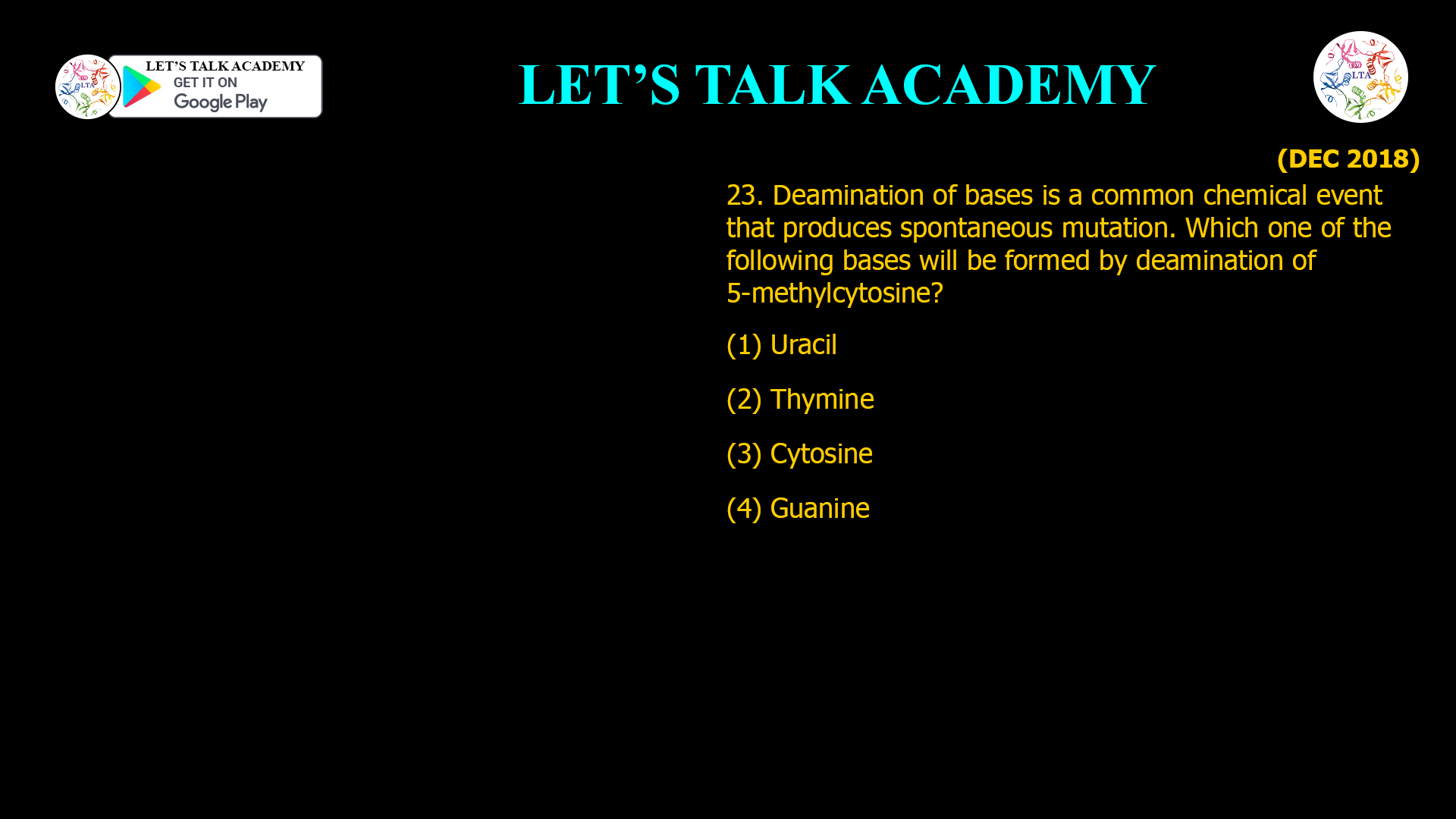
23. Dearnination of bases is a common chemical event that produces spontaneous mutation. Which one of the following bases will be formed by deamination of 5-methylcytosine?
(1) Uracil (2) Thymine
(3) Cytosine (4) Guanine
The deamination of 5-methylcytosine results in the formation of thymine. This is because 5-methylcytosine, which is cytosine with a methyl group attached to the 5th carbon, upon losing its amino group (-NH2) by deamination, chemically converts into thymine, forming a G- T mismatch in DNA. This mutation is a common spontaneous mutation in DNA and is a source of transition mutations from CG to AT base pairs.
Explanation of the options:
-
Uracil is formed by the deamination of cytosine, not 5-methylcytosine.
-
Thymine is the correct product formed by the deamination of 5-methylcytosine.
-
Cytosine cannot be formed by deamination; rather, it is the original base before modification.
-
Guanine is not a product of deamination of 5-methylcytosine or cytosine.
Therefore, the correct answer is option (2) Thymine.
Introduction:
Deamination is a common chemical event in DNA that can cause spontaneous mutations. Specifically, the deamination of 5-methylcytosine, a methylated form of cytosine, results in thymine formation. This chemical change can impact the genetic code and lead to mutation hotspots in genomes.
Detailed Explanation:
Deamination removes an amino group from DNA bases. When 5-methylcytosine undergoes deamination, it converts into thymine rather than uracil (which is formed when unmethylated cytosine deaminates). This difference is crucial because thymine is a normal DNA base, leading to a G- T mismatch that can escape efficient DNA repair. Consequently, this results in transition mutations (C to T) which are common in methylated regions of DNA. Understanding this process helps explain mutation mechanisms in molecular genetics and disease development.
Each option analyzed:
-
Uracil (option 1) arises from regular cytosine deamination, which is recognized and repaired by the cell.
-
Thymine (option 2) is formed specifically from 5-methylcytosine deamination, making it the correct choice.
-
Cytosine (option 3) is the original unmodified base, not a deamination product.
-
Guanine (option 4) is unrelated to the deamination process of cytosine derivatives.
This knowledge is important for geneticists and molecular biologists studying mutation and epigenetic regulation in DNA.
If you want, I can also prepare a detailed answer script with molecular structures and mutation consequences for educational purposes.


