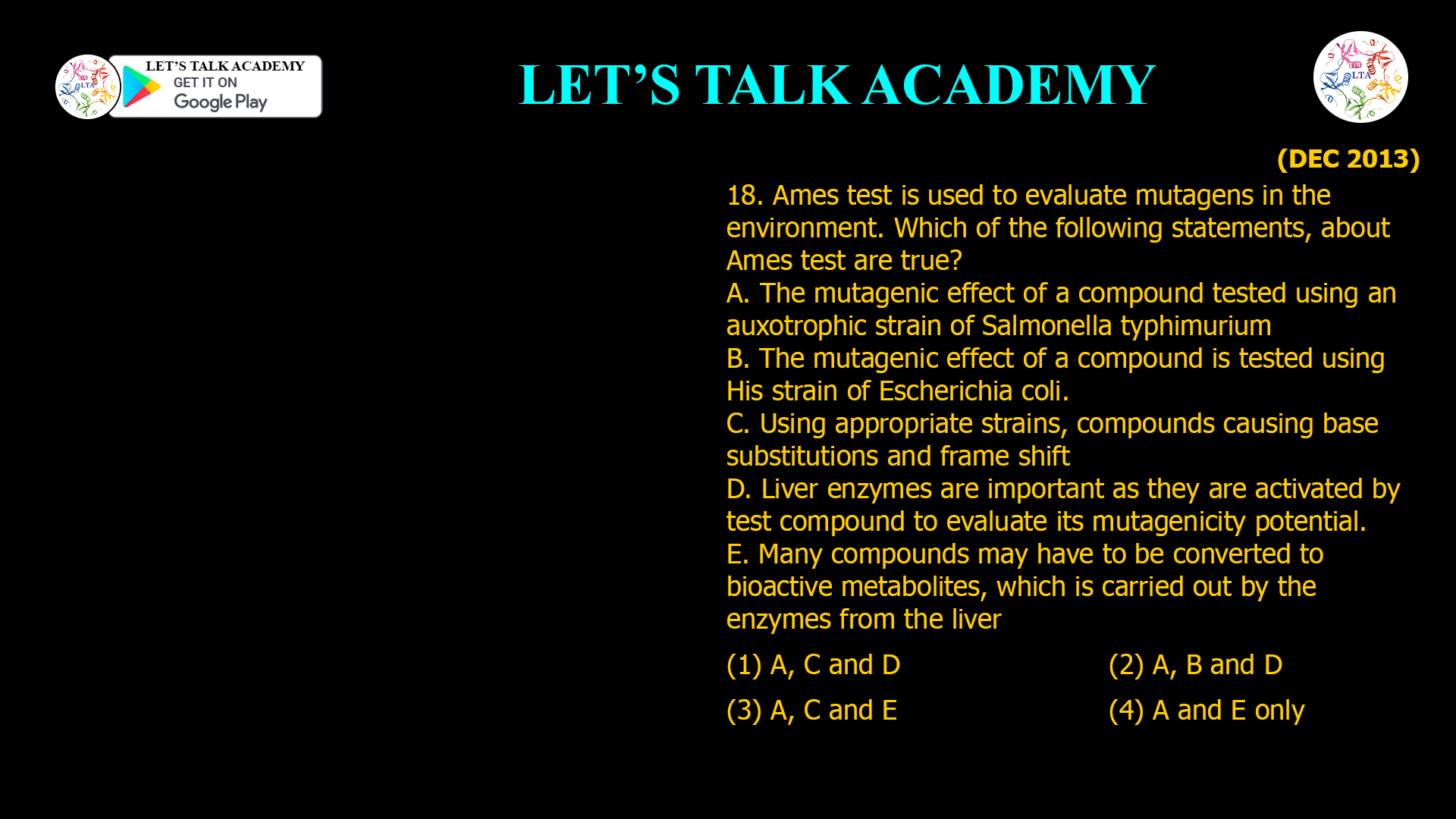
18. Ames test is used to evaluate mutagens in the environment. Which of the following statements, about Ames test are true?
A. The mutagenic effect of a compound tested using an auxotrophic strain of Salmonella typhimurium
B. The mutagenic effect of a compound is tested using His strain of Escherichia coli.
C. Using appropriate strains, compounds causing base substitutions and frame shift
D. Liver enzymes are important as they are activated by test compound to evaluate its mutagenicity potential.
E. Many compounds may have to be converted to bioactive metabolites, which is carried out by the enzymes from the liver
(1) A, Cand D (2) A, B and D
(3) A, C and E (4) A and E only
The correct true statements about the Ames test are A, C, and E, corresponding to option (3).
Explanation of each option:
A. True. The Ames test uses auxotrophic strains of Salmonella typhimurium that cannot synthesize histidine due to mutations. The mutagenic effect of a compound is evaluated by its ability to cause reverse mutations that restore the ability of these strains to grow without histidine supplementation.
B. False. While the Ames test sometimes uses Escherichia coli strains for mutagenicity testing, the classical and most common test strains are histidine auxotrophs of Salmonella typhimurium, not histidine-deficient (His) strains of E. coli.
C. True. The Ames test uses specific strains engineered to detect mutagens causing base substitutions and frameshift mutations. Different strains detect different mutation types, such as frameshift or point mutations in the histidine operon genes.
D. False. Liver enzymes themselves are not activated by the test compound; rather, liver enzymes (in the form of rat liver extract, S9 mix) are added to simulate mammalian metabolism because many compounds require metabolic activation by liver enzymes to become mutagenic.
E. True. Many compounds are not directly mutagenic but require conversion to bioactive metabolites by liver enzymes, mainly cytochrome P450 enzymes found in the liver, which is mimicked in the Ames test by adding liver extracts to activate these compounds for mutagenicity evaluation.
Introduction:
The Ames test is a widely used biological assay to evaluate the mutagenic potential of chemical compounds in the environment. It primarily uses auxotrophic strains of Salmonella typhimurium that require histidine to grow. The test identifies mutagens by detecting reverse mutations that restore the ability of these bacteria to synthesize histidine. To accurately determine mutagenicity, the test incorporates liver enzyme extracts to mimic metabolic activation of compounds, which is crucial because many mutagens require conversion into bioactive metabolites. This article explains the principles, key features, and significance of the Ames test in environmental mutagen detection.
Explanation of Answer Choices:
A. The test uses auxotrophic (histidine-dependent) strains of Salmonella typhimurium to evaluate mutagenicity. These bacteria cannot grow on histidine-free media unless a mutation reverses the effect, allowing for selection of revertant colonies indicating mutagenic activity.
B. The Ames test commonly uses Salmonella typhimurium, not Escherichia coli, for histidine mutation detection. While E. coli is used sometimes for specific applications, the classical assay focuses on Salmonella his- strains.
C. Different tester strains of Salmonella are designed to detect base substitutions and frameshift mutations, allowing comprehensive identification of mutagenic mechanisms of test compounds.
D. Liver enzymes themselves are not “activated” by the test compound. Instead, liver enzymes metabolically activate (convert) the test compound into mutagenic derivatives, hence the use of liver extract (S9 mix) in the assay.
E. Many chemicals require metabolic activation by liver enzymes to become mutagenic. The inclusion of liver enzymes in the Ames test simulates this process, enabling detection of mutagens that only show activity after metabolism.
This detailed explanation confirms that the correct true statements consistent with the Ames test procedure are A, C, and E (Option 3).
If you need a fully formatted SEO article draft based on this for your content creation, I can provide that as well.


