(DEC 2011)
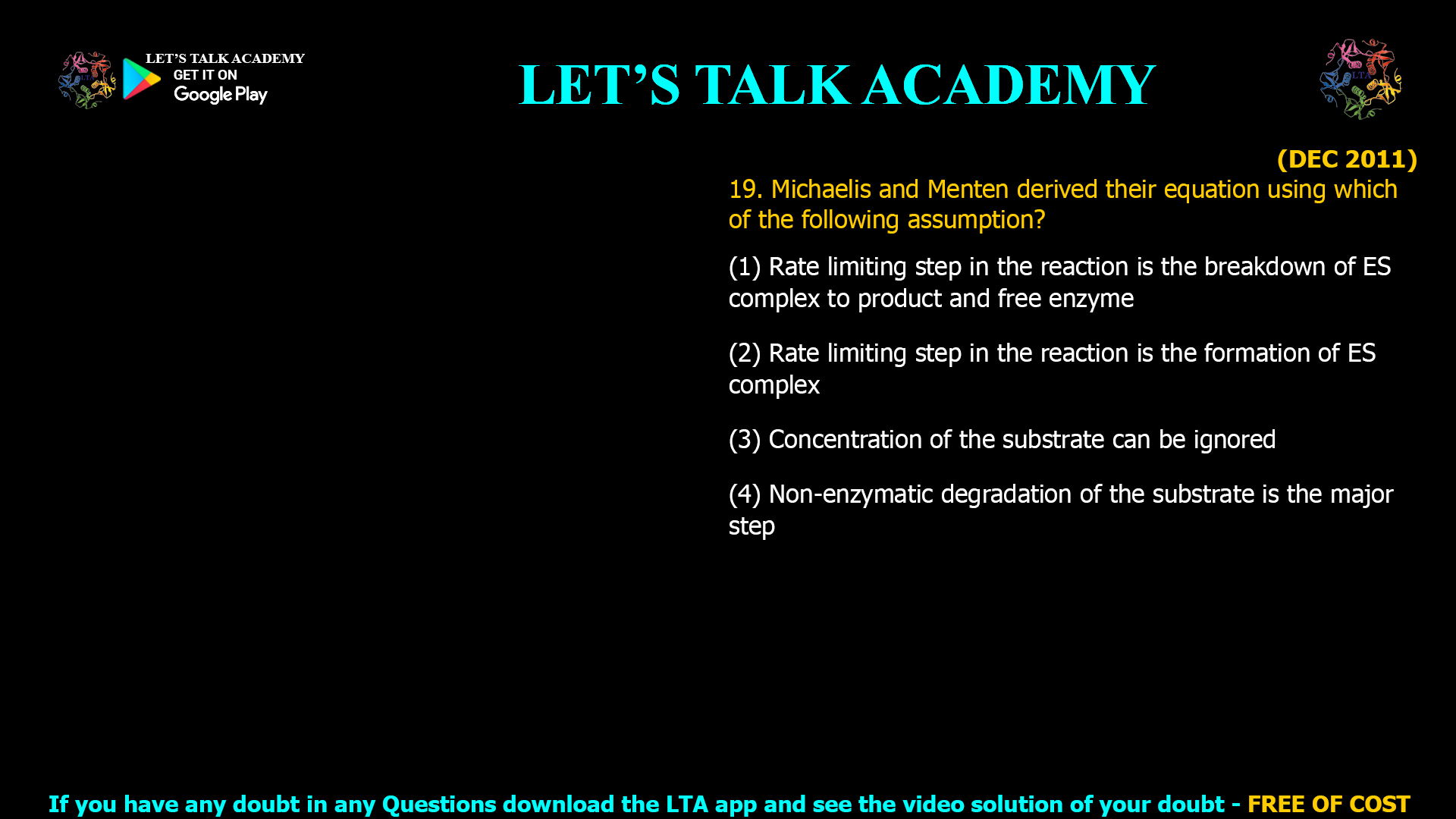
19. Michaelis and Menten derived their equation using which of the following assumption?
(1) Rate limiting step in the reaction is the breakdown of ES complex to product and free
enzyme
(2) Rate limiting step in the reaction is the formation of ES complex
(3) Concentration of the substrate can be ignored
(4) Non-enzymatic degradation of the substrate is the major step
The correct answer is (1) Rate limiting step in the reaction is the breakdown of ES complex to product and free enzyme.
Introduction
The Michaelis-Menten equation is one of the most important models in biochemistry, describing how enzymes catalyze reactions depending on substrate concentrations. Its derivation is based on critical assumptions about the enzyme-substrate complex (ES) and the steps in the catalytic cycle. This article explains these assumptions, especially highlighting the rate-limiting step being the breakdown of the ES complex to form product and free enzyme, and how this influences enzymatic reaction rates.
Background: Enzyme Catalysis and the ES Complex
The basic enzymatic reaction:
E+S⇌k−1k1ES→k2E+P
-
E: enzyme
-
S: substrate
-
ES: enzyme-substrate complex
-
P: product
The sequence involves substrate binding, formation of the ES complex, and conversion to product releasing enzyme.
Michaelis-Menten Assumptions
The derivation of the Michaelis-Menten equation relies on these key assumptions:
-
Steady-State Assumption: The concentration of the enzyme-substrate complex [ES] remains constant over the initial phase of the reaction. This means the rate of ES formation equals the rate of ES breakdown.
-
Initial Rate Measurement: The rate is measured under conditions where the product concentration is negligible so that the reverse reaction E+P→ES is ignored.
-
Substrate Concentration: The total substrate concentration [S] is much greater than the total enzyme concentration [E]t, so that the substrate concentration stays approximately constant during the initial reaction phase.
-
Rate-Limiting Step: The breakdown of the ES complex to product and free enzyme is the slowest (rate-determining) step controlling the overall reaction rate.
Why the Breakdown of ES Complex is Rate-Limiting
-
After enzyme and substrate form the complex, conversion into product and enzyme release proceeds slower than substrate binding.
-
The k2 rate constant for forward catalysis often limits the reaction velocity.
-
This assumption simplifies kinetic equations, allowing mathematical derivation of a formula relating substrate concentration to reaction velocity.
Michaelis-Menten Equation
The Michaelis-Menten equation derived under these assumptions is:
v=Vmax[S]Km+[S]
Where
-
v = initial reaction velocity
-
Vmax=k2[E]t = maximal velocity when enzyme is saturated with substrate
-
Km=k−1+k2k1 = Michaelis constant, substrate concentration for half maximal velocity
Significance of the Assumption
-
The rate-limiting step assumption ensures that the enzyme catalysis rate depends primarily on the conversion of bound substrate to product.
-
This contrasts with substrate binding being reversible and rapid.
-
It explains why increasing substrate concentration increases reaction rate until saturation.
Summary Table
| Assumption | Explanation |
|---|---|
| Rate limiting step is ES breakdown (correct) | Catalytic conversion ES→E+P is slowest step |
| Rate limiting is ES formation (incorrect) | Binding is generally faster than catalysis |
| Substrate concentration can be ignored (incorrect) | Substrate affects rate, especially at low concentrations |
| Non-enzymatic degradation major step (incorrect) | Enzyme catalysis dominates reaction pathway |
Conclusion
The Michaelis-Menten equation was derived assuming the breakdown of the enzyme-substrate complex to product and free enzyme is the rate-limiting step. This assumption is essential for accurately describing enzyme kinetics and predicting reaction velocities based on substrate concentration, providing a foundation for understanding enzyme behavior in biological systems and experimental settings.


46 Comments
Sakshi yadav
September 12, 2025Rate limiting step in the reaction is the breakdown of ES complex to product and free enzyme.
Mohd juber Ali
September 12, 2025Option a Rate limiting step in the reaction is the breakdown of ES complex to product and free enzyme.
Priya dhakad
September 12, 2025Rate limiting step in the reaction is the breakdown of ES complex to product and free enzyme.
Aakansha sharma Sharma
September 12, 2025Rate limiting step in the reaction is the breakdown of ES complex to product and free enzyme.
Varsha Tatla
September 12, 2025Option 1st will be correct
Rate limiting step is breakdown of ES complex to productnd free enz
Tanvi Panwar
September 12, 2025Rate limiting step is the break down of ES complex into enzymes and product.
Dharmpal Swami
September 13, 2025Rate limiting factor break down in Es complex and enzyme free
Sakshi Kanwar
September 13, 2025They have considered rate limiting step that is the ES complex which convert into product and free enzyme
Roopal Sharma
September 13, 2025Breakdown of ES complex to product and feee enzymes.
Roopal Sharma
September 13, 2025Breakdown of ES complex to product and feee enzymes. ✨
Mansukh Kapoor
September 13, 2025The correct answer is option 1st
Rate limiting step in the reaction is the breakdown of ES complex to product and free enzyme
Kanica Sunwalka
September 13, 2025Rate limiting step in the rxn is breakdown of E-S complex -> E + P
( as catalysis occurs only in 1% cases ideally )
Kirti Agarwal
September 13, 2025Opt A
Neha Yadav
September 13, 2025Michaelis – Menten equation was derived assuming the rate limiting step in the reaction is the breakdown of ES complex into product and free enzyme
Bhawna Choudhary
September 13, 2025Rate limiting step in the reaction is the breakdown of ES complex to product and free enzyme
Santosh Saini
September 13, 2025Option 1st will be correct Rate limiting step is the breakdown of enzyme substrate complex to product and free enzymes
Nilofar Khan
September 14, 2025correct answer is (1)
Rate limiting step in the reaction is the breakdown of ES complex to product and free enzyme.
Soniya Shekhawat
September 14, 2025The rate limiting step means slowest step is ES complex is breakdown into the free enzyme+product.
Aafreen Khan
September 14, 2025Rate limiting step in the reaction is the breakdown of ES complex to product and free enzyme
Khushi Agarwal
September 14, 2025The correct answer is A
Rate limiting step in the reaction is the breakdown of ES complex to product and free enzyme
Pooja
September 14, 2025Option A is correct
Rate limiting step in the reaction is the breakdown of ES complex to product and free enzyme.
Ayush Dubey
September 14, 2025Rate limiting step in the reaction is the breakdown of ES complex to product and free enzyme.
Vanshika Sharma
September 14, 2025Rate limit step in the rxn is the break down of Es complex to product and free enzyme
Anjali
September 14, 2025Rate limiting step in the reaction is the breakdown of ES complex to product and free enzyme
Anurag Giri
September 14, 2025The correct answer is (1) Rate limiting step in the reaction is the breakdown of ES complex to product and free enzyme
Kajal
September 14, 2025Option 1 means rate limiting step is that in which break down of enzyme substrate complex to enzyme and product
Mitali saini
September 14, 2025The correct answer is (1) Rate limiting step in the reaction is the breakdown of ES complex to product and free enzyme.
Rishita
September 14, 2025Rate limiting step in the reaction is the breakdown of ES complex to product and free enzyme.
Payal Gaur
September 14, 2025Option A rate of limiting step in the reaction breakdown of ES complex to product and free enzyme
Avni
September 14, 2025The correct answer is (1) Rate limiting step in the reaction is the breakdown of ES complex to product and free enzyme
Anju
September 14, 2025Ans:1
Rate limiting factor break down in ES complex to product and free enzyme
Asha Gurzzar
September 14, 2025A is Correct rate limiting step in the reaction is the breakdown of enzyme substrate complex to product and free enzyme
Arushi Saini
September 14, 2025Option 1st is correct
Rate limiting step in the reaction is the breakdown of ES complex to product and free enzyme
Heena Mahlawat
September 14, 2025Rate limiting step is enzyme catalysis where breakdown of ES complex and release free enzyme
Aartii sharma
September 14, 2025Rate limiting step is enzyme catalysts where breakdown of ES complex and release free enzyme
Pallavi Ghangas
September 14, 2025Rate limiting step in the reaction is the breakdown of ES complex to product and free enzyme.
anjani sharma
September 14, 2025Answer 1
Rate limiting step in the reaction is the breakdown of ES complex to product and free enzyme.
Deepika sheoran
September 15, 2025Option A Rate limiting step in the reaction is the breakdown of Es complex to product and free enzyme.
yashika
September 15, 2025Rate limiting step in the reaction is the breakdown of es complex
Simran Saini
September 15, 2025Option 1
Rate limiting step in the reaction is the breakdown of ES complex to product and free enzyme.
Khushi Vaishnav
September 15, 2025Rate limiting step in the reaction is the breakdown of ES complex to product and free enzyme.
Muskan singodiya
September 15, 2025Option 1 is correct
Anjana sharma
September 16, 2025Rate limiting step in the reaction is the breakdown of ES complex to product and free enzyme.
Minal Sethi
September 16, 2025Rate of Formation of product from ES complex and breakdown of ES complex is the rate limiting step as at steady state both rates are considered equal
Muskan Yadav
September 17, 2025The correct answer is (1) Rate limiting step in the reaction is the breakdown of ES complex to product and free enzyme.
Yogita
September 17, 2025The rate limiting step in the reaction is the breakdown of ES complex to product and free enzyme