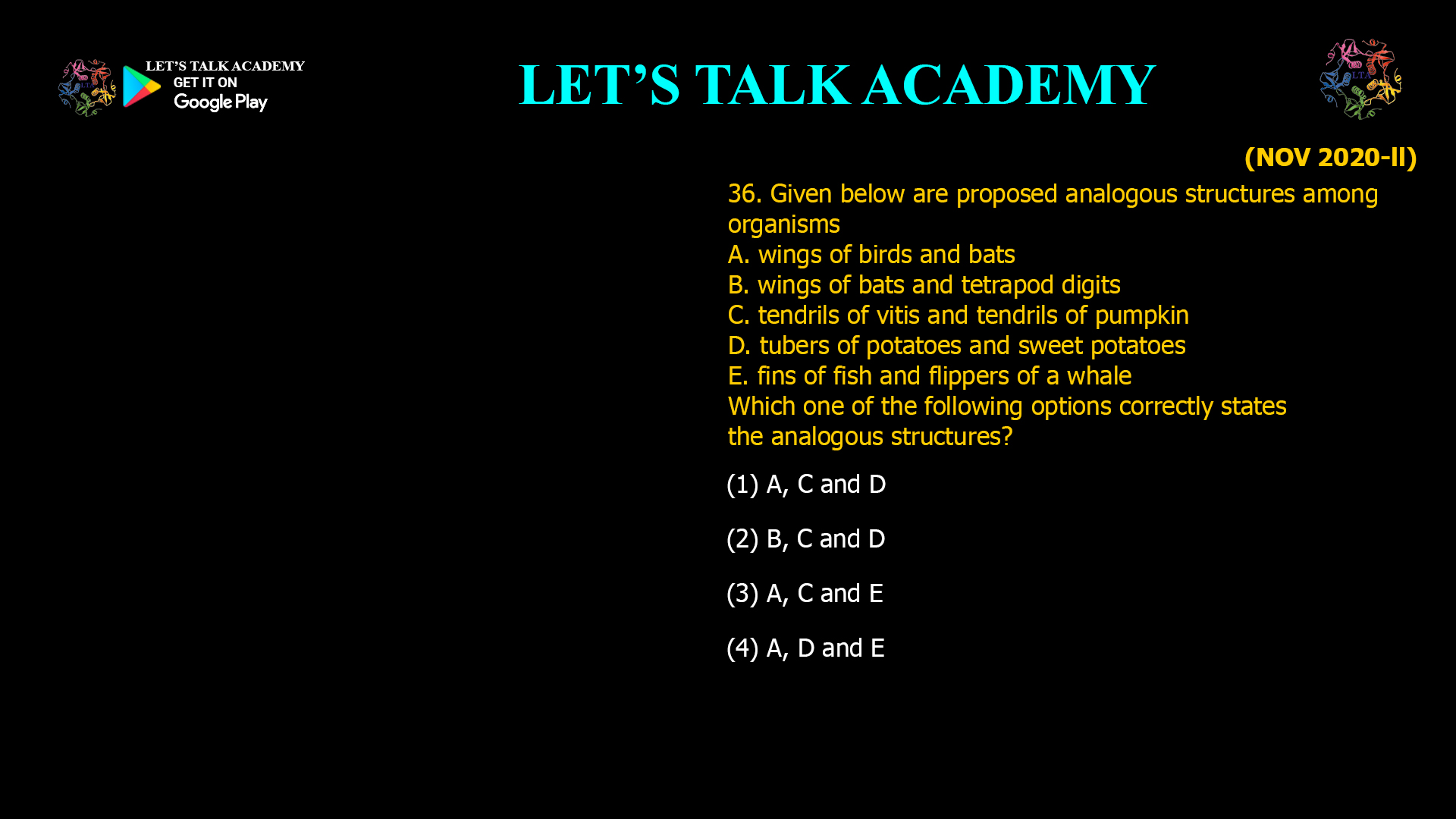
- Given below are proposed analogous structures among organisms
A. wings of birds and bats
B. wings of bats and tetrapod digits
C. tendrils of vitis and tendrils of pumpkin
D. tubers of potatoes and sweet potatoes
E. fins of fish and flippers of a whale
Which one of the following options correctly states the analogous structures?
(1) A, C and D (2) B, C and D
(3) A, C and E (4) A, D and E
Introduction
In evolutionary biology, analogous structures are body parts in different species that perform similar functions but evolved independently, without a common ancestral origin. These structures arise due to convergent evolution, where unrelated organisms adapt similarly to comparable environmental pressures.
This article examines which among the following pairs represent true analogous structures:
-
Wings of birds and bats
-
Wings of bats and tetrapod digits
-
Tendrils of vitis and pumpkin
-
Tubers of potatoes and sweet potatoes
-
Fins of fish and flippers of whales
What Are Analogous Structures?
Analogous structures serve similar functions but differ anatomically and evolutionarily. For example, wings in birds and bats both enable flight but evolved independently—birds from reptilian ancestors and bats from mammals. Their wing structures differ internally, reflecting their distinct evolutionary paths.
Analysis of Given Examples
A. Wings of Birds and Bats
Analogous structures. Both serve for flight but evolved independently. Bird wings are modified forelimbs with feathers, while bat wings are skin membranes stretched over elongated fingers. Despite functional similarity, their anatomical differences and distinct evolutionary origins make them classic examples of analogy.
B. Wings of Bats and Tetrapod Digits
Not analogous. Bat wings are modified tetrapod digits (fingers). This is an example of homology, where structures share a common evolutionary origin but may serve different functions.
C. Tendrils of Vitis and Pumpkin
Analogous structures. Tendrils in grapevines (Vitis) and pumpkins are both used for climbing but evolved independently in different plant families. Their structural origins differ, making them analogous.
D. Tubers of Potatoes and Sweet Potatoes
Not analogous. Both are storage organs but differ anatomically and evolutionarily. Potato tubers develop from underground stems (stem tubers), while sweet potato tubers develop from roots (root tubers). Since they arise from different plant parts, they are analogous in function but structurally distinct. However, in botanical terms, they are often considered analogous due to different origins.
E. Fins of Fish and Flippers of Whales
Analogous structures. Fish fins and whale flippers are used for swimming but evolved independently. Fish fins are supported by rays or spines, while whale flippers are modified limbs with bones similar to terrestrial mammals. This is a textbook example of analogy due to convergent evolution.
Correct Set of Analogous Structures
Based on the above analysis, the correct analogous structures among the options are:
-
A. Wings of birds and bats
-
C. Tendrils of vitis and pumpkin
-
D. Tubers of potatoes and sweet potatoes
Thus, the correct answer is:
(1) A, C and D
Conclusion
Analogous structures highlight the fascinating ways evolution shapes similar solutions to environmental challenges in unrelated species. Wings, tendrils, tubers, and fins illustrate how different organisms independently evolve comparable functions, showcasing the power of convergent evolution.
SEO-Friendly Slugs:
-
analogous-structures-wings-tendrils-tubers-fins
-
examples-of-analogous-structures-in-nature
-
convergent-evolution-analogous-structures-explained
-
difference-between-homologous-and-analogous-structures
-
wings-of-birds-and-bats-analogous-structures
Understanding analogous structures deepens our appreciation of evolutionary biology and the diversity of life’s adaptations.
Summary:
The wings of birds and bats, tendrils of vitis and pumpkin, and tubers of potatoes and sweet potatoes are analogous structures, all evolved independently to serve similar functions despite different evolutionary origins.


2 Comments
Manisha choudhary
October 3, 2025A,C,D
Sonal Nagar
November 13, 2025A,D,E