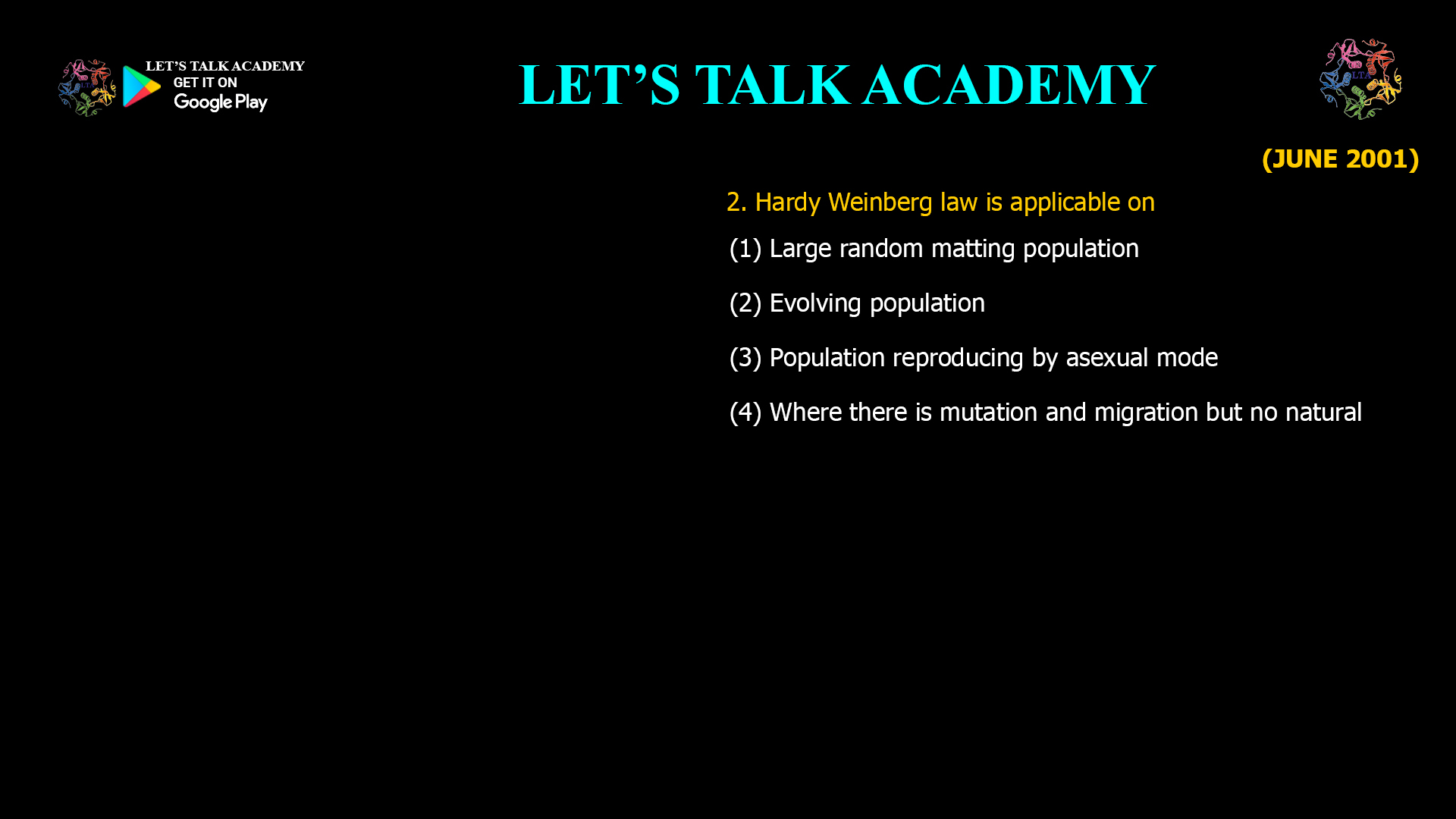
- Hardy Weinberg law is applicable on
(1) Large random matting population
(2) Evolving population
(3) Population reproducing by asexual mode
(4) Where there is mutation and migration but no naturalHardy-Weinberg Law: Applicability and Essential Conditions in Population Genetics
The Hardy-Weinberg law is a foundational principle in population genetics, describing how allele and genotype frequencies remain constant from generation to generation in the absence of evolutionary forces. This equilibrium provides a baseline for detecting when evolution is occurring within a population. But under what conditions does this law actually apply?
Conditions Required for Hardy-Weinberg Equilibrium
For a population to be in Hardy-Weinberg equilibrium, several strict conditions must be met:
-
Large Population Size: The population must be sufficiently large to prevent random changes in allele frequencies due to genetic drift.
-
Random Mating: Individuals must mate randomly, with no preference for specific genotypes.
-
No Mutation: There must be no new mutations introducing new alleles into the population.
-
No Migration: There must be no movement of individuals into or out of the population (no gene flow).
-
No Natural Selection: All genotypes must have equal chances of survival and reproduction—no selective advantage for any allele.
Why Large, Randomly Mating Populations?
The Hardy-Weinberg law is specifically applicable to large, randomly mating populations. In such populations, the effects of genetic drift (random changes in allele frequencies) are minimized, and random mating ensures that genotype frequencies are determined solely by allele frequencies, not by mate choice or inbreeding.
Why Not the Other Options?
-
Evolving populations: The law does not apply to populations undergoing evolution, as evolutionary forces (like selection, mutation, or migration) alter allele frequencies over time.
-
Asexual reproduction: The law assumes sexual reproduction with random mating; asexual populations do not meet this criterion.
-
Mutation and migration present: The presence of mutation or migration introduces new alleles or changes allele frequencies, violating Hardy-Weinberg conditions.
Conclusion: The Correct Answer
The Hardy-Weinberg law is applicable to large, randomly mating populations.
This principle is vital for studying genetic variation and serves as a null model for detecting evolutionary change in natural populations.
Correct answer: (1) Large random mating population
-