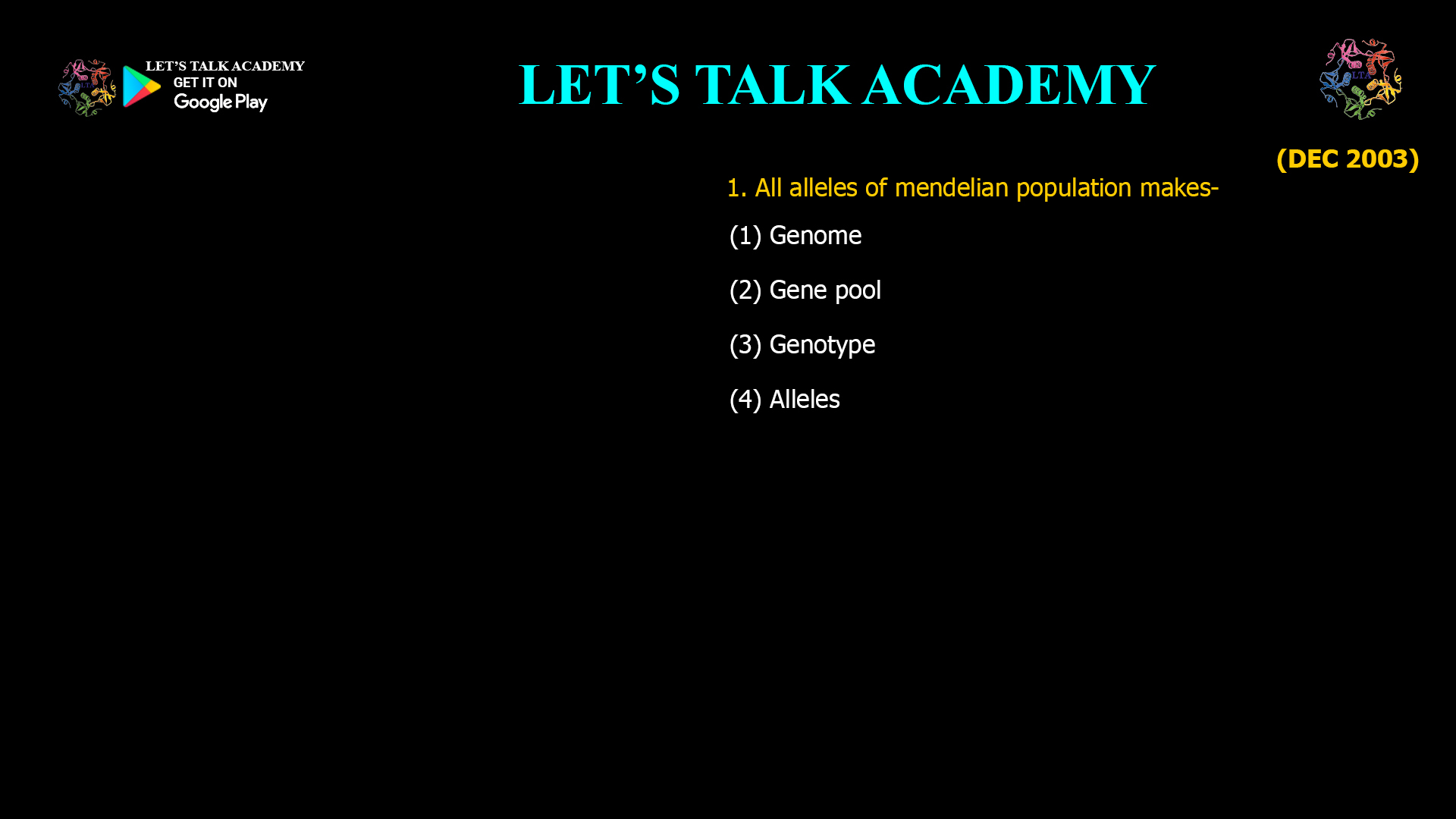
- All alleles of mendelian population makes-
(1) Genome (2) Gene pool
(3) Genotype (4) AllelesWhat Do All Alleles of a Mendelian Population Make? Understanding the Gene Pool
In the field of genetics and evolutionary biology, understanding how genetic variation is organized within a population is fundamental. A key concept that encapsulates this variation is the gene pool. But what exactly does this term mean, and why is it so important? Let’s explore how all alleles in a Mendelian population together form the gene pool, and what this means for the study of genetics and evolution.
What Is a Mendelian Population?
A Mendelian population refers to a group of interbreeding individuals of the same species that share a common set of genes and alleles. These populations are defined by random mating and the potential for genetic exchange among all members, ensuring genetic diversity and the application of Mendel’s laws of inheritance.
Defining the Gene Pool
The gene pool is the complete collection of all the alleles of every gene present in all individuals of a Mendelian population at a specific time. In other words, it is the sum total of all genetic material—every variant, or allele, of every gene—that can be passed on to the next generation.
“The gene pool is the collection of different genes in a population of a particular species at a given time. The gene pool term includes the sum of all the alleles of genes present at all of the loci within a population of a single species.”
Why Is the Gene Pool Important?
-
Genetic Diversity: The gene pool represents the raw material for evolution. The greater the diversity of alleles, the higher the potential for adaptation and survival under changing environmental conditions.
-
Population Health: A large and diverse gene pool is associated with greater biological fitness, resilience to disease, and adaptability.
-
Evolutionary Studies: Changes in the gene pool over time—through mutation, selection, genetic drift, migration, and recombination—drive the evolutionary process.
Gene Pool vs. Other Genetic Terms
Term Definition Genome The complete set of DNA (genes and non-genes) in an individual or species. Genotype The genetic makeup of an individual organism at one or more loci. Allele A specific variant of a gene at a particular locus. Gene Pool The sum total of all alleles of all genes in all individuals of a Mendelian population. Examples in Nature
-
Human Populations: The gene pool includes all the genetic variants present in all humans worldwide, or within a specific population.
-
Plant Populations: In a field of wildflowers, the gene pool encompasses all color, height, and disease-resistance alleles present in the population.
Conclusion: The Correct Answer
All alleles of a Mendelian population make up the gene pool.
This concept is central to population genetics, as it provides the foundation for understanding how genetic variation is maintained, how populations evolve, and how species adapt to their environments.
Correct answer: (2) Gene pool
-