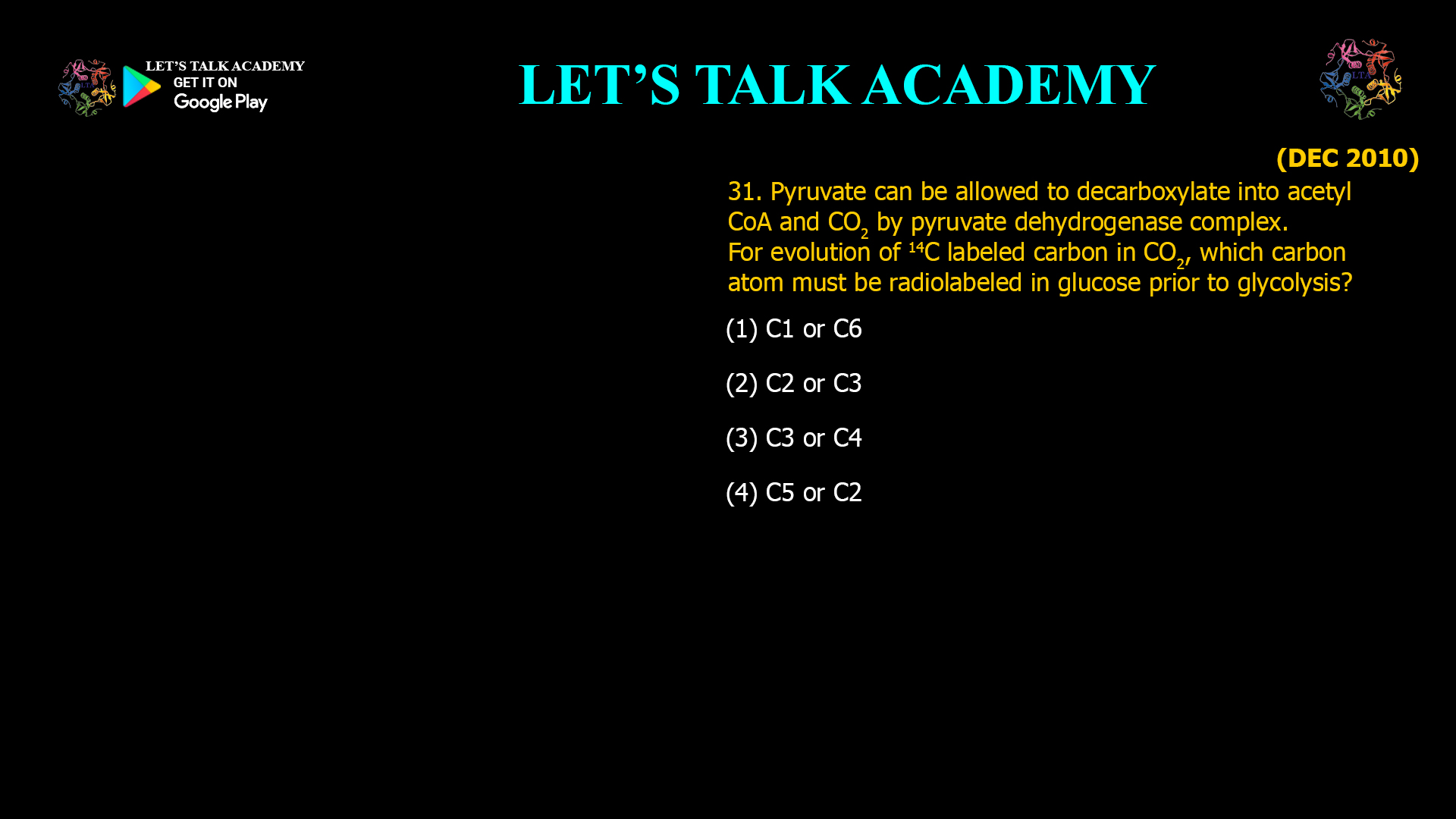
- Pyruvate can be allowed to decarboxylate into acetyl CoA and CO2 by pyruvate
dehydrogenase complex. For evolution of 14C labeled carbon in CO2, which carbon
atom must be radiolabeled in glucose prior to glycolysis?
(1) C1 or C6 (2) C2 or C3
(3) C3 or C4 (4) C5 or C2The conversion of pyruvate to acetyl-CoA by the pyruvate dehydrogenase complex is a pivotal step linking glycolysis to the citric acid cycle. This reaction involves the decarboxylation of pyruvate, releasing carbon dioxide (CO₂). When studying metabolic pathways using radiolabeled glucose, identifying which carbon atoms are released as CO₂ helps trace the biochemical fate of glucose carbons.
This article explains which carbon atoms in glucose must be radiolabeled to observe the evolution of ¹⁴CO₂ during pyruvate decarboxylation.
Background: Glycolysis and Pyruvate Structure
Glucose is a six-carbon sugar (C1 to C6). During glycolysis, it is split into two molecules of pyruvate, each containing three carbons (numbered C1, C2, C3 in pyruvate).
-
The carbons in glucose are rearranged during glycolysis, but the numbering in pyruvate corresponds as follows:
-
Glucose C1, C2, and C3 become pyruvate carbons C3, C2, and C1 respectively in one molecule.
-
The other pyruvate molecule contains glucose carbons C4, C5, and C6.
-
Pyruvate Decarboxylation and CO₂ Release
The pyruvate dehydrogenase complex catalyzes the oxidative decarboxylation of pyruvate:
-
The carboxyl group (C1) of pyruvate is removed as CO₂.
-
The remaining two carbons form acetyl-CoA.
Thus, only the C1 carbon of pyruvate is released as CO₂ during this step.
Mapping Back to Glucose Carbons
Since pyruvate is derived from glucose, to track the carbon released as CO₂, the radiolabel must be on the glucose carbon that becomes C1 of pyruvate.
-
This corresponds to C3 or C4 of glucose, depending on which pyruvate molecule is considered.
Therefore, labeling carbon 3 or carbon 4 of glucose will result in the release of ¹⁴CO₂ during pyruvate decarboxylation.
Summary of Options
Option Description Correctness (1) C1 or C6 Labels glucose carbons 1 or 6 Incorrect (2) C2 or C3 Labels glucose carbons 2 or 3 Partially correct (C3 correct) (3) C3 or C4 Labels glucose carbons 3 or 4 Correct (4) C5 or C2 Labels glucose carbons 5 or 2 Incorrect Conclusion
To observe the evolution of ¹⁴CO₂ during the conversion of pyruvate to acetyl-CoA, the third or fourth carbon of glucose must be radiolabeled prior to glycolysis.
Correct answer: (3) C3 or C4
-


12 Comments
Kirti Agarwal
September 18, 2025Glucose break in 2 molecule of pyruvate.
1st molecule of pyruvate contain cabon 1,2,3 and 2nd molecule of pyruvate contain carbon 4 , 5,6 so carbon 3,4 is labeled
Pallavi Ghangas
September 22, 2025c3, c4
Dharmpal Swami
September 23, 2025Labelled glucose carbon are C3 and C4
Aakansha Sharma sharma
September 23, 2025Labelled glucose carbon are C3 and C4
Heena Mahlawat
September 24, 2025C3 and C4
Roopal Sharma
September 24, 2025Carbon 3 and 4 should be radiolabeled
Minal Sethi
September 24, 2025the evolution of ¹⁴CO₂ during the conversion of pyruvate to acetyl-CoA, the third or fourth carbon of glucose must be radiolabeled prior to glycolysis.
C3 and C4
Deepika sheoran
September 24, 2025C3 and C4
Mohd juber Ali
September 25, 2025C3 and c4 carbon must be radiolabeled during the conversion of py to acetyl coA
Arushi Saini
September 27, 2025the evolution of ¹⁴CO₂ during the conversion of pyruvate to acetyl-CoA, the third or fourth carbon of glucose must be radiolabeled prior to glycolysis.
C3 and C4
Varsha Tatla
September 27, 2025C3,c4
Kajal
October 2, 2025C3 and c4 must be radio labelled prior to glycolysis