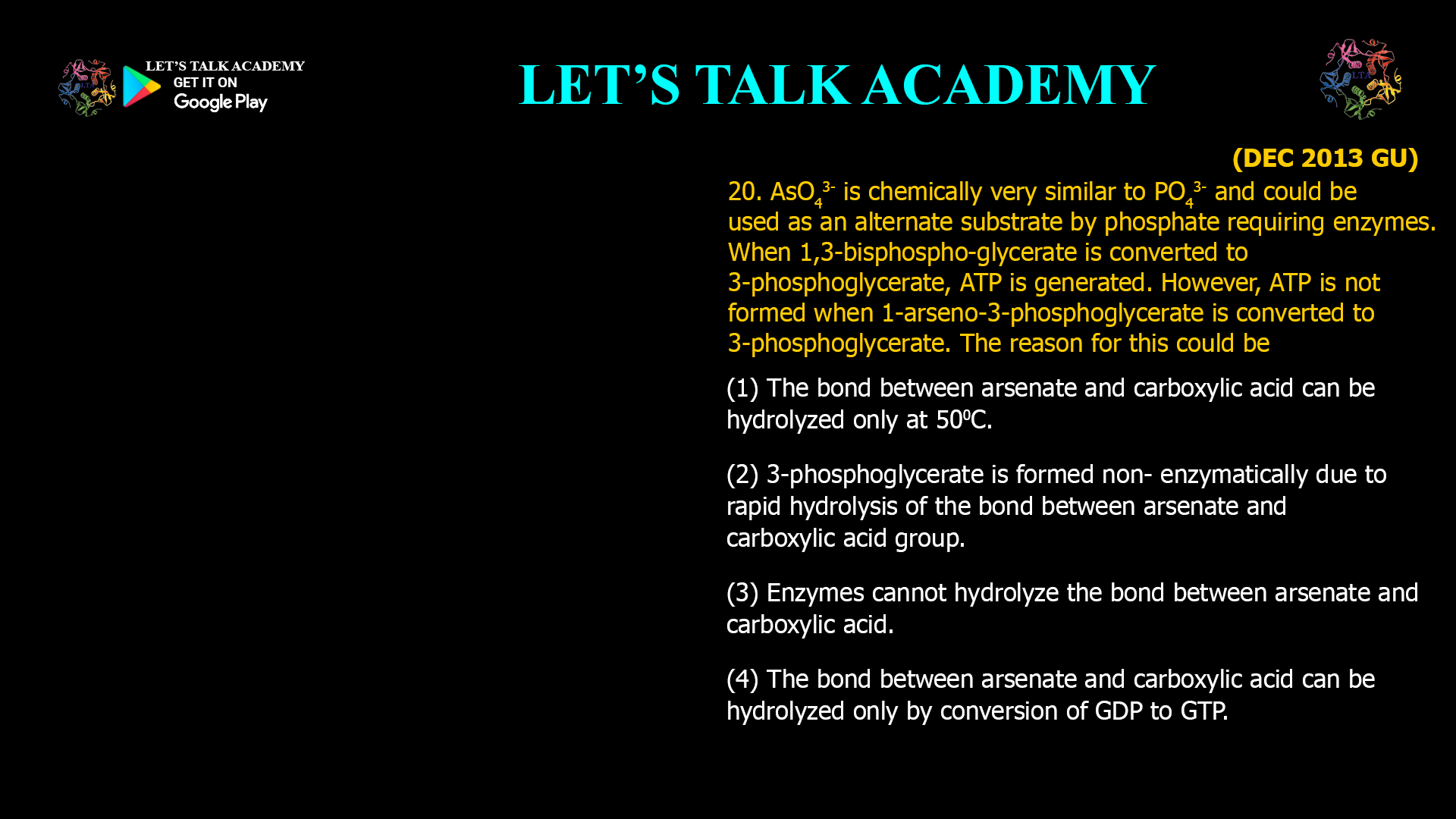
- AsO43- is chemically very similar to PO43- and could be used as an alternate substrate by phosphate requiring enzymes. When 1,3-bisphospho-glycerate is converted to 3-phosphoglycerate, A TP is generated. However, ATP is not formed when 1-arseno-3-phosphoglycerate is converted to 3-phosphoglycerate. The reason for this could be
(1) The bond between arsenate and carboxylic acid can be hydrolyzed only at 500C.
(2) 3-phosphoglycerate is formed non- enzymatically due to rapid hydrolysis of the bond between arsenate and carboxylic acid group.
(3) Enzymes cannot hydrolyze the bond between arsenate and carboxylic acid.
(4) The bond between arsenate and carboxylic acid can be hydrolyzed only by conversion of GDP to GTP.
Arsenate (AsO4^3−) is chemically very similar to phosphate (PO4^3−), allowing it to act as a phosphate analog in many biochemical reactions. This similarity enables arsenate to substitute phosphate in phosphate-requiring enzymes, sometimes leading to unique biochemical consequences.
One such example is the conversion of 1,3-bisphosphoglycerate (1,3-BPG) to 3-phosphoglycerate (3-PG) during glycolysis, a step that normally produces ATP. However, when arsenate replaces phosphate to form 1-arseno-3-phosphoglycerate, ATP is not generated upon its conversion to 3-phosphoglycerate. This article explains the biochemical reason behind this phenomenon.
The Normal Glycolytic Step: 1,3-Bisphosphoglycerate to 3-Phosphoglycerate
In glycolysis, the enzyme phosphoglycerate kinase catalyzes the transfer of a high-energy phosphate group from 1,3-BPG to ADP, forming ATP and 3-PG. This reaction is a substrate-level phosphorylation, directly generating ATP.
Arsenate Substitution and Its Effects
When arsenate substitutes phosphate, the molecule formed is 1-arseno-3-phosphoglycerate. Although arsenate can bind similarly to phosphate in the enzyme’s active site and participate in the reaction, the key difference lies in the stability of the arsenate ester bond.
Rapid Hydrolysis of Arsenate Esters
-
The bond between arsenate and the carboxylic acid group in 1-arseno-3-phosphoglycerate is chemically unstable.
-
This bond undergoes rapid non-enzymatic hydrolysis, breaking down spontaneously before ATP can be formed.
-
As a result, 3-phosphoglycerate is formed directly, but without the concomitant production of ATP.
This contrasts with the phosphate ester bond in 1,3-BPG, which is sufficiently stable to allow enzymatic transfer of the phosphate group to ADP.
Why ATP Is Not Formed
The rapid hydrolysis of the arsenate ester bond means that the high-energy intermediate required for substrate-level phosphorylation is short-lived and does not persist long enough for ATP synthesis. Consequently, the energy that would normally be conserved as ATP is lost as heat.
Evaluating the Given Options
-
The bond between arsenate and carboxylic acid can be hydrolyzed only at 50°C.
-
Incorrect. Hydrolysis occurs rapidly at physiological temperatures, not requiring elevated temperatures.
-
-
3-phosphoglycerate is formed non-enzymatically due to rapid hydrolysis of the bond between arsenate and carboxylic acid group.
-
Correct. This explains why ATP is not formed.
-
-
Enzymes cannot hydrolyze the bond between arsenate and carboxylic acid.
-
Incorrect. The bond hydrolyzes spontaneously, not due to enzyme inability.
-
-
The bond between arsenate and carboxylic acid can be hydrolyzed only by conversion of GDP to GTP.
-
Incorrect. This process is unrelated to arsenate hydrolysis.
-
Summary
Option Explanation Correctness (1) Hydrolysis requires 50°C Incorrect (2) Rapid non-enzymatic hydrolysis forms 3-PG without ATP formation Correct (3) Enzymes cannot hydrolyze arsenate-carboxylic acid bond Incorrect (4) Hydrolysis linked to GDP to GTP conversion Incorrect Conclusion
The reason ATP is not generated when 1-arseno-3-phosphoglycerate converts to 3-phosphoglycerate is because the arsenate ester bond is highly unstable and undergoes rapid non-enzymatic hydrolysis. This prevents the formation of the high-energy intermediate necessary for substrate-level phosphorylation and ATP synthesis.
Correct answer: (2) 3-phosphoglycerate is formed non- enzymatically due to rapid hydrolysis of the bond between arsenate and carboxylic acid group.
-


9 Comments
Manisha choudhary
September 22, 2025Arsenic chemically very similar to phosphate group
arsinate ester bond is highly unstable
Rapidly hydrolysis without enymatically and without formation of ATP
Pallavi Ghangas
September 22, 20253-phosphoglycerate is formed non-enzymatically due to rapid hydrolysis of the bond between arsenate and carboxylic acid group.
Aakansha sharma Sharma
September 22, 20253-phosphoglycerate is formed non-enzymatically due to rapid hydrolysis of the bond between arsenate and carboxylic acid group.
Roopal Sharma
September 23, 2025Rapid Hydrolysis occur
Minal Sethi
September 24, 2025The arsenate ester bond is highly unstable and undergoes rapid non-enzymatic hydrolysis. This prevents the formation of the high-energy intermediate necessary for substrate-level phosphorylation and ATP synthesis.
option 2
Soniya Shekhawat
September 24, 2025Arsenate allows glycolysis to continue but bypasses ATP generation because the arsenate compound is too unstable to transfer energy bcz rapidly hydrolysis without forming of ATP.
Arushi Saini
September 27, 20253-phosphoglycerate is formed non- enzymatically due to rapid hydrolysis of the bond between arsenate and carboxylic acid group.
Kajal
October 2, 2025Option 2 due to bond unstability
Sakshi Kanwar
November 26, 20253-phosphoglycerate is formed non- enzymatically due to rapid hydrolysis of the bond between arsenate and carboxylic acid group