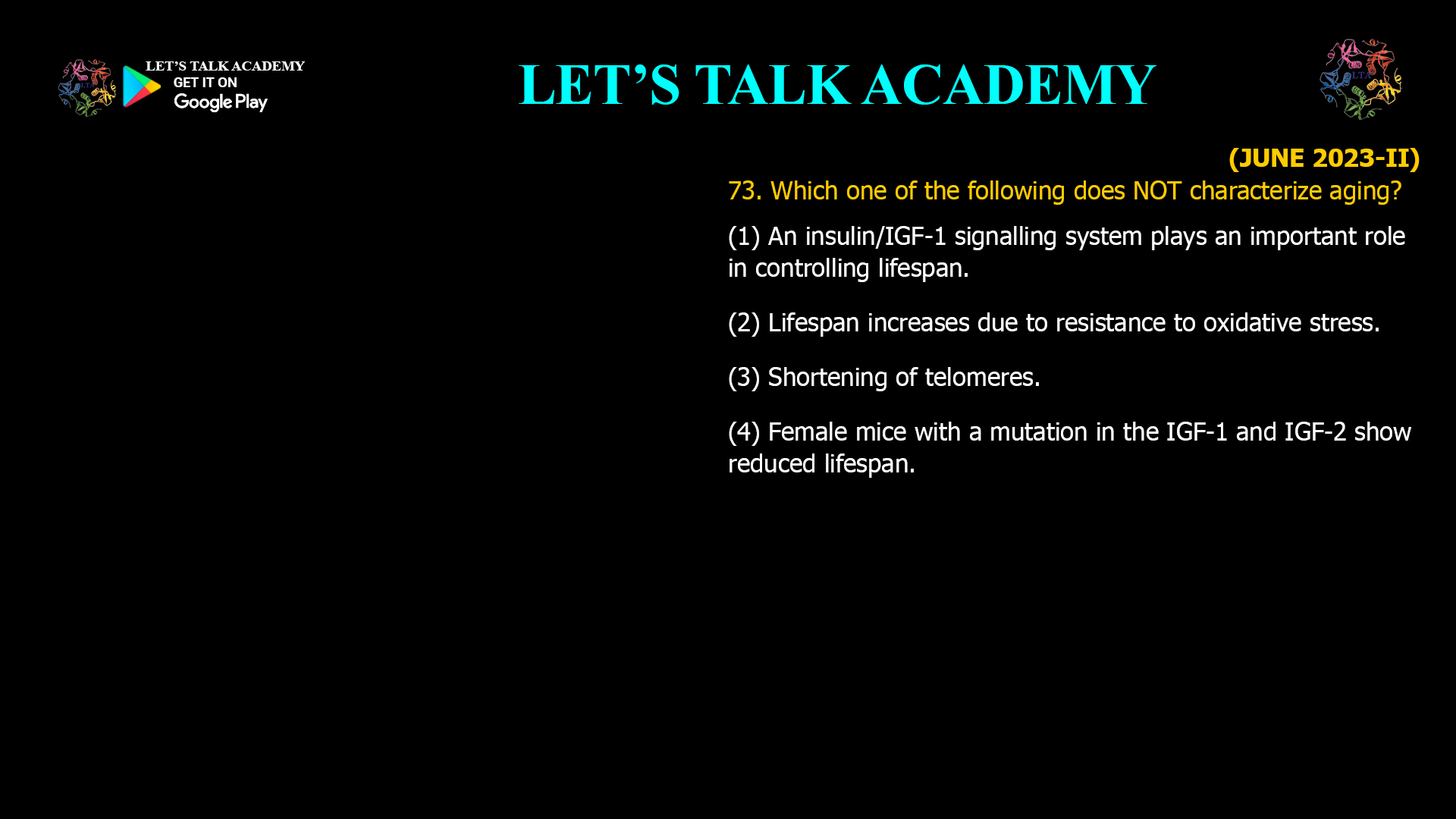
- Which one of the following does NOT characterize aging?
(I) An insulin/IGF-I signaling system plays an important role in controlling lifespan.
(2) Lifespan increases due to resistance to oxidative stress.
(3) Shortening of telomeres.
(4) Female mice with a mutation in the IGF-1 and IGF-2 show reduced lifespan.
Analysis of the Statements
-
An insulin/IGF-I signaling system plays an important role in controlling lifespan.
-
True. The insulin/IGF-1 signaling (IIS) pathway is evolutionarily conserved and plays a pivotal role in regulating longevity across species, including C. elegans, flies, mice, and humans. Reduced IIS activity is often associated with increased lifespan and stress resistance.
-
-
Lifespan increases due to resistance to oxidative stress.
-
True. Enhanced resistance to oxidative stress is a well-known factor contributing to increased lifespan. Organisms with better oxidative stress defenses tend to live longer.
-
-
Shortening of telomeres.
-
True. Telomere shortening is a hallmark of cellular aging and contributes to replicative senescence and organismal aging.
-
-
Female mice with a mutation in the IGF-1 and IGF-2 show reduced lifespan.
-
False. Studies show that reduced IGF-1 signaling (such as in Igf1r heterozygous knockout mice) actually increases lifespan, especially in females. Reduced IGF signaling is linked to longevity, not decreased lifespan.
-
Conclusion
The statement that does NOT characterize aging is:
(4) Female mice with a mutation in the IGF-1 and IGF-2 show reduced lifespan.
This is incorrect because mutations that reduce IGF-1 signaling generally increase lifespan in female mice.
Keywords
aging, insulin/IGF-1 signaling, lifespan regulation, oxidative stress resistance, telomere shortening, IGF-1 mutation, mouse longevity, aging pathways
Correct answer:
(4) Female mice with a mutation in the IGF-1 and IGF-2 show reduced lifespan.


14 Comments
Kajal
July 29, 2025Option 4 is correct
Not aware about all options only know about the 3rd one properly but now clear
Alec Joseph
July 29, 2025Correct ans is 4 because reduction in IGF signaling increases lifespan .
Anisha jakhar
July 29, 2025Option 4 .This is incorrect because mutations reducing IGF-1 signaling increases lifespan in female mice.
Aman Choudhary
July 29, 2025Upar wale 3 aate the 4th wale ka pata chal gaya
Dipti Sharma
July 29, 2025Understood
Soniya Shekhawat
July 30, 2025Mutation in IGF-1 and IGF-2 is increase the lifespan of female mice so 4 is correct answer
Niti Tanwar
July 30, 2025Correct answer is 4
Shivani panwar
July 30, 2025Ans is 4th
Manisha choudhary
July 30, 2025Oxidative stress s resistance may be DNA m kuch esi gene on kr de jo life span bdha de oxidative stress may be esi gene ko on krta hoga jo harmful ho jo lifespan ko km krti ho
IGF 1-2 ki signalling m kmi hogi yaa mutation ho jaaye jis s signalling km ho jaaye yaa bndh ho jaaye too life span bdha jaayega y c elegance flies mice humans hota h
Mohini
August 2, 2025understood sir
Mahima Sharma
August 3, 2025No idea
Aafreen Khan
August 23, 2025Not characterize aging is:-
Female mice with a mutation in the IGF-1 and IGF-2 show reduced lifespan
Nilofar Khan
August 23, 2025Correct answer is(d)
The statement that does’nt characterize aging is-
Female mice with a mutation in the IGF-1 and IGF-2 show reduced lifespan.
Deepika Sheoran
November 7, 2025Because reduction in IGF signalling increases lifespam.