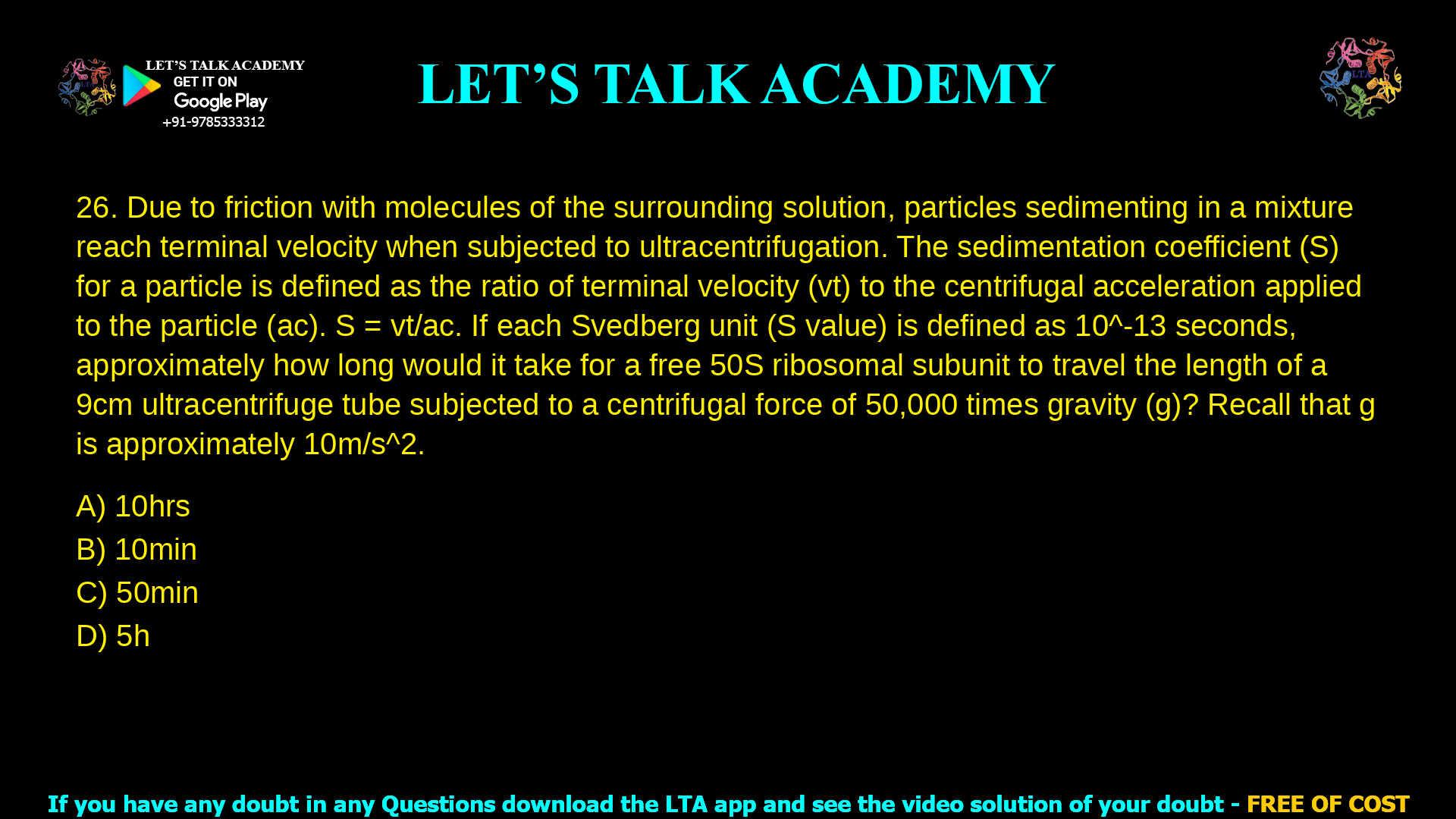
11. Due to friction with molecules of the surrounding solution, particles sedimenting in a
mixture reach terminal velocity when subjected to ultracentrifugation. The
sedimentation coefficient (S) for a particle is defined as the ratio of terminal velocity
(vt) to the centrifugal acceleration applied to the particle (ac).
S = vt / ac
If each Svedberg unit (S value) is defined as 10–13 seconds, approximately how long
would it take for a free 50S ribosomal subunit to travel the length of a 9 cm
ultracentrifuge tube subjected to a centrifugal force of 50,000 times gravity (g)?
Recall that g is approximately 10 m/s2.
a. 10 hrs
b. 10 min
c. 50 min
d. 5 h
Question Context
A 50S ribosomal subunit reaches terminal velocity in ultracentrifugation,
sedimenting through a 9 cm tube under 50,000 × g in approximately 10 hours.
Sedimentation Basics
The sedimentation coefficient (S) equals terminal velocity (vt)
divided by centrifugal acceleration (ac), so:
vt = S × ac
For a 50S ribosomal subunit, S = 50 × 10−13 s;
tube length = 0.09 m; and
ac = 50,000 × 10 = 5 × 10⁵ m/s².
The time required is distance divided by vt,
yielding t = 36,000 s ≈ 10 hours.
Calculation Steps
- Convert units: S = 5 × 10⁻¹² s.
- Compute terminal velocity: vt = S × ac = 2.5 × 10⁻⁶ m/s.
- Calculate time:
t = 0.09 / 2.5×10⁻⁶ = 36,000 s ≈ 600 min = 10 hours.
Friction balances force at terminal velocity, making the sedimentation coefficient depend on particle size and shape.
Option Analysis
- a. 10 hrs: Matches calculation exactly (36,000 s). ✅
- b. 10 min: Too short; equals 600 s, off by factor of 60.
- c. 50 min: Equals 3,000 s; underestimates by 12-fold.
- d. 5 h: Equals 18,000 s; half the correct time.
Correct answer: a. 10 hrs.
Introduction to Sedimentation Coefficient in Ultracentrifugation
The sedimentation coefficient measures how quickly particles like the
50S ribosomal subunit settle under centrifugal force in
ultracentrifugation. Defined as S = vt / ac,
where one Svedberg unit (S) = 10−13 s, it helps calculate how long
it takes a particle to travel through a 9 cm ultracentrifuge tube at 50,000 × g.
This concept frequently appears in CSIR NET Life Sciences questions
testing knowledge of terminal velocity and ribosomal sedimentation.
Understanding 50S Ribosomal Subunit Properties
Bacterial 50S ribosomal subunits sediment at 50 Svedbergs,
comprising 23S rRNA, 5S rRNA, and 31 proteins.
Friction with solvent molecules limits speed to terminal velocity
during ultracentrifugation, and standard tubes of ~9 cm length are
typical for these experiments.
Step-by-Step Time Calculation
S = 50 × 10−13 s;
ac = 50,000 × 10 = 5 × 10⁵ m/s².
Terminal velocity vt = S × ac = 2.5 × 10⁻⁶ m/s.
Distance = 0.09 m → t = 0.09 / 2.5×10−6 = 36,000 s = 10 hours.
Confirmed answer: a. 10 hrs.
Common Errors in Options
| Option | Time (s) | Error Factor | Reason |
|---|---|---|---|
| a. 10 hrs | 36,000 | None | Correct |
| b. 10 min | 600 | ×60 | Minutes mistaken for hours |
| c. 50 min | 3,000 | ×12 | Partial calculation error |
| d. 5 h | 18,000 | ×2 | Halved distance/velocity |
CSIR NET Exam Relevance
Understanding sedimentation coefficients and ultracentrifugation principles
is essential for biochemistry and cell biology
units in the CSIR NET Life Sciences syllabus. Mastery of units, conversions
(cm → m, g = 10 m/s²), and proportional reasoning helps avoid frequent errors
in similar numerical problems.


