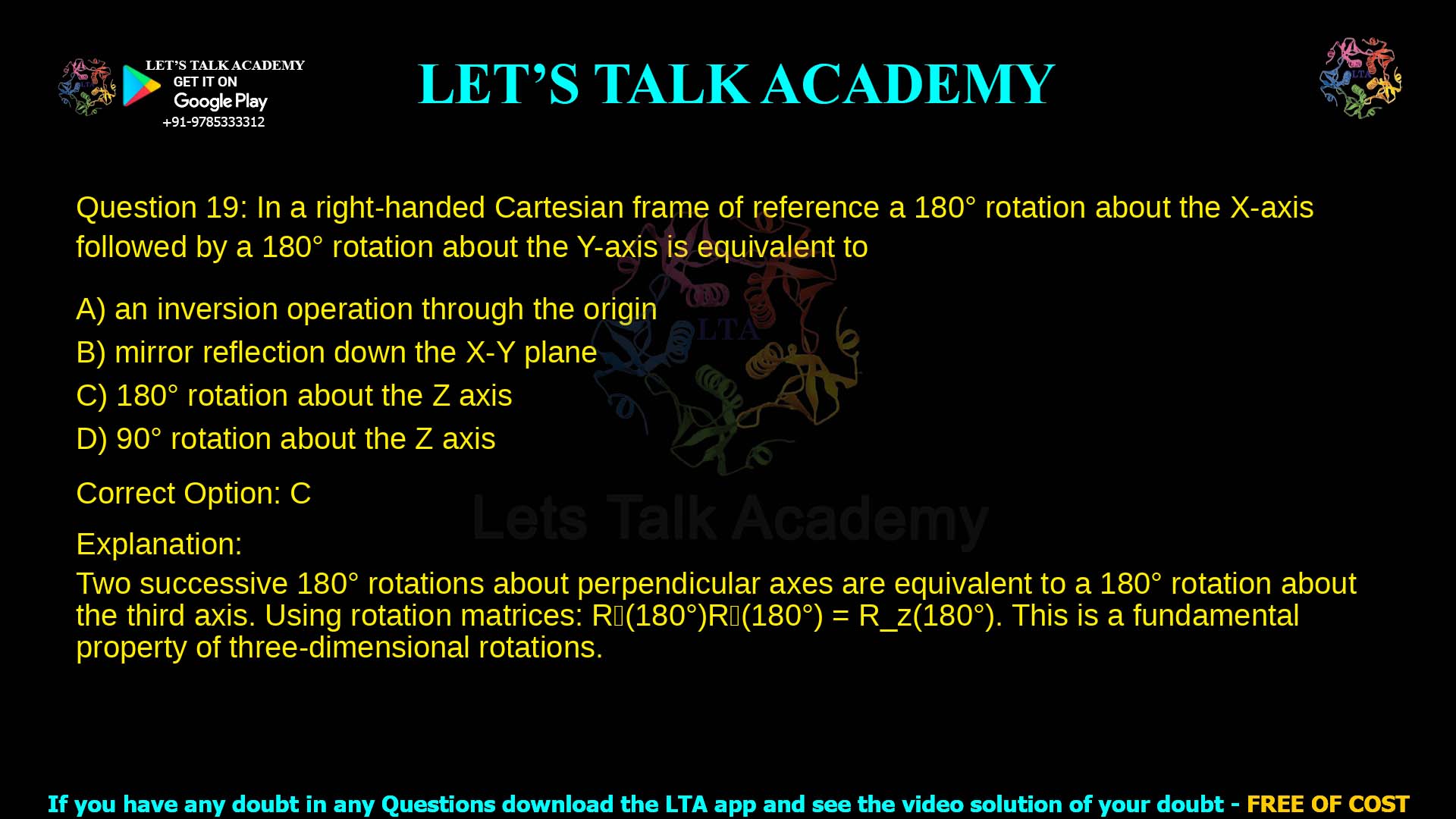
4. In a right-handed Cartesian frame of reference a 180° rotation about the X-axis
followed by a 180° rotation about the Y-axis is equivalent to
a. an inversion operation through the origin
b. mirror reflection down the X-Y plane
c. 180° rotation about the Z axis
d. 90° rotation about the Z axis
180° Rotation X-Axis Followed by 180° Y-Axis: Equivalent Transformation Explained
In a right-handed Cartesian frame, a 180° rotation about the X-axis followed by a 180° rotation about the Y-axis combines to a specific 3D transformation matching one exam option.
Matrix Calculation
Rotation matrices confirm the result. The X-axis 180° matrix \( R_x = \begin{pmatrix} 1 & 0 & 0 \\ 0 & -1 & 0 \\ 0 & 0 & -1 \end{pmatrix} \) flips Y and Z coordinates. The Y-axis 180° matrix \( R_y = \begin{pmatrix} -1 & 0 & 0 \\ 0 & 1 & 0 \\ 0 & 0 & -1 \end{pmatrix} \) flips X and Z coordinates. Their composition \( R_y R_x = \begin{pmatrix} -1 & 0 & 0 \\ 0 & -1 & 0 \\ 0 & 0 & 1 \end{pmatrix} \) matches a 180° Z-axis rotation.
Option Analysis
- a. Inversion through origin: Matrix \( -I = \begin{pmatrix} -1 & 0 & 0 \\ 0 & -1 & 0 \\ 0 & 0 & -1 \end{pmatrix} \) negates all coordinates, differing by Z sign.
- b. Mirror XY plane: Matrix \( \begin{pmatrix} 1 & 0 & 0 \\ 0 & 1 & 0 \\ 0 & 0 & -1 \end{pmatrix} \) keeps X,Y unchanged but flips Z, not matching.
- c. 180° Z-axis rotation: Matrix \( \begin{pmatrix} -1 & 0 & 0 \\ 0 & -1 & 0 \\ 0 & 0 & 1 \end{pmatrix} \) exactly equals the composition, confirming equivalence.
- d. 90° Z-axis rotation: Matrix \( \begin{pmatrix} 0 & -1 & 0 \\ 1 & 0 & 0 \\ 0 & 0 & 1 \end{pmatrix} \) cycles coordinates, unrelated.
Correct answer: c.
In right-handed Cartesian frames common to physics and chemistry exams like CSIR NET, composing a 180° rotation X-axis followed by 180° Y-axis equivalent reveals key symmetry insights. This sequence transforms points predictably via matrix multiplication, aiding group theory and crystallography studies.
Transformation Breakdown
The operation applies first \( R_x(180^\circ) \), then \( R_y(180^\circ) \), yielding \( \begin{pmatrix} -1 & 0 & 0 \\ 0 & -1 & 0 \\ 0 & 0 & 1 \end{pmatrix} \). Test on (1,1,1): becomes (-1,-1,1), matching 180° Z-rotation which negates X,Y while preserving Z direction. Right-hand rule ensures positive angles follow thumb-to-fingers curl.
Why Not Other Options?
| Option | Matrix | Effect on (1,1,1) | Matches? |
|---|---|---|---|
| a. Inversion | diag(-1,-1,-1) | (-1,-1,-1) | No |
| b. XY Mirror | diag(1,1,-1) | (1,1,-1) | No |
| c. 180° Z | diag(-1,-1,1) | (-1,-1,1) | Yes |
| d. 90° Z | [[0,-1,0],[1,0,0],[0,0,1]] | (-1,1,1) | No |
This equivalence stems from SO(3) group properties where axis rotations compose orthogonally. For CSIR NET Life Sciences or Physical Sciences, recognize such relations distinguish proper rotations from improper ones like reflections.


