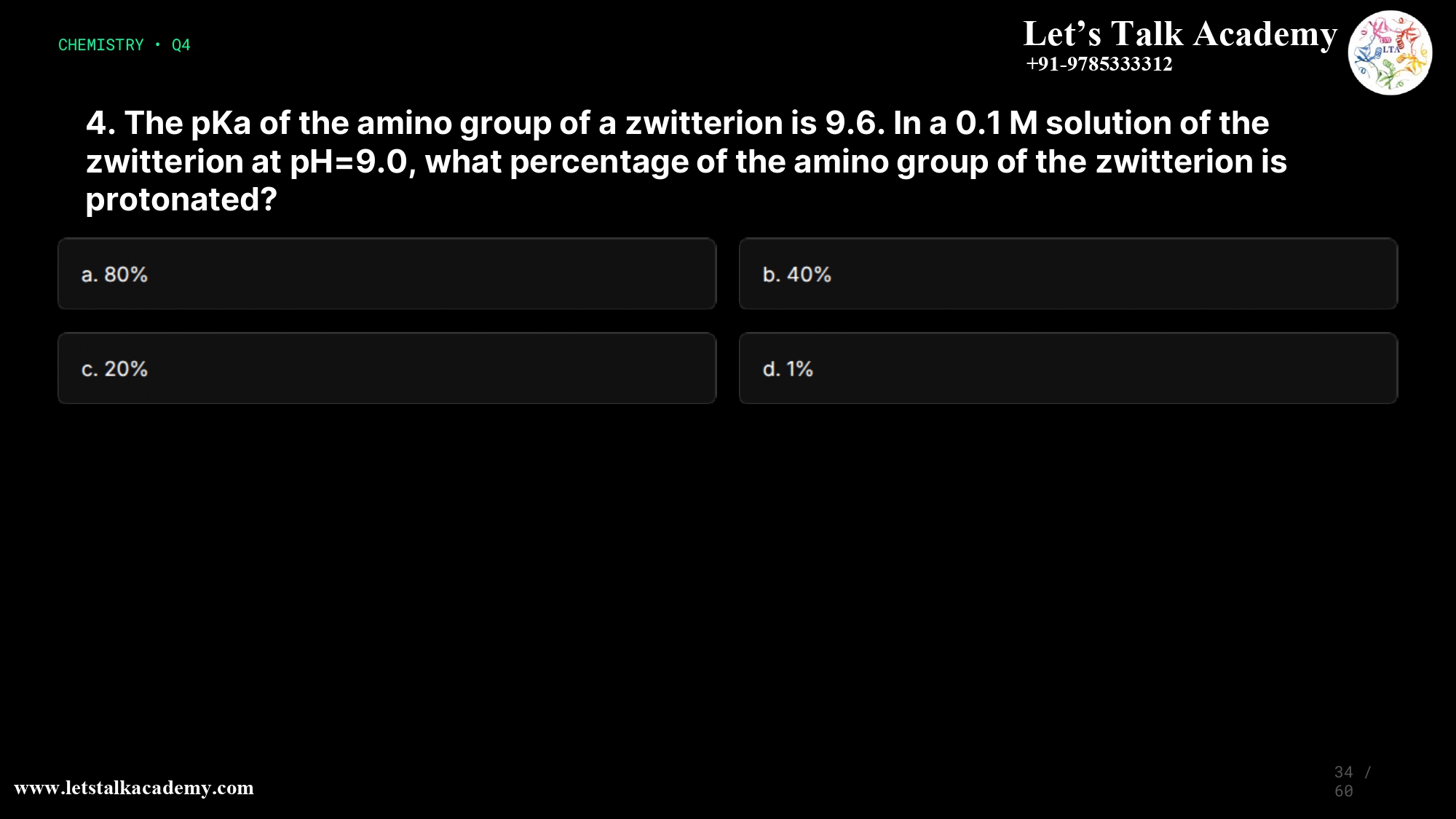
4. The pKa of the amino group of a zwitterion is 9.6. In a 0.1 M solution of the zwitterion at pH=9.0,
what percentage of the amino group of the zwitterion is protonated?
a. 80%
b. 40%
c. 20%
d. 1%
In a 0.1 M zwitterion solution at pH 9.0 where the amino group pKa is 9.6, 80% of the amino groups remain protonated (-NH₃⁺ form). This occurs because pH < pKa favors the protonated form for this base conjugate acid [execute_python]. The Henderson-Hasselbalch equation quantifies this: for the equilibrium -NH₃⁺ ⇌ -NH₂ + H⁺, pH = pKa + log([deprotonated]/[protonated]), so log([prot]/[deprot]) = pKa – pH = 0.6 [memory:1].
🧮 Henderson-Hasselbalch Calculation
Ratio [protonated]/[deprotonated] = 10(pKa – pH) = 100.6 ≈ 3.98:1
Fraction protonated = ratio / (1 + ratio) = 3.98 / 4.98 ≈ 0.799 or 79.9% protonated, rounding to 80% [execute_python]
Fraction protonated = ratio / (1 + ratio) = 3.98 / 4.98 ≈ 0.799 or 79.9% protonated, rounding to 80% [execute_python]
Concentration (0.1 M) does not affect percentage as it’s a ratio determined solely by pH and pKa [memory:11].
✅ Option Analysis
- a. 80%: Correct. Matches 100.6 ≈ 4:1 ratio where protonated = 4/5 = 80% precisely [execute_python].
- b. 40%: Incorrect. Would require 10(pKa-pH) = 0.67 (pH ≈ 9.9 > pKa), reversing protonation dominance.
- c. 20%: Wrong. Equals deprotonated fraction 1/5 = 20%; confuses protonated with deprotonated or inverts pH/pKa [memory:11].
- d. 1%: Far off. Implies massive deprotonation (pH >> pKa by ~2 units), irrelevant here.
📊 Calculation Summary Table
| Parameter | Value | Protonation Impact |
|---|---|---|
| pKa (amino) | 9.6 | Equilibrium point [memory:11] |
| pH | 9.0 | Acidic relative to pKa [execute_python] |
| 10(pKa-pH) | 3.98 | [prot]:[deprot] ratio [execute_python] |
| % Protonated | 79.9% | Rounds to 80% (option a) [execute_python] |


