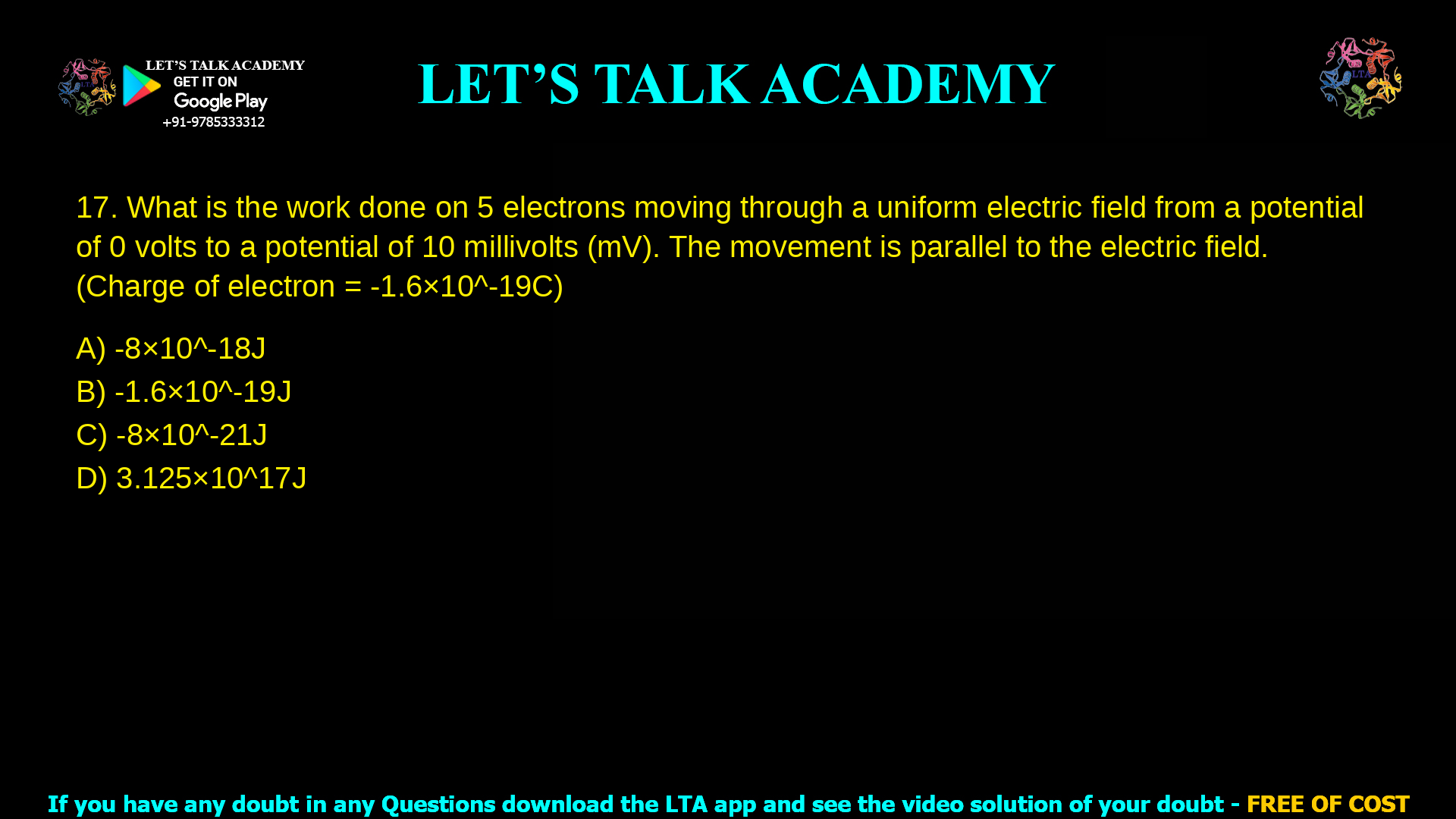
2. What is the work done on 5 electrons moving through a uniform electric field from a
potential of 0 volts to a potential of 10 millivolts (mV). The movement is parallel to the
electric field.
(Charge of electron = – 1.6 × 10⁻¹⁹ C)
a. – 8 × 10-18 J
b. -1.6 10-19 J
c. – 8 × 10-21 J
d. 3.125 × 10¹⁷ J
Concept and Formula
Work done by or on a charge in an electric field when it moves through a potential difference ΔV is given by
ΔU = qΔV, where ΔU is the change in electric potential energy and q is the charge.
For multiple identical charges, total charge is Qtotal = n × q, so ΔU = Qtotal ΔV.
Given Data
- Charge of one electron: qe = −1.6 × 10⁻¹⁹ C
- Number of electrons: n = 5
- Initial potential: Vi = 0 V
- Final potential: Vf = 10 mV = 10 × 10−3 V = 0.01 V
- Potential difference: ΔV = Vf − Vi = 0.01 V
Total Charge and Work Done
Total charge of 5 electrons:
Qtotal = 5 × (−1.6 × 10⁻¹⁹) = −8.0 × 10⁻¹⁹ C.
Change in potential energy (work done on the electrons):
ΔU = Qtotal ΔV = (−8.0 × 10−19) × 0.01 = −8.0 × 10⁻²¹ J.
Thus, the work done on the 5 electrons is −8 × 10⁻²¹ J.
Explanation of Each Option
Option (a) −8 × 10⁻¹⁸ J
This value is larger by a factor of 103 compared to the correct answer.
It likely comes from incorrectly taking 10 mV as 10 V instead of 0.01 V, i.e., using ΔV = 10 V gives
(−8 × 10−19) × 10 = −8 × 10⁻¹⁸ J.
Option (b) −1.6 × 10⁻¹⁹ J
This looks like the charge of a single electron in magnitude, not the calculated work.
It could come from confusing charge (q) with energy, or from using only one electron instead of 5 and still not multiplying by the correct potential difference.
Option (c) −8 × 10⁻²¹ J (Correct)
This matches the correct calculation:
- Total charge of 5 electrons: −8 × 10⁻¹⁹ C
- Potential difference: 0.01 V
- Work done: ΔU = (−8 × 10−19) × 0.01 = −8 × 10⁻²¹ J
The negative sign indicates that the potential energy of the electrons decreases as they move to a higher potential (since electrons are negatively charged), consistent with motion parallel to the electric field direction.
Option (d) 3.125 × 10¹⁷ J
This value is unphysically huge for microscopic charges and clearly incorrect.
It most likely arises from a severe unit or exponent error, such as inverting powers of 10 or mixing up joules and electron-volts without proper conversion.
Brief Introduction for SEO
Understanding how to calculate the work done on electrons moving through a uniform electric field is essential for mastering electrostatics, semiconductor physics, and competitive exams like CSIR NET, GATE, and JEE.
By applying the simple relation ΔU = qΔV, students can quickly solve MCQs involving electrons moving between two potentials, provided they handle units such as millivolts (mV) correctly.


