Toxoplasma is a parasite known to induce behavioural changes in mice, such
as making them less fearful of cats. About 30-70% of humans are thought to
be infected by Toxoplasma. A study was conducted to determine if reckless
driving leading to motor accidents could be due to toxoplasma infection (Flegr
et al 2002) and the following data were obtained:
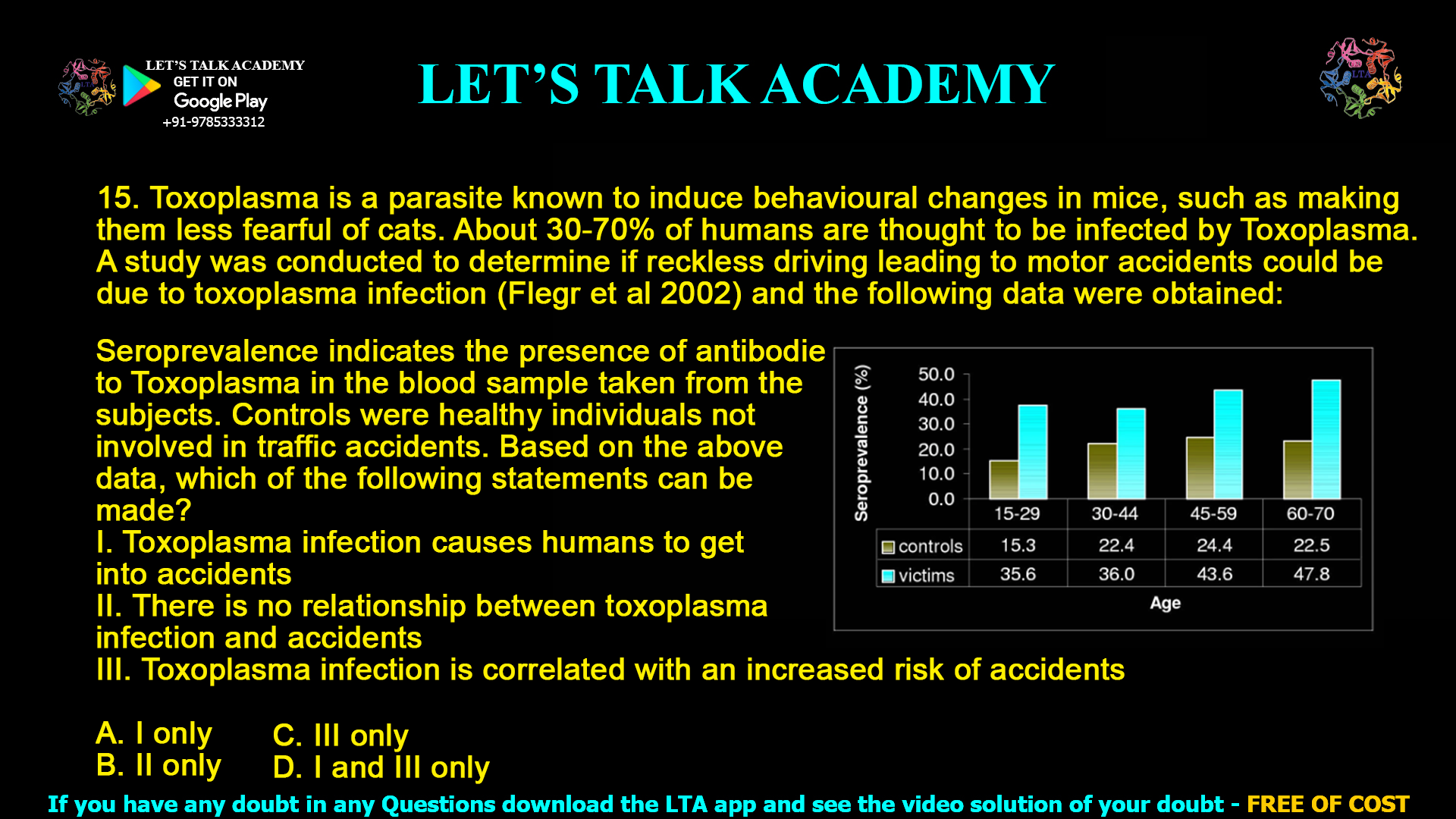
Seroprevalence indicates the presence of antibodies to Toxoplasma in the
blood sample taken from the subjects. Controls were healthy individuals not
involved in traffic accidents. Based on the above data, which of the following
statements can be made?
- Toxoplasma infection causes humans to get into accidents
- There is no relationship between toxoplasma infection and accidents
III. Toxoplasma infection is correlated with an increased risk of accidents
I only
II only
III only
I and III only
A common exam question in biology and epidemiology asks about the relationship between Toxoplasma infection and motor vehicle accidents. The slide you shared describes a study (Flegr et al., 2002) that compared the seroprevalence of Toxoplasma antibodies in:
-
Victims of traffic accidents
-
Controls (healthy individuals not involved in traffic accidents)
The data are shown for four age groups. In every age group, the percentage of Toxoplasma‑positive accident victims is higher than that of controls.
Based on this, the question asks:
Which of the following statements can be made?
I. Toxoplasma infection causes humans to get into accidents
II. There is no relationship between Toxoplasma infection and accidents
III. Toxoplasma infection is correlated with an increased risk of accidents
Options:
A. I only
B. II only
C. III only
D. I and III only
Correct answer
Correct option: C. III only
The data support a correlation between Toxoplasma infection and a higher risk of road accidents, but they do not prove that the infection causes accidents.
Why option I is incorrect
Statement I: “Toxoplasma infection causes humans to get into accidents.”
-
The study design described is a case–control study: it compares accident victims with non‑victim controls and measures how many in each group have Toxoplasma antibodies.
-
Case–control data can show that infection is more common in accident victims, but it cannot establish causation by itself.
-
Many confounding factors might exist: risk‑taking behavior, alcohol use, sleep patterns, or other health issues could be associated both with Toxoplasma infection and accident risk.
-
To claim causation, we would need stronger evidence (e.g., prospective cohort studies, experimental or mechanistic proof that infection directly alters human behavior in a way that leads to accidents).
Therefore, although Toxoplasma might be a possible cause, the given data alone only show an association, so statement I is not justified.
Why option II is incorrect
Statement II: “There is no relationship between toxoplasma infection and accidents.”
-
The graph clearly shows that in every age group (15–29, 30–44, 45–59, 60–70), the seroprevalence (%) of Toxoplasma antibodies is higher in accident victims than in controls.
-
Example from the table in the figure (approximate values):
-
Age 15–29: controls 15.3%, victims 35.6%
-
Age 30–44: controls 22.4%, victims 36.0%
-
Age 45–59: controls 24.4%, victims 43.6%
-
Age 60–70: controls 22.5%, victims 47.8%
-
-
This consistent pattern across all age groups strongly indicates a relationship.
Since the prevalence is not equal and victims are more frequently infected, there is a relationship, so statement II is clearly false.
Why option III is correct
Statement III: “Toxoplasma infection is correlated with an increased risk of accidents.”
-
The term “correlated” means that two variables show a statistical association: when one is present, the other tends to occur more often. It does not automatically imply causation.
-
In the given data, accident victims in every age group have a higher seroprevalence of Toxoplasma than controls.
-
This pattern supports the conclusion that Toxoplasma infection is correlated with an increased risk of accidents.
Because the study design can support association but not cause-and-effect, statement III is the only scientifically valid inference. Hence, option C (III only) is correct.
Summary of all options
-
Option A (I only) – Incorrect
-
Claims causation, which cannot be concluded from case–control data.
-
-
Option B (II only) – Incorrect
-
Directly contradicts the data; a clear relationship exists.
-
-
Option C (III only) – Correct
-
Accurately reflects the observed correlation without overstating it as causation.
-
-
Option D (I and III only) – Incorrect
-
Includes statement I, which is unjustified, even though III is true.
-


