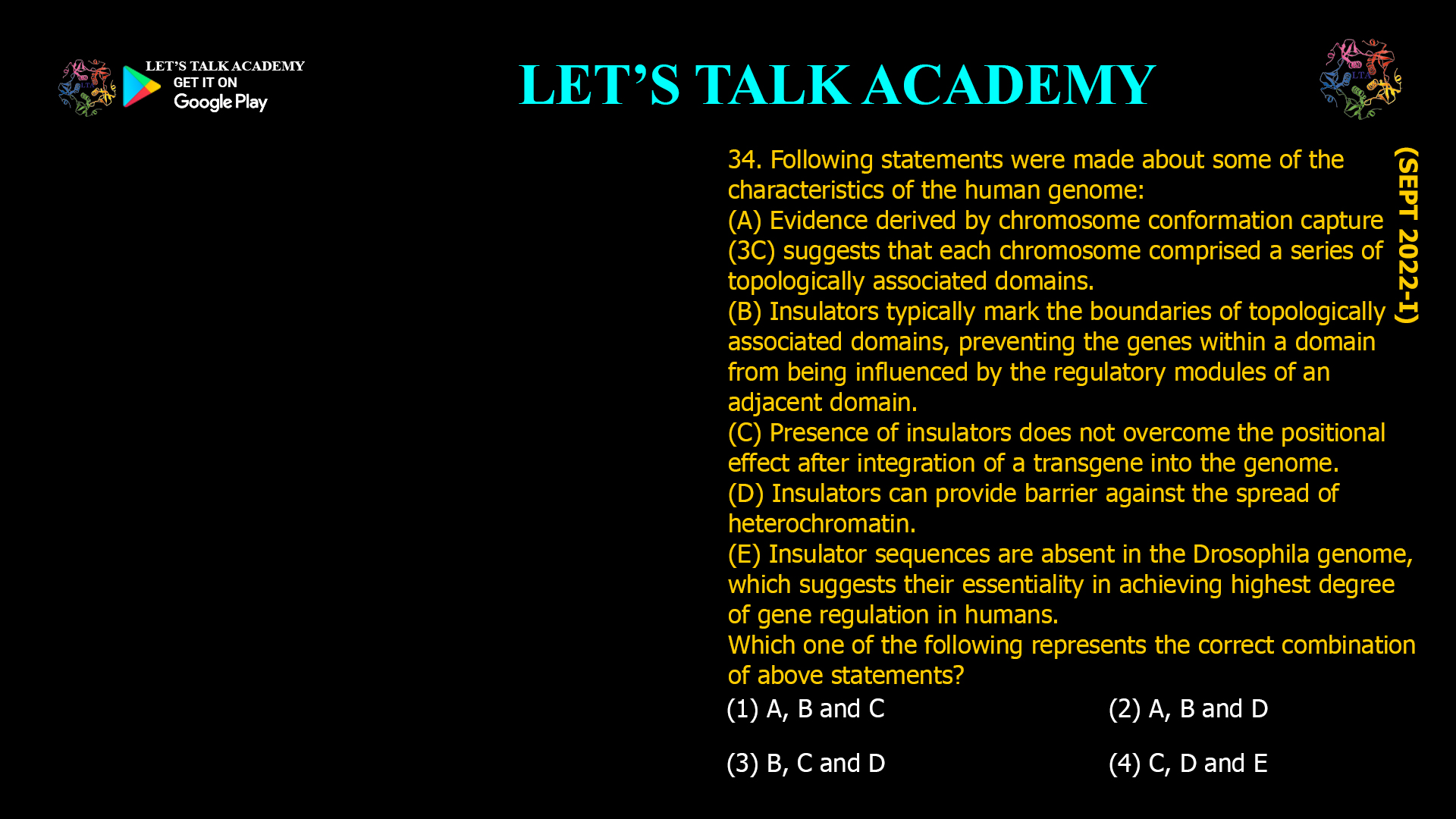
34. Following statements were made about some of the characteristics of the human genome:
(A) Evidence derived by chromosome conformation capture (3C) suggests that each chromosome comprised a series of topologically associated domains.
(B) Insulators typically mark the boundaries of topologically associated domains, preventing the genes within a domain from being influenced by the regulatory modules of an adjacent domain.
(C) Presence of insulators does not overcome the positional effect after integration of a transgene into the genome.
(D) Insulators can provide barrier against the spread of heterochromatin.
(E) Insulator sequences are absent in the Drosophila genome, which suggests their essentiality in achieving highest degree of gene regulation in humans.
Which one of the following represents the correct combination of above statements?
(1) A, B and C
(2) A, B and D
(3) B. C and D
(4) C, D and E
Introduction
The human genome is intricately organized within the nucleus, not as a linear sequence but as a three-dimensional structure that influences gene regulation and cellular function. A fundamental unit of this organization is the topologically associating domain (TAD)—a self-interacting genomic region that facilitates interactions between regulatory elements and genes within its boundaries while insulating them from neighboring domains. This article explores the characteristics of TADs, the role of insulators in demarcating these domains, and their impact on gene expression.
What Are Topologically Associating Domains (TADs)?
TADs are contiguous segments of the genome where DNA sequences interact more frequently with each other than with sequences outside the domain. Discovered through chromosome conformation capture techniques like Hi-C, TADs typically span hundreds of kilobases to a few megabases in humans.
These domains serve as regulatory neighborhoods, ensuring that enhancers and promoters interact within the same domain, thus maintaining precise gene expression patterns. TAD boundaries are conserved across different cell types and species, highlighting their fundamental role in genome architecture.
Role of Insulators at TAD Boundaries
Insulators are DNA elements located at the boundaries of TADs. They function as barriers that prevent regulatory elements such as enhancers or silencers in one domain from influencing genes in adjacent domains. This insulation preserves the specificity of gene regulation and prevents inappropriate gene activation or repression.
The insulator protein CCCTC-binding factor (CTCF), along with cohesin complexes, is highly enriched at TAD boundaries and is crucial for maintaining their integrity. These proteins facilitate the formation of chromatin loops that define TAD borders.
Key Characteristics of TADs and Insulators
-
Chromosome Conformation Capture Evidence: Techniques like 3C and Hi-C have demonstrated that chromosomes are partitioned into TADs, each forming a distinct 3D structure within the nucleus.
-
Insulator Function: Insulators mark TAD boundaries, preventing cross-talk between regulatory elements of adjacent domains. This ensures genes within a TAD respond only to regulatory sequences within the same domain.
-
Barrier Against Heterochromatin Spread: Insulators can act as barriers that block the spread of repressive heterochromatin into active domains, maintaining gene expression patterns.
-
Effect on Transgenes: While insulators can protect genes from positional effects to some extent, they do not always fully overcome positional variegation when transgenes integrate randomly into the genome.
-
Conservation Across Species: Contrary to some misconceptions, insulator sequences are present in organisms like Drosophila, indicating their evolutionary conservation and importance in gene regulation.
Biological Significance of TADs and Insulators
-
Gene Regulation Precision: By restricting enhancer-promoter interactions within TADs, insulators and TAD boundaries ensure precise spatial and temporal gene expression.
-
Disease Association: Disruption of TAD boundaries or insulator function can lead to misexpression of genes, contributing to developmental disorders, cancers, and other diseases.
-
Chromatin Organization: TADs contribute to the hierarchical folding of chromosomes, influencing replication timing and chromatin state.
Clarifying Common Misconceptions
-
Insulators do not always completely overcome positional effects after transgene integration, but they significantly reduce variability in gene expression.
-
Insulator sequences are not absent in Drosophila; in fact, Drosophila has well-characterized insulator elements essential for its gene regulation.
Correct Combination of Statements About Human Genome Organization
Based on current scientific understanding, the correct statements regarding TADs and insulators are:
-
(A) Each chromosome comprises a series of topologically associating domains.
-
(B) Insulators mark TAD boundaries, preventing regulatory cross-talk.
-
(D) Insulators act as barriers against heterochromatin spread.
Conclusion
Topologically associating domains and insulator elements are fundamental to the 3D organization of the genome and the regulation of gene expression. By creating insulated regulatory neighborhoods, they ensure genes respond appropriately to their enhancers and silencers, maintaining cellular identity and function. Understanding these structures provides insights into genome biology and the molecular basis of various diseases.
Answer:
The correct combination of statements is (2) A, B and D.


